What are battle royale hacks and why do players use them?
Battle royale hacks are unauthorized software tools that alter core game mechanics, including aim, visibility, and movement, to hand one player an advantage no legitimate skill could replicate. They are not glitches or clever tactics. They are third-party programs injected into a game's memory or rendered as overlays to change what you see and how your inputs behave.
Why do players reach for them? The motivations are predictable:
- Competitive frustration: Losing repeatedly, especially in ranked modes, pushes players toward shortcuts.
- Peer pressure: When a squad member cheats and wins, the temptation spreads.
- Ego and rank: Many players want the cosmetic rewards or leaderboard position without the grind.
- Curiosity: Some players want to understand how cheats work before deciding whether to use them.
The appeal is real, but so is the cost. Cheat sites routinely scam the players who visit them, and the games themselves have become increasingly hostile to anyone caught running unauthorized software.
Common types of battle royale cheats and how they work
Understanding what these tools actually do makes it easier to recognize them, report them, and understand why anti-cheat systems are built the way they are. The most commonly detected cheats fall into a few well-defined categories:
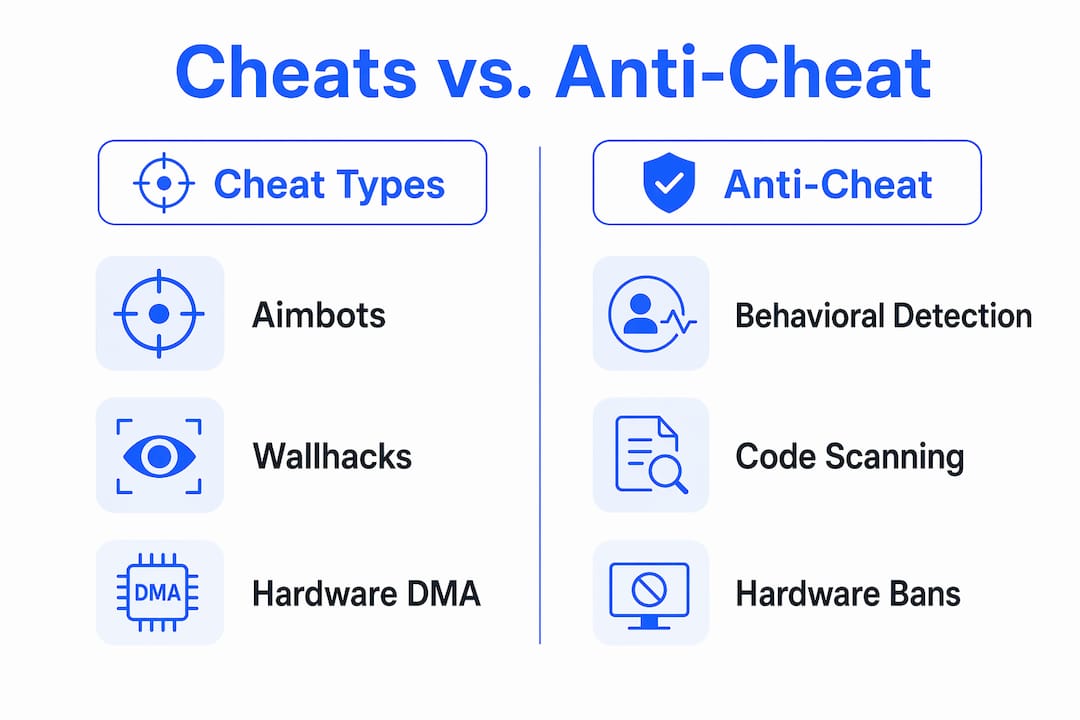
- Aimbots: Software that takes over mouse or controller input to lock crosshairs onto an enemy's head or body automatically. Some aimbots are tuned to look human, with adjustable smoothness and field-of-view settings. Others snap instantly, which makes them trivially easy to spot in killcam footage.
- Wallhacks (ESP): Short for Extra Sensory Perception, these overlays draw colored boxes or outlines around enemies through walls, terrain, and structures. You see every player on the map in real time, regardless of cover.
- Radar cheats: A separate minimap overlay, often running on a second monitor or phone, that pulls enemy position data from game memory and displays it as a live radar feed. Harder to detect visually than ESP because nothing appears on the main screen.
- Triggerbots: An add-on to aimbots that fires the weapon automatically the instant the crosshair passes over a valid target. The player just moves the mouse; the triggerbot handles the shot.
- Recoil removal: Scripts or memory edits that cancel weapon recoil entirely, producing laser-accurate fire at any range. Often bundled with aimbots but sold separately as a "macro."
- Speed hacks and movement exploits: Tools that increase a player's movement speed beyond what the game allows, or allow clipping through geometry. Less common in modern titles because server-side validation catches them quickly.
Each of these tools works by reading or writing to game memory, injecting code into the game process, or rendering an external overlay that pulls data from the game's state. The technical method matters because it determines how detectable the cheat is.

Risks and consequences of using battle royale hacks
The risks are not hypothetical. They are documented, frequent, and often worse than the ban itself.
- Permanent account bans: Epic Games uses Easy Anti-Cheat to detect aimbots and wallhacks in Fortnite, and bans are permanent. Even professional players have lost accounts and sponsorships after being caught.
- Hardware bans (HWID bans): Some anti-cheat systems fingerprint your hardware. A new account does not help if your PC is flagged. You need to spoof or replace hardware identifiers to get back in.
- Malware and credential theft: Most websites promising free cheats are scams. They bundle keyloggers, remote access trojans, or ransomware with the cheat loader. You run the file as administrator, and the attacker owns your machine.
- Phishing and account theft: Cheat forums frequently require account login or Discord verification. Those credentials get harvested and sold.
- Financial loss: Players pay real money for cheats that stop working after the next ban wave, with no refund and no recourse.
The core risk most players underestimate: Running a cheat loader with administrator privileges on a Windows machine gives that software full access to your files, browser passwords, and payment data. A ban is recoverable. Identity theft is not.
Community reports on platforms like Reddit consistently describe the same pattern: a player downloads a "free" cheat, gets their Steam or Epic account stolen within days, and never recovers the account. The cheat rarely even works as advertised.
Anti-cheat technologies and enforcement trends in battle royale games
Anti-cheat has evolved from simple signature scanning into a layered system that operates at the kernel level and uses machine learning to flag anomalous behavior. The enforcement approach now combines several methods simultaneously:
- Easy Anti-Cheat (EAC) and BattleEye: The two dominant anti-cheat solutions used across Fortnite, Apex Legends, PUBG, and dozens of other titles. Both run at the kernel level on Windows, giving them visibility into processes and memory that user-level software cannot hide from easily.
- Behavioral detection: Rather than looking for known cheat signatures, modern systems flag statistical anomalies. A player whose headshot rate is three standard deviations above the server average, or whose aim snaps at inhuman speed, gets flagged for review.
- Machine learning models: Trained on millions of matches, these models identify patterns that correlate with cheat use without needing to detect the cheat itself. The model does not need to know what software you are running; it only needs to know that your inputs look wrong.
- Hardware bans: When a software ban fails to stop a player, developers escalate to hardware identifier bans, blocking the specific machine rather than just the account.
- Ban waves: Rather than banning cheaters the moment they are detected, developers sometimes collect flagged accounts and ban them in batches. This delays the feedback loop cheaters use to test whether their software is still undetected.
- Community reporting: Player reports feed into automated review queues. A spike in reports against a single player triggers faster manual review.
The cat-and-mouse dynamic is real and accelerating. Every time a new anti-cheat update ships, cheat developers reverse-engineer it within days. Every time a cheat method is patched, a new one appears.
How widespread is cheating across popular battle royale games?
Cheating is not evenly distributed. Some games attract far more cheat activity than others, driven by player base size, prize pool incentives, and how aggressively the developer enforces its rules.
- Fortnite sees the highest cheat activity in the genre, with aimbots outnumbering wallhacks roughly 2:1 in prevalence. The free-to-play model makes account replacement cheap after a ban, which keeps the cheat economy active.
- Apex Legends has a persistent wallhack and aimbot problem, particularly in ranked lobbies. The developer, Respawn Entertainment, runs periodic ban waves but the community consistently reports that cheaters return quickly on new accounts.
- PUBG was historically one of the most cheated games on PC, particularly in Asian server regions. BattleEye enforcement has improved, but the game's large player base and competitive scene keep demand for cheats high.
- Repeated cheating after bans is the norm, not the exception. Account-level bans only block a single account, so a cheater who pays $10 for a new account can resume within an hour. This is why hardware bans and machine learning detection matter more than account suspensions alone.
The community discussion around cheat prevalence is consistent: players in high-ranked lobbies report encountering obvious cheaters regularly, and the frequency increases near the end of competitive seasons when rank rewards are on the line.
Expert insights on legitimate competitive advantages and cheating risks
Security researchers and gaming industry professionals are clear on two points: the cheat market is predatory, and legitimate performance gains are both safer and more durable than anything a cheat provides.
What experts warn about:
- Fake cheat sites are designed to look credible. They use professional layouts, fake review sections, and Discord servers to build trust before delivering malware.
- Official game developers do not distribute cheat codes; any site claiming otherwise is a scam by definition.
- Even paid cheats from established underground providers carry risk. A single anti-cheat update can render a $50/month subscription worthless overnight.
Legitimate performance improvements that actually work:
- Visualized sound effects: Fortnite's built-in setting converts audio cues into on-screen visual indicators, giving you directional information without requiring expensive headphones. Pro players use this setting as a standard part of their setup.
- Hardware tuning: A monitor with a 1ms response time and 144Hz refresh rate changes what you can react to. A gaming mouse with adjustable DPI lets you dial in sensitivity for both close-range and long-range engagements.
- Movement mastery: Sliding, strafing, and dolphin-diving are mechanics built into games like Fortnite and Black Ops Royale. Mastering them makes you genuinely harder to hit without touching any third-party software.
- Aim training: Tools like Aim Lab let you practice specific flicking, tracking, and switching scenarios outside of live matches, with measurable improvement over time.
- Settings optimization: Adjusting field of view, disabling controller vibration, enabling sprint by default, and tuning sensitivity all produce real, measurable improvements in reaction time and accuracy.
Pro Tip: Before downloading anything labeled a "cheat" or "trainer," run the file hash through VirusTotal. Legitimate software passes. Malware-bundled loaders almost always flag on multiple engines, even when the cheat itself appears to function.
How game developers detect and respond to new hacking methods
Detection is not a one-time event. It is an ongoing engineering process that runs parallel to cheat development.
When a new hack method appears, developers typically follow a response cycle. First, the anti-cheat team identifies the method through flagged accounts, community reports, or internal honeypot accounts designed to attract cheaters. Second, engineers analyze the cheat's technical approach: is it reading memory externally, injecting into the game process, or using a hardware device to intercept data? Third, a detection signature or behavioral rule is written and pushed silently, often without a public patch note, to avoid tipping off cheat developers.
Hardware-based cheats, which use direct memory access (DMA) cards to read game data from a separate PC, are the current frontier. They are harder to detect because the cheat software never runs on the same machine as the game. Developers are responding with integrity checks that verify the consistency of game state data in ways that DMA reads cannot easily spoof.
The timeline from new cheat release to detection varies. Simple software cheats often get caught within days of a ban wave. Hardware-based methods can persist for weeks or months before a reliable detection method is deployed. This is why the cheat market charges a premium for hardware solutions and why developers invest heavily in kernel-level anti-cheat that can observe hardware behavior.
Legal implications of creating and distributing cheats
Using a cheat risks a ban. Creating or selling one risks something far worse.
In the United States, cheat software sits in legally contested territory under the Computer Fraud and Abuse Act (CFAA) and the Digital Millennium Copyright Act (DMCA). Developers have successfully argued that cheat software circumvents technological protection measures, which is a DMCA violation. Epic Games has filed and won civil suits against aimbot developers, resulting in settlements and injunctions.
Beyond civil liability, distributing cheat software that bundles malware crosses into criminal territory under the CFAA, which prohibits unauthorized access to computer systems. A cheat loader that installs a keylogger on a user's machine without disclosure is not just a terms-of-service violation. It is a federal crime.
Outside the United States, enforcement varies. South Korea and China have criminalized cheat development directly, with prison sentences handed down to developers of large-scale cheat operations. European jurisdictions have pursued cheat distributors under computer misuse statutes. The legal risk for cheat creators has increased substantially over the past five years as publishers have become more aggressive in litigation.
For players, the legal exposure is lower but not zero. Accepting a cheat's terms of service does not protect you from civil action if the developer chooses to pursue it. Epic Games' lawsuits against individual players, including minors, established that users are not immune simply because they are consumers rather than creators.
Key Takeaways
Battle royale hacks carry permanent ban risk, active malware exposure, and legal consequences that most players never factor into the decision to cheat.
| Point | Details |
|---|---|
| Aimbots dominate cheat use | In Fortnite, aimbots outnumber wallhacks roughly 2:1 in prevalence and are the most commonly detected cheat type. |
| Free cheat sites are scams | Most sites offering free cheats steal credentials, install malware, or compromise devices rather than deliver working software. |
| Account bans alone don't stop cheaters | Bans applied only to accounts allow cheaters to return on new accounts, driving demand for hardware bans and machine learning detection. |
| Legitimate gains are safer and durable | Hardware tuning, visualized sound effects, and movement mastery produce real improvements without ban or malware risk. |
| Cheat creation carries legal liability | Under the CFAA and DMCA, developing and distributing cheat software exposes creators to civil suits and criminal charges in the United States. |
Where to find cheats that are actually tested and safe
If you've read this far and still want a competitive edge, the difference between a scam site and a legitimate provider comes down to one thing: daily testing and real support. Midnight-market offers undetected cheats and DMA hardware solutions across popular titles, with every product tested daily against current anti-cheat builds. There is no guessing whether a cheat is still working after a patch. Live Discord support means you get answers in real time, not a ticket queue that goes cold.
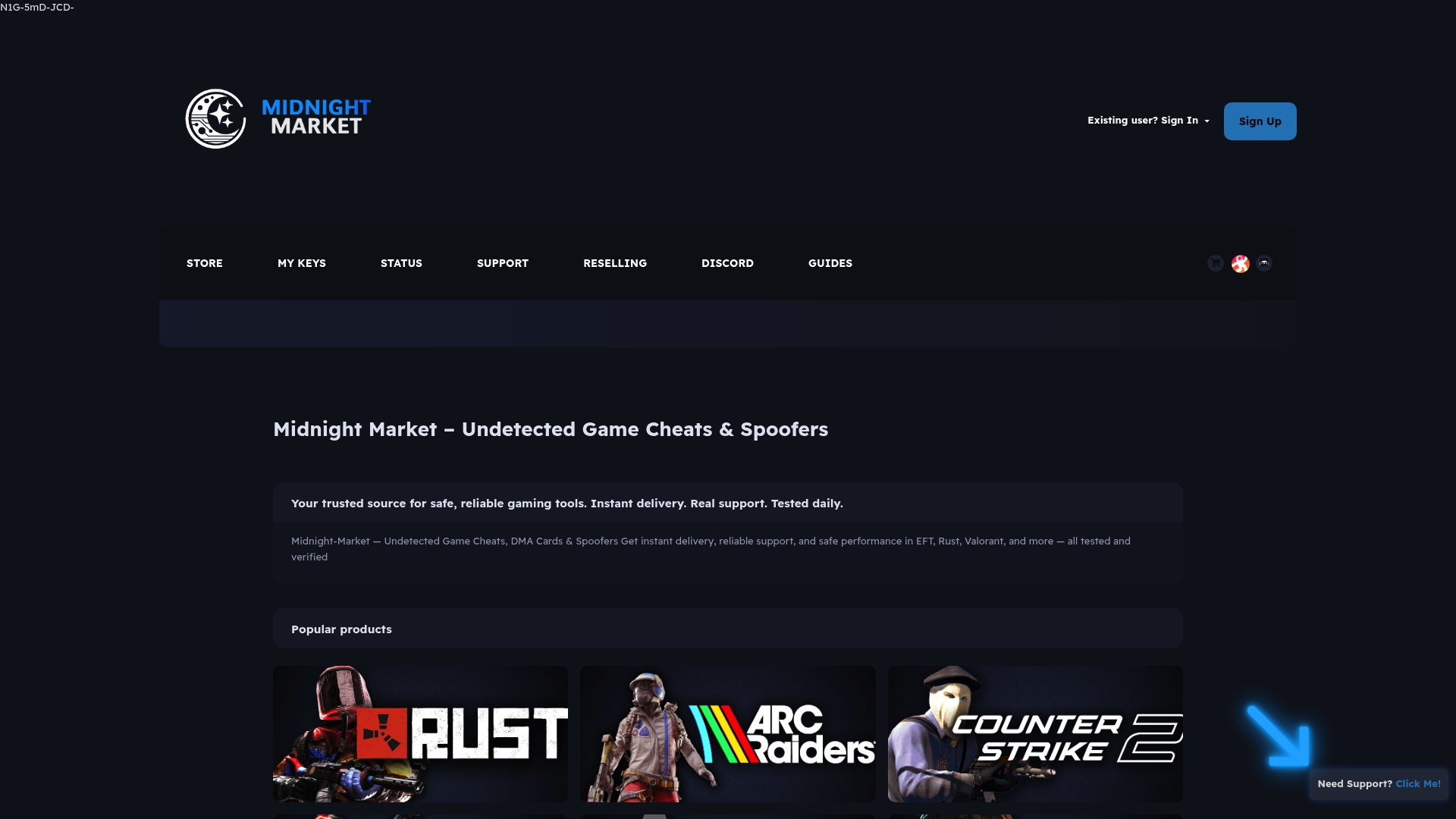
For Fortnite players specifically, Midnight-market's Fortnite external cheats use external rendering methods that avoid direct game process injection, reducing detection surface compared to standard software cheats. Hardware warranties and an active community of players back every product on the platform.