
Encryption is defined as the process of encoding game data and telemetry to block unauthorized access, forming the foundational defense against cheating in competitive gaming. The role of encryption in cheats is more layered than most gamers realize. Standards like AES (Advanced Encryption Standard) and TLS/SSL govern how sensitive game data moves between your client and the server. Anti-cheat systems built on these protocols protect everything from character attributes to mouse movement telemetry. Understanding how encryption works, where it succeeds, and where it falls short gives you a clearer picture of the security arms race playing out in every match.
How does encryption protect game data from cheating?
Encryption secures game data by making it unreadable to anyone without the correct decryption key. Industry documentation prescribes multi-layer encryption protocols that protect sensitive gaming data both at rest and in transit. AES handles stored character attributes like health, position, and inventory. TLS/SSL wraps that data while it travels between your machine and the game server. Without these layers, a cheat developer could intercept a network packet and read or modify your stats in plain text.

Telemetry data gets the same treatment. Encrypted telemetry covers inputs like mouse movements and click timing, which anti-cheat systems use to flag inhuman behavior. If that telemetry travels unencrypted, a cheat can spoof the values before they reach the server, making an aimbot look like a human player. Encryption forces the cheat to work much harder to fake legitimate input.
Game files and assets also benefit from encryption. Encrypted packages deter casual asset ripping, the practice of extracting map geometry or character models to build wallhacks. This is not a perfect solution, but it raises the cost of entry for low-effort cheat developers.
- AES at rest: Protects stored player attributes from offline tampering
- TLS/SSL in transit: Secures data packets traveling between client and server
- Telemetry encryption: Blocks spoofing of mouse, keyboard, and controller inputs
- Asset encryption: Raises the barrier for extracting game geometry used in wallhacks
Pro Tip: If you want to understand whether a game's anti-cheat is doing its job, check whether it uses kernel-level drivers. Games that rely solely on usermode encryption leave a much wider attack surface.
Why encryption alone cannot stop advanced cheats
Encryption is a barrier, not a fortress. Developers caution that encryption serves as a deterrent requiring complementary server-side validation for genuine cheat prevention. A cheat developer who controls the client machine can decrypt data locally, because the game itself must decrypt it to run. That means encryption only protects data in motion or at rest, not during active use.
Kernel-level cheats expose this gap directly. Advanced cheats use kernel or hypervisor privileges to read memory directly, bypassing usermode encryption entirely. A kernel cheat does not need to intercept an encrypted packet. It reads the decrypted values already loaded into RAM by the game process. Standard encryption has no answer for this attack vector.
The solution is server-authoritative design. When the server controls all game logic, the client never holds the authoritative values. A cheat reading local memory only sees a prediction or a display value, not the real game state. Encryption of client data still matters, but it works best as one layer inside a system where the server makes every meaningful decision.
- Kernel cheats bypass usermode protections by reading physical memory directly
- Client-side decryption is unavoidable because the game must read its own data
- Server-authoritative logic removes the value of reading local memory
- Encryption without server validation leaves the core game state exposed
Developers who treat encryption as a complete solution create a false sense of security. The most resilient anti-cheat systems treat encryption as one component inside a stack that includes server validation, behavioral analysis, and driver-level monitoring.
What are the newest cryptographic tools for anti-cheat?
Fully Homomorphic Encryption (FHE) is the most significant cryptographic advance in anti-cheat research right now. FHE allows a server to perform computations on encrypted data without ever decrypting it. FHE frameworks let servers evaluate encrypted game states without exposing detection logic to the client, which eliminates the reverse engineering problem entirely. A cheat developer cannot study the detection thresholds if those thresholds never leave the server in readable form.
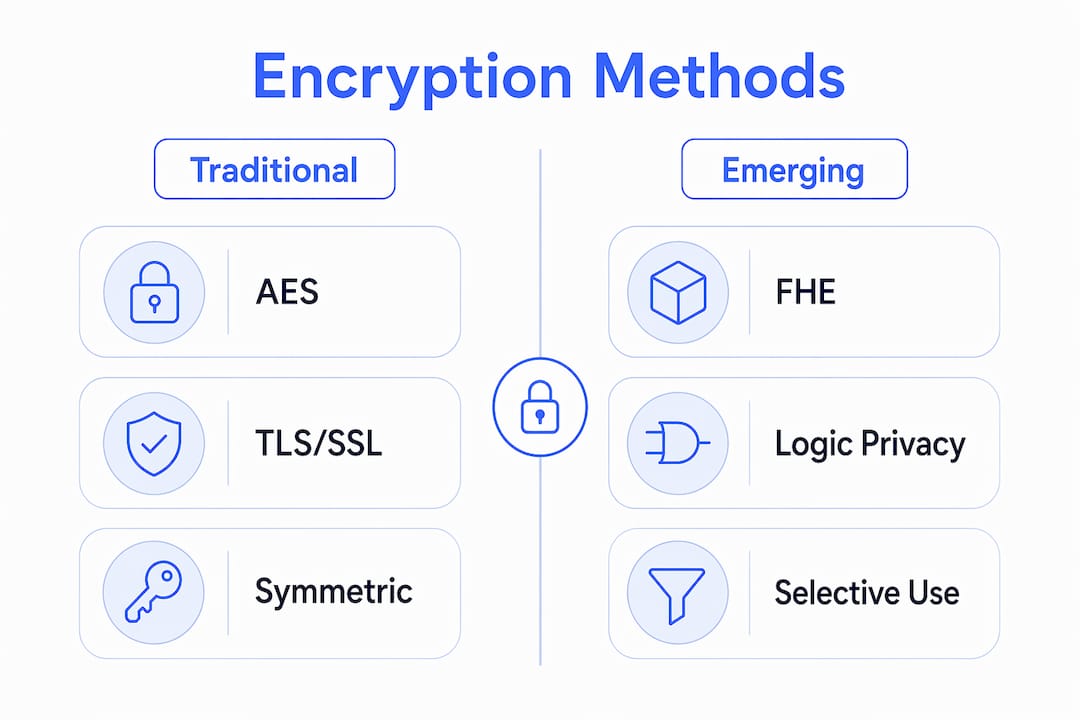
The performance barrier that made FHE impractical has been shrinking fast. Optimized LUT circuit designs achieve a 2.7x speedup in detection computations, making encrypted game state analysis viable in near real time. That speedup matters because anti-cheat systems must process thousands of events per second without adding noticeable latency to the game.
| Cryptographic Method | Core Benefit | Anti-Cheat Application |
|---|---|---|
| AES | Fast symmetric encryption | Protecting stored player attributes |
| TLS/SSL | Encrypted data transit | Securing client-server communication |
| FHE | Computation on encrypted data | Server-side cheat detection without exposing logic |
| LUT circuit optimization | 2.7x speed improvement | Real-time encrypted game state analysis |
Logic privacy is the practical outcome of FHE in this context. The server runs its detection algorithms entirely on encrypted inputs. The client receives only a pass or fail signal. Cheat developers who reverse engineer the client binary find no detection thresholds, no scoring weights, and no behavioral signatures to work around.
Pro Tip: FHE is still computationally expensive compared to standard encryption. Games using it today apply it selectively to the highest-value detection checks, not every game event.
How does AI combine with encryption to catch cheats?
AI and encryption work better together than either does alone. Researchers in 2026 demonstrate AI-driven cryptographic frameworks that verify player actions and analyze telemetry for cheating patterns. The AI model processes encrypted behavioral data, looking for statistical anomalies that no static rule set would catch. A player whose aim snaps to targets 40 milliseconds faster than any human reflex leaves a pattern in the telemetry, even when that telemetry is encrypted end to end.
Static detection systems fail against adaptive cheats. A cheat that randomizes its timing or adds artificial input noise can fool a fixed threshold. AI models retrain on new cheat behavior and update their detection logic without requiring a game patch. Hybrid cryptography and AI models represent a scalable future for cheat detection that static rule systems cannot match.
The implications reach beyond gaming. The same framework that detects an aimbot by analyzing encrypted mouse telemetry could detect fraud in financial transaction streams or anomalies in encrypted network traffic. Gaming is proving the concept at scale, with millions of concurrent players generating the behavioral data needed to train these models.
- Encrypted telemetry analysis: AI reads behavioral patterns without exposing raw input data
- Adaptive retraining: Models update against new cheat techniques without client patches
- Anomaly detection: Statistical outliers in timing and movement flag inhuman behavior
- Cross-domain potential: The same framework applies to financial fraud and network security
The Midnight COD Cheats product line at Midnight-market is built with awareness of exactly these detection systems, which is why daily testing against live anti-cheat environments matters more than ever.
Key Takeaways
Encryption is a necessary but insufficient defense against cheating. It must be combined with server-authoritative design, FHE-based logic privacy, and AI-driven behavioral analysis to form a genuinely effective anti-cheat stack.
| Point | Details |
|---|---|
| Encryption secures data in transit and at rest | AES and TLS/SSL protect character attributes and telemetry from interception and tampering. |
| Kernel cheats bypass client-side encryption | Advanced cheats read decrypted values from RAM, making server-side validation mandatory. |
| FHE enables server-side detection without exposure | Servers evaluate encrypted game states, hiding detection logic from reverse engineers. |
| AI enhances cryptographic detection | AI models analyze encrypted telemetry for behavioral anomalies that static rules miss. |
| Multi-layer defense is the standard | Encryption alone is a deterrent. Real cheat prevention requires stacked security measures. |
Encryption in gaming is more complex than the patch notes suggest
Gamers often assume that when a developer ships an anti-cheat update, the encryption improvements inside it close the door on cheating. That assumption underestimates how fast cheat developers adapt. I have watched this cycle play out repeatedly. A game ships stronger telemetry encryption, cheat developers shift to kernel-level memory reads within weeks, and the game studio scrambles to add driver-level monitoring. Encryption is always one move in a longer game.
What I find genuinely encouraging is the FHE research. The idea that a server can evaluate your game state without ever seeing it in plain text is not just clever cryptography. It removes an entire category of reverse engineering attacks. Cheat developers cannot tune their tools against thresholds they cannot read. That is a structural advantage, not just a speed bump.
The AI integration is where I think the real long-term shift happens. Static detection is a rule book, and rule books get studied. AI models that retrain on live cheat behavior are a moving target. The combination of FHE and adaptive AI means cheat developers will face detection systems that are both opaque and constantly changing. That is a genuinely hard problem to solve from the outside.
For gamers who use tools from providers like Midnight-market, understanding this arms race matters. The Evo Valorant DMA Cheats and similar hardware-level products exist precisely because software-only cheats face increasingly sophisticated encrypted detection. Knowing what the detection stack looks like helps you make informed decisions about what tools carry real risk and what tools are built to stay ahead of it.
— Fonics
Midnight-market's products built for the modern detection environment
Midnight-market tests every product daily against live anti-cheat systems, including those using encrypted telemetry analysis and behavioral detection. That testing discipline is what separates a product that works today from one that gets your account flagged tomorrow.

The full product catalog covers software cheats and DMA hardware across titles like Valorant, EFT, Apex Legends, and more. DMA cards operate at the hardware level, reading memory through a separate PCIe device rather than a software process, which places them outside the reach of most usermode and kernel anti-cheat scans. The Midnight 100T DMA Card is built specifically for gamers who need that hardware-layer separation. Live Discord support means you get real answers when detection environments shift, not a ticket queue.
FAQ
What is the role of encryption in cheats?
Encryption in cheats refers to how anti-cheat systems use AES and TLS/SSL to protect game data and telemetry from being read or modified by cheat software. It also describes how cheat developers must work around or bypass these protections to function.
Can encryption fully prevent cheating in games?
Encryption cannot fully prevent cheating on its own. Kernel-level cheats bypass usermode encryption by reading decrypted values directly from RAM, which requires server-authoritative design and behavioral analysis to counter.
What is Fully Homomorphic Encryption in anti-cheat?
FHE allows a game server to analyze encrypted player data without decrypting it, keeping detection thresholds hidden from cheat developers. LUT-optimized FHE achieves a 2.7x speedup that makes this practical for real-time cheat detection.
How does AI improve encrypted cheat detection?
AI models analyze encrypted telemetry for behavioral patterns that static rules miss, such as inhuman aim timing or movement anomalies. 2026 research confirms that hybrid AI-cryptography frameworks adapt to new cheat methods without requiring game patches.
Are DMA cheats affected by encryption-based anti-cheat?
DMA cheats operate through a separate hardware device that reads memory via PCIe, placing them outside the scope of software-based encrypted monitoring. This hardware-layer separation makes them significantly harder for standard encryption and usermode anti-cheat systems to detect.