
Game updates break cheats by reorganizing the memory addresses, binary structures, and server validation logic that cheat tools depend on, making them crash or trigger detection until developers rebuild them from scratch. This is the core technical reality behind every "cheat stopped working after patch" report you've seen. Understanding how game updates affect cheats determines whether you stay undetected or lose your account. The standard industry term for this process is "cheat invalidation," and it happens across every major title, from Escape from Tarkov to Valorant. Midnight-market tests all products daily to catch these breaks before you do.
How game updates break cheats at the technical level
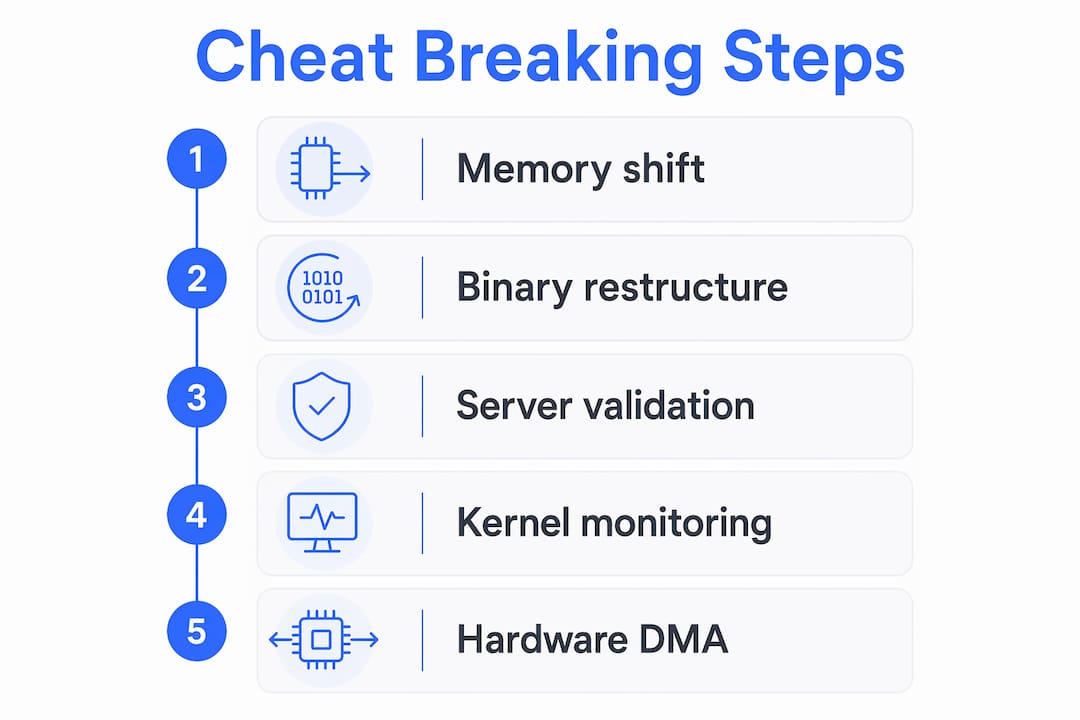
Game updates break cheats through three distinct mechanisms: memory address shifts, binary layout changes, and server-side validation upgrades. Each one hits differently, and each requires a different fix from cheat developers.
Memory address and offset shifts
Every cheat trainer reads specific memory addresses to find values like health, ammo, or player position. When a game updates, the executable recompiles and those addresses move. The cheat tries to read the old location, finds garbage data or nothing at all, and crashes. Premium trainers push updates within 24–48 hours of a major patch because shifted offsets are the most common cause of post-update crashes. That window is when your risk is highest.

Binary and executable layout changes
Major patches often do more than shift a few addresses. They restructure the entire executable. Re-reverse-engineering the full binary is required when a developer changes how functions are organized, adds new code sections, or applies obfuscation. This is why some cheats go dark for days after a large content update. The cheat developer is not being slow. They are rebuilding the map from zero.
Server-side validation
The third mechanism is the most permanent. Server-authoritative architecture validates all game actions on the server rather than the client, which removes the exploit surface that most client-side cheats rely on. When a game moves a mechanic server-side, no amount of memory editing on your machine changes the outcome. Speed hacks, teleportation, and resource manipulation all fail against this design. This is why games with strong server authority are the hardest to cheat in long-term.
Pro Tip: If your cheat crashes immediately after a patch but shows no ban notification, the cause is almost always a broken offset, not detection. Wait for a verified update before assuming the worst.
How advanced anti-cheat technologies target cheats beyond software updates
Anti-cheat systems do not just sit still between patches. They update alongside the game, and in 2026, the most aggressive systems now target hardware directly.
Kernel-level monitoring
Modern anti-cheats run at Ring 0, the kernel level, giving them the same system privileges as device drivers. At that level, they can observe memory reads, detect injected code, and flag processes that interact with the game in unauthorized ways. User-level cheats have no visibility into what the anti-cheat is doing, which makes kernel-level systems extremely difficult to evade without matching their privilege level.
Hardware DMA targeting
The most significant development in 2026 is Riot Vanguard's approach to DMA cheat hardware. Vanguard uses IOMMU enforcement to block unauthorized DMA devices from accessing memory, then corrupts their firmware through forced page faults and restarts. The result is a bricked device. A $6,000 DMA card becomes permanently nonfunctional until complex recovery steps are completed. That is not a software ban. That is a hardware kill.
| Anti-cheat layer | What it targets | Cheat impact |
|---|---|---|
| Signature scanning | Known cheat files and processes | Bypassed by same-day repacks |
| Kernel-level monitoring | Memory reads, code injection | Requires Ring 0 cheat drivers |
| IOMMU hardware enforcement | DMA device memory access | Firmware corruption, device bricking |
| Server-side validation | Client-reported game actions | Renders client manipulation useless |
Pro Tip: If you use DMA hardware for Valorant, verify that your setup accounts for IOMMU enforcement before the next major patch cycle. Midnight-market's Sensory Valorant DMA and Evo Valorant DMA products are tested against current Vanguard builds.
Why cheat developers race to update tools after game patches
The cheat update lifecycle is a direct response to how anti-cheat detection works. Signature-based detection is reactive, meaning it only blocks cheats it already knows about. That creates a window right after a game patch where a freshly rebuilt cheat is invisible to the detection system. Cheat developers race to exploit that window.
Here is how the update cycle plays out after a major game patch:
- Game patch releases. Memory addresses shift, binary layout changes, and anti-cheat signatures update simultaneously.
- Cheats crash or get flagged. Outdated tools either fail to read correct memory or match a new detection signature.
- Cheat developers reverse-engineer the new binary. They locate updated offsets, rebuild injection logic, and test against the new anti-cheat build.
- New cheat version releases. The rebuilt tool evades current signatures because it is not yet in the detection database.
- Anti-cheat adds new signatures. The cycle restarts at the next patch.
Games with ranked resets and cosmetics economies give cheat developers strong financial reasons to maintain this pace. High demand means revenue. Revenue funds faster development. That is why cheat-as-a-service providers for titles like Valorant and Escape from Tarkov invest heavily in rapid patch response.
The counterintuitive part of cheat update frequency is that faster is not always safer. High-end cheat developers delay updates by 24–48 hours after major patches to verify stability and avoid automated ban waves triggered by unstable cheat versions. Rushing a broken update out the door is worse than waiting. An unstable cheat injecting conflicting values into game memory is far more likely to trigger behavioral detection than a clean, tested one.
Signature-based detection creates an escalating arms race where cheat developers must continuously reverse-engineer patches to stay ahead. The developers who survive long-term are the ones who treat update management as a discipline, not a reaction.
Practical safety measures for cheat users during and after game updates
The period immediately after a game patch is the highest-risk window for cheat users. Outdated cheats crash, inject bad values, and in some cases trigger detection before the developer has a chance to push a fix. These steps reduce that risk significantly.
- Back up your save files and AppData before applying any cheat. Backing up AppData before cheat use prevents permanent data loss if an outdated process injects conflicting values into your save. This takes two minutes and has saved countless hours of progress.
- Disable automatic updates on Steam for single-player titles. Playing on an older game version with a compatible cheat is safer than running an updated game with an outdated tool. Go offline in Steam before launching if you need to hold a version.
- Do not re-enable cheats until the developer confirms compatibility. A trainer crash after a patch is almost never a ban. It is an incompatibility. Wait for a verified update from your cheat provider before injecting again.
- Isolate your gaming OS when possible. Proper cheat usage includes isolating the gaming environment to prevent outdated cheat processes from corrupting system-level data or triggering cross-process detection.
- Time cheat activation carefully in single-player games. Disabling cheats like infinite gold before quest triggers prevents breaking game progression scripts that check for expected value ranges.
Pro Tip: Use an HWID spoofer as a baseline layer of protection during high-risk update windows. If a cheat does trigger detection before a fix is available, hardware bans are the hardest to recover from.
Key Takeaways
Game updates break cheats by shifting memory addresses, restructuring executables, and moving validation server-side, and the safest cheat users are the ones who wait for verified updates before re-enabling their tools.
| Point | Details |
|---|---|
| Memory shifts cause crashes | Cheats crash post-patch because they read outdated memory addresses that no longer hold valid data. |
| Kernel and hardware targeting | Anti-cheats like Riot Vanguard now operate at Ring 0 and can brick DMA hardware via IOMMU enforcement. |
| Reactive detection creates windows | Signature-based systems only block known cheats, giving rebuilt tools a brief undetected window after patches. |
| Update timing matters | Rushing a cheat update increases ban risk. Verified updates released 24–48 hours post-patch are safer. |
| Server-side validation is permanent | When games move mechanics server-side, no client-side cheat can override the outcome. |
The arms race is accelerating, and most cheat users are not keeping up
I have watched the anti-cheat space shift dramatically over the past few years, and the 2026 Riot Vanguard update is the clearest signal yet that the industry is done playing defense. Bricking a $6,000 DMA device at the firmware level is not a patch. It is a statement. Anti-cheat teams are now willing to cause real financial harm to hardware owners to protect their games.
What concerns me more than the hardware targeting is the server-side trend. Server-authoritative design fundamentally shrinks exploit surfaces, and more studios are adopting it with every major engine update. Client-side cheats are fighting a shrinking battlefield. The developers who adapt by focusing on what the server cannot see, things like visual overlays, radar, and aim assistance that does not alter server-reported data, will survive. The ones still building speed hacks and teleport tools will not.
For cheat users, the ethical and practical calculus is shifting too. The risk is no longer just a software ban. It is hardware loss, account loss, and in some jurisdictions, legal exposure. Managing that risk requires treating cheat selection and update timing as seriously as any other competitive decision. The casual approach of "just download and run" stopped working a long time ago.
My advice to cheat developers is direct: invest in update infrastructure before you invest in new features. A cheat that breaks on patch day and takes a week to fix loses users permanently. The providers who build fast, verified update pipelines are the ones with long-term businesses.
— Fonics
Midnight-market keeps your cheats current when patches hit
Every game patch is a reset. Cheats that were undetected yesterday may be flagged or broken today, and the difference between a safe session and a ban is whether your provider updated before you launched.

Midnight-market runs daily compatibility testing across all products, including EFT cheats, Apex Legends cheats, and specialized DMA hardware built to stay functional through anti-cheat updates. Live Discord support means you get real-time status on cheat compatibility the moment a patch drops, not hours later. Visit the Midnight-market store to find updated, tested tools for your title.
FAQ
How quickly do cheats break after a game update?
Most cheats break within minutes of a major patch due to shifted memory addresses. Premium providers restore compatibility within 24–48 hours.
Is a cheat crash after a patch the same as a ban?
No. A crash caused by broken offsets produces no ban notification. A ban triggers account restrictions or hardware blocks. Wait for a verified cheat update before assuming detection occurred.
What is IOMMU and why does it matter for DMA cheats?
IOMMU is a hardware security feature that controls which devices can access system memory. IOMMU enforcement blocks DMA cheat devices from reading game memory and can corrupt their firmware permanently.
Why do some cheat providers delay updates after patches?
Rushing an unstable cheat update increases the risk of triggering behavioral detection. Delaying 24–48 hours allows developers to verify stability and avoid automated ban waves from broken injection logic.
Can server-side validation completely stop cheats?
Server-side validation eliminates client-side manipulation cheats entirely for any mechanic it covers. Server-authoritative design renders speed hacks, teleportation, and resource cheats ineffective, though visual overlays and aim tools remain viable.