
Obfuscation in cheat software is defined as the deliberate transformation of code structure, logic, and strings to make that code harder to read, analyze, and detect. The role of obfuscation cheat safety plays is straightforward: it raises the cost of reverse engineering so high that anti-cheat systems and researchers struggle to identify what the code actually does. Techniques like control-flow flattening, string encryption, and name obfuscation each add a layer of complexity that slows detection. Midnight-market builds this principle into every product it tests and ships, treating obfuscation not as a bonus feature but as a baseline requirement for any cheat that claims to be undetected.
How does obfuscation work to protect cheat software from detection?
Obfuscation protects cheat software by restructuring code so that its true function is hidden from static analysis tools and human reviewers. The goal is not to make detection impossible. The goal is to make it expensive enough that anti-cheat teams move on to easier targets.
Core obfuscation techniques
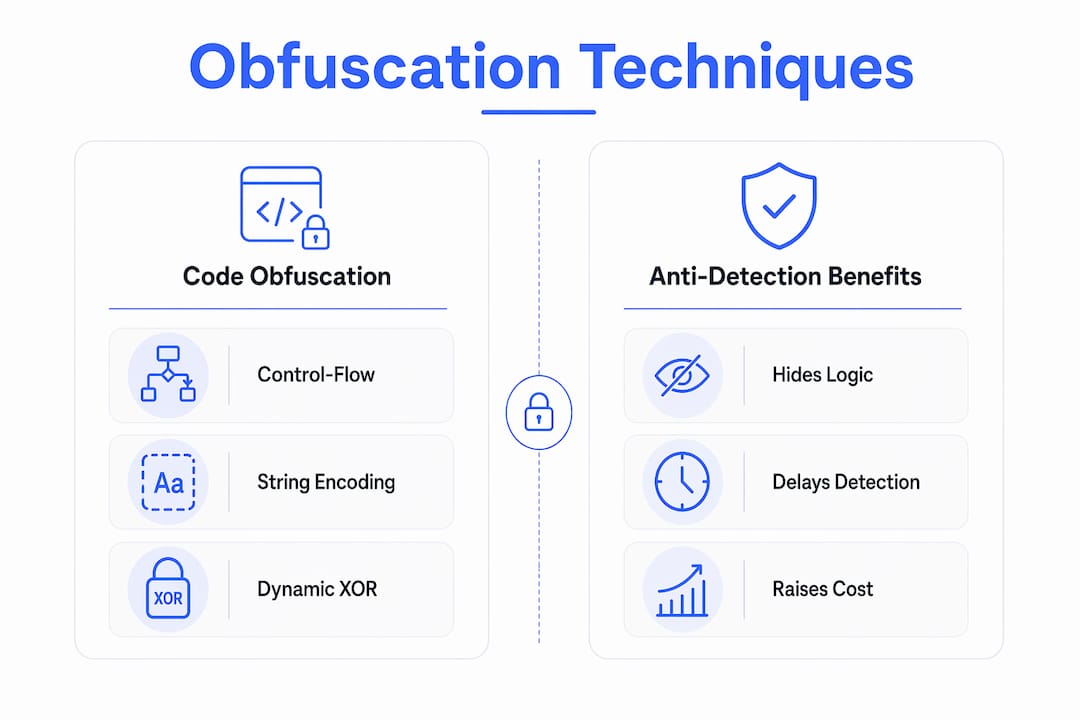
The strongest protection comes from layered obfuscation stacks that combine multiple methods rather than relying on any single approach. Each layer compounds the difficulty for a reverse engineer trying to map what the code does.
- Name obfuscation: Replaces meaningful function and variable names with random strings, removing all semantic clues from the code.
- Control-flow flattening: Restructures the logical order of code execution so that the original program flow becomes nearly unreadable without running the code.
- String encryption: Encrypts readable strings inside the binary so that keywords, URLs, and identifiers cannot be spotted by simple pattern matching.
- Runtime self-protection: Adds checks that detect debugging or tampering attempts and terminate or alter the cheat's behavior in response.
Dynamic XOR encoding and similar memory obfuscation methods significantly increase the time and difficulty required for anyone trying to locate and tamper with game resources. That time advantage is what keeps a cheat undetected through a game's update cycle.
Performance trade-offs you need to understand

Obfuscation is not free. Tools like Kagura impose a text-section overhead of 1.69x–1.87x on code size and complexity when applying control-flow flattening and string encryption. That overhead means the protected binary is larger and may execute slightly slower than the original. For competitive gamers, this matters because any frame-rate drop or input lag is a real disadvantage.
The solution is selective hardening. Applying obfuscation only to the most sensitive code paths, such as the aimbot logic or ESP rendering routines, keeps performance impact minimal while protecting the parts that matter most.
Pro Tip: Ask any cheat provider whether their obfuscation targets critical paths specifically. Blanket obfuscation applied to every function wastes performance budget and can introduce instability.
What is the role of obfuscation in modern multi-layered anti-cheat systems?
Obfuscation is one layer in a defense stack, not a standalone solution. Modern anti-cheat systems use multiple detection methods simultaneously, and obfuscation addresses only one of them.
Here is how a typical layered cheat detection system operates in 2026:
- Static signature scanning: Anti-cheat software scans binary files for known patterns. Obfuscation defeats this layer by making the code unrecognizable.
- Dynamic analysis: The anti-cheat runs or emulates the cheat code to observe its behavior. Control-flow flattening and runtime self-protection slow this process significantly.
- Kernel-level memory inspection: Kernel drivers inspect process memory at a level that bypasses Win32 protections entirely. This is where basic obfuscation begins to lose effectiveness.
- Server-side validation: Game servers check player statistics and outcomes for anomalies that no client-side obfuscation can hide.
- AI behavioral scoring: Machine learning models analyze mouse movement, reaction times, and aim patterns to flag synthetic inputs regardless of how well the cheat code is hidden.
Modern anti-cheat systems use incremental rollouts starting with roughly 1% of users before full deployment, which means a newly obfuscated cheat may survive initial waves even if it is eventually flagged. That window is what cheat developers race to extend through better obfuscation.
AI-driven behavioral analysis is shifting the role of obfuscation from hiding cheat existence to simply delaying analysis. Synthetic input detection is now the primary method for cheat identification in titles like Valorant and EFT. Obfuscation buys time. It does not replace behavioral caution.
What are the limitations and common countermeasures against obfuscation in cheat safety?
Obfuscation is not a silver bullet. Every technique has a countermeasure, and anti-cheat developers invest heavily in finding them.
- Kernel-level anti-cheats restrict process memory access at the driver level, rendering standard obfuscation ineffective against deep-level protections. A cheat hidden behind layers of name obfuscation is still visible to a kernel driver that reads raw memory.
- Deobfuscation tools automate the reversal of common techniques. Control-flow flattening, for example, can be partially reversed by tools that trace execution paths and reconstruct the original logic.
- AI-powered static analysis trains on thousands of obfuscated samples and learns to recognize obfuscation patterns themselves, not just the underlying code.
- Over-obfuscation backfires. Poorly configured obfuscation can produce false positives and negatives that inadvertently assist attackers in locating game logic by creating recognizable noise patterns.
The core principle is that obfuscation raises attacker cost beyond the value of the target rather than making detection impossible. When the cost of breaking the obfuscation drops below the value of catching the cheat, anti-cheat teams will invest the resources to do it. This is why cheat developers must continuously update and re-obfuscate their code after each game patch.
No single anti-cheat technique is adequate on its own. Combining obfuscation with kernel-level drivers and AI behavior monitoring is the only approach that consistently distinguishes legitimate from synthetic inputs. Cheat developers who understand this build their protection stacks accordingly.
How can competitive gamers use obfuscation cheats while minimizing safety risks?
Selecting a well-obfuscated cheat is the single most important decision a competitive gamer makes before loading any software. The quality of the obfuscation determines how long the cheat survives detection, not just whether it works today.
What to look for in a safe obfuscated cheat
A cheat that uses only name obfuscation is significantly weaker than one that stacks control-flow flattening, string encryption, and runtime self-protection together. Ask specifically which techniques the provider applies and whether they update obfuscation after each game patch. Providers who test daily, like Midnight-market, catch detection signatures before they reach the full player base.
Performance matters as much as protection. A cheat with heavy blanket obfuscation may cause stuttering or input lag that is more noticeable to other players than the cheat itself. The best undetected cheat options apply obfuscation selectively to sensitive code paths, keeping frame rates stable while protecting the logic that matters.
Behavioral discipline is the layer that obfuscation cannot provide. Even a perfectly obfuscated aimbot will trigger AI behavioral scoring if the player's aim snaps at inhuman speeds. Keeping settings within human-plausible ranges extends the life of any cheat far beyond what obfuscation alone can achieve.
Stay current on anti-cheat updates for your specific title. Valorant's Vanguard and EFT's BattlEye both push detection updates frequently. A cheat that was safe last week may be flagged today if the provider has not re-obfuscated after the latest patch.
Pro Tip: Choose providers who publish their update logs and testing schedules. Daily testing is the clearest signal that a provider takes detection risk seriously, not just at launch but continuously.
Key Takeaways
Obfuscation is a critical but time-limited defense that works best when layered with runtime protection, behavioral discipline, and a provider who updates continuously.
| Point | Details |
|---|---|
| Obfuscation delays, not prevents | Code obfuscation raises reverse engineering costs but does not make detection impossible against kernel-level or AI-driven systems. |
| Layering is mandatory | Stacking name obfuscation, control-flow flattening, string encryption, and runtime self-protection compounds attacker difficulty significantly. |
| Performance overhead is real | Tools applying control-flow flattening impose a 1.69x–1.87x size overhead, so selective hardening of critical paths is preferred. |
| Behavioral discipline extends cheat life | AI behavioral scoring detects synthetic inputs regardless of obfuscation quality, so keeping settings within human ranges is non-negotiable. |
| Daily testing is the key differentiator | Providers who test and re-obfuscate after every game patch give gamers the longest detection-free window available. |
Obfuscation in 2026: my honest assessment after years in this space
I have watched obfuscation go from a niche developer trick to the baseline expectation for any serious cheat release. The shift has been dramatic, and most gamers still underestimate what it actually does and does not protect against.
The uncomfortable truth is that obfuscation's value has narrowed. Kernel-level anti-cheats have fundamentally changed the equation. A cheat that would have survived for months on obfuscation alone in 2020 now gets flagged within days if the provider is not also addressing memory access patterns at the driver level. The code hiding is almost secondary to the hardware and driver architecture underneath it.
What I find genuinely interesting is the behavioral analysis arms race. Anti-cheat teams are not really trying to read your cheat code anymore. They are watching how you play. That means the most important safety layer for a competitive gamer is not the obfuscation stack. It is the settings configuration and how naturally the cheat mimics human behavior. Obfuscation buys you time to play. Behavioral discipline determines how long that time lasts.
My practical advice: treat obfuscation as a necessary foundation, not a guarantee. The providers worth trusting are the ones who treat it the same way.
— Fonics
Midnight-market's tested cheat solutions for serious gamers
Midnight-market tests every product daily across titles including EFT, Valorant, and Apex Legends, specifically to catch detection signatures before they reach the full player base.

Every cheat in the Midnight-market store ships with obfuscation and layered protections already applied, not as an afterthought but as a core part of the product. Gamers who want Apex Legends cheats with aimbot and ESP, or DMA hardware solutions that operate outside the game process entirely, will find options built around the same principles covered in this article. Live Discord support means any detection concern gets addressed in real time, not through a ticket queue.
FAQ
What is obfuscation in cheat software?
Obfuscation in cheat software is the transformation of code structure, logic, and strings to make the code harder to analyze and detect. Techniques include control-flow flattening, string encryption, and name obfuscation, each adding difficulty for reverse engineers and anti-cheat scanners.
Does obfuscation make a cheat completely undetectable?
Obfuscation does not make a cheat completely undetectable. Kernel-level anti-cheats and AI behavioral scoring can identify cheats regardless of obfuscation quality, which is why layered protection and behavioral discipline are also required.
How does obfuscation affect cheat performance?
Obfuscation tools applying control-flow flattening impose a code size overhead of 1.69x–1.87x, which can affect execution speed. Selective hardening of critical code paths keeps performance impact minimal while protecting the most sensitive logic.
Why do cheat providers need to update obfuscation regularly?
Anti-cheat systems push signature updates after every game patch, which can expose previously hidden code. Providers who re-obfuscate and test after each update extend the detection-free window for their users.
What is the most effective cheat protection method in 2026?
The most effective approach combines obfuscation with kernel-level driver architecture, runtime self-protection, and behavioral settings that mimic human input patterns. No single technique provides adequate protection on its own.