
Cheap cheats are defined by one core flaw: they are built to sell, not to last. Budget cheat software skips the testing, maintenance, and infrastructure that keep tools undetected when anti-cheat systems update. The result is a product that works briefly, then collapses. Understanding why cheap cheats fail faster saves you money, protects your account, and helps you make smarter decisions about where to invest for real competitive performance. This guide breaks down the technical, economic, and psychological forces that turn a cheap shortcut into an expensive mistake.
Why cheap cheats fail faster: the technical breakdown
The core technical reason budget cheats break down quickly is the absence of graceful recovery mechanisms. When a premium cheat encounters an error, it adjusts automatically and maintains uptime. A cheap cheat simply crashes under stress, forcing you to restart the entire process or abandon the session entirely.
Cheap cheat code is also notoriously unmaintainable. Developers cut corners on input validation, skip edge-case handling, and ignore technical debt. When an anti-cheat platform pushes an update, there is no clean path to patch the software. The result is a full rebuild, which costs between $12,000 and $25,000 in professional software contexts. That financial pressure means most cheap cheat developers simply abandon the product instead of fixing it.

Detection rates tell the same story. Cheap proxy and cheat tools commonly face ban rates between 25% and 40% under pressure from major anti-cheat platforms. That is not a minor risk. It means roughly one in three users loses their account or tool within a short period of use.
The hidden maintenance bill compounds the problem further. Poorly written code requires ongoing bug fixes costing $200–$500 weekly after launch. Those costs do not show up in the original price tag. They show up later, when the cheat stops working and you need to pay again.
Key technical warning signs of a cheap cheat include:
- No documented update history or patch notes
- No support channel or response time guarantee
- Single-developer projects with no testing team
- No mention of anti-cheat compatibility testing
- Code that requires manual restarts after detection events
Pro Tip: Before buying any cheat software, ask the provider directly how often they push updates after anti-cheat patches. A provider that cannot answer that question specifically is almost certainly not testing daily.
How the business model of cheap cheat providers guarantees failure
Cheap cheat providers operate on a high-turnover model. The goal is to sell as many licenses as possible before the product gets detected, then move on. This model prioritizes immediate sales over durability, which means real-time maintenance never happens.
When an anti-cheat system updates, a premium provider patches within hours. A cheap provider has no infrastructure to do that. Their backend systems generate silent retries and failed calls that multiply operational costs by 2 to 5 times compared to stable implementations. That inefficiency accelerates the product's collapse.
The staffing problem makes it worse. Cheap development operations suffer from high turnover and lack of institutional knowledge. Voluntary attrition in low-cost development environments reached 31% in documented cases, meaning the person who wrote the cheat code is often gone before the first major anti-cheat update hits. Nobody left on the team knows how to fix it.
Here is how the cost comparison plays out over a typical three-month period:
- Month one: Cheap cheat works as advertised. You pay a low upfront price and feel good about the purchase.
- Month two: An anti-cheat update hits. The cheat breaks. The provider goes silent or pushes a partial fix that increases detection risk.
- Month three: Your account gets flagged or banned. You buy a replacement cheat, paying the low price again. Your total spend now exceeds what a premium product would have cost.
- Ongoing: Each replacement cycle adds account risk, lost progression, and wasted time. The "cheap" option has become the most expensive one.
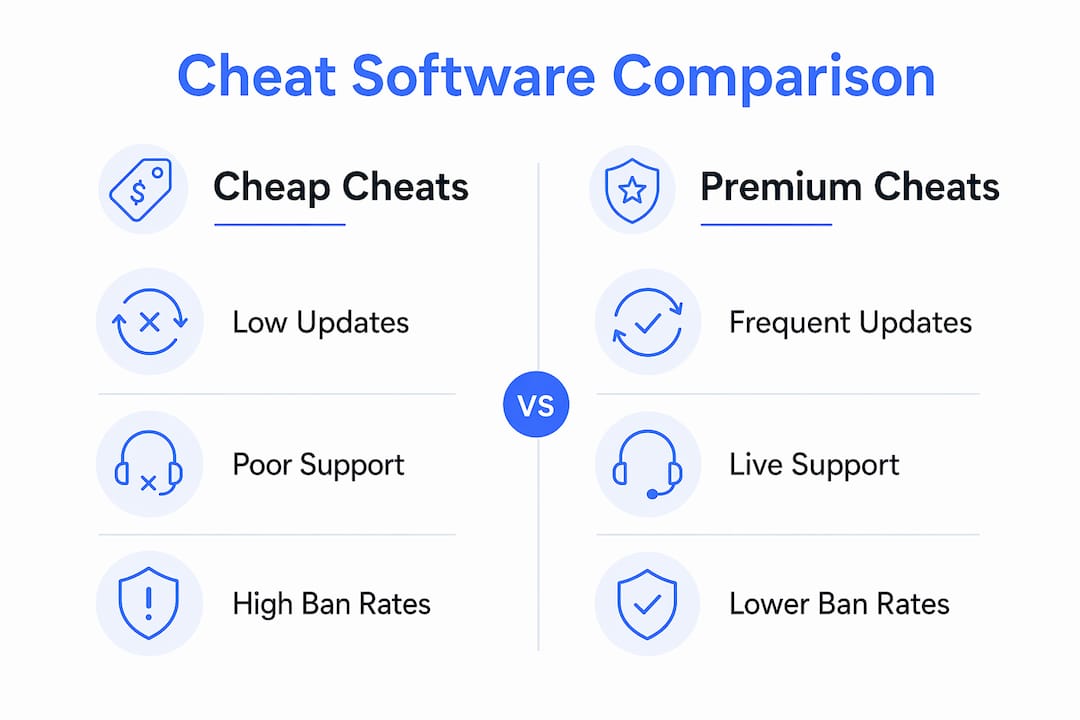
| Feature | Cheap cheat | Premium cheat |
|---|---|---|
| Update frequency | Irregular or never | Daily or after every anti-cheat patch |
| Support response | None or delayed | Live support via Discord or similar |
| Detection rate | 25%–40% ban rate | Actively minimized through daily testing |
| Total cost over 3 months | High due to replacements | Lower due to stability and longevity |
| Code quality | Unmaintainable, high debt | Maintained, tested, and documented |
Why gamers keep buying cheap cheats anyway
Present bias is the behavioral economics term for why budget cheats don't work as a long-term strategy, yet gamers keep buying them. Present bias describes the human tendency to overvalue immediate savings and undervalue future costs. A $10 cheat feels like a win today. The $50 account replacement next month feels like a separate problem.
False economy reinforces this trap. False economy occurs when short-term savings are outweighed by long-term expenses such as account replacements and repeated cheat purchases. The math is clear, but the psychology fights against it.
"Cheap purchases feel safer emotionally because failure is written off quickly. Users mentally disconnect the failed product from the original purchase, which makes them willing to spend again on another cheap option rather than upgrading to something reliable. This cycle of repeated small losses adds up to a total cost far exceeding what a quality product would have required upfront."
Optimism bias plays a supporting role. Most gamers assume they will be in the lucky percentage that avoids detection. That assumption ignores the documented ban rates and the reality that anti-cheat systems are designed specifically to catch the patterns cheap cheats produce. Social normalization in gaming communities also reinforces the behavior. When everyone in a Discord server is recommending the cheapest option, it feels like the correct choice.
The psychological traps that keep gamers in this cycle include:
- Present bias: The low price feels like a win regardless of long-term outcome.
- Optimism bias: "I won't be the one who gets banned."
- Sunk cost reversal: Writing off failures quickly rather than learning from them.
- Social proof: Community recommendations normalize cheap options even when outcomes are poor.
What actually happens when a cheap cheat fails in a live match
The practical consequences of cheap cheat failure go beyond a simple error message. Detection events in titles like Escape from Tarkov or Valorant result in permanent account bans. That means lost skins, lost rank, lost progression, and the cost of a new account on top of the replacement cheat.
Bugs are the second major failure mode. Cheap cheats skip critical testing and edge-case handling, which means they behave unpredictably under real match conditions. An aimbot that misfires or an ESP that renders incorrectly does not just fail to help. It actively signals abnormal behavior to anti-cheat systems.
Long-run outcomes favor players who invest in quality. Long-run utility favors skill-building once game difficulty and detection systems become advanced. That finding applies directly to cheat investment: the players who survive long-term are the ones using tools that survive long-term.
The real-world failure pattern looks like this:
- Detection event triggers a permanent ban on a ranked account
- Replacement account costs time and money to rebuild to previous rank
- New cheap cheat purchase repeats the cycle within weeks
- Total time lost to bans and rebuilds exceeds the time saved by cheating
Pro Tip: If a cheat provider does not list a specific anti-cheat compatibility status for each title it supports, treat it as unverified. Vague claims like "works on all games" are a reliable indicator of a product that has not been tested against current anti-cheat builds.
How to identify reliable cheat alternatives worth your money
Reliable cheats share a set of identifiable characteristics that cheap options consistently lack. The most important is a documented update schedule tied directly to anti-cheat patch cycles. A provider that pushes updates within 24 hours of a game patch is maintaining active infrastructure. One that goes silent for weeks after an update is not.
Live support is the second marker. A provider offering real-time support via Discord or a dedicated channel has a team invested in keeping the product working. That investment does not exist in high-turnover, low-cost operations. Midnight-market, for example, provides live Discord support alongside daily testing across titles including EFT and Valorant.
Hardware-based solutions add another layer of reliability. DMA cards operate at the hardware level, which makes them significantly harder for software-based anti-cheat systems to detect. Products like the Midnight 100T DMA Card represent a category of cheat hardware that does not depend on software patches to maintain its detection resistance.
When evaluating any cheat provider, apply a cost-per-use framework. Divide the total price by the expected weeks of reliable use. A $15 cheat that lasts two weeks costs $7.50 per week. A $60 product that runs reliably for six months costs $2.50 per week. The math consistently favors quality.
Key Takeaways
Cheap cheats fail faster because they are built without the maintenance infrastructure, testing, and support that modern anti-cheat systems demand.
| Point | Details |
|---|---|
| Technical debt causes fast failure | Cheap cheats skip testing and edge-case handling, leading to rapid detection and crashes. |
| Business model drives abandonment | High-turnover providers prioritize sales over updates, leaving users exposed after every anti-cheat patch. |
| Present bias inflates real cost | Gamers underestimate total spending because they mentally disconnect each failed purchase from the last. |
| Ban rates are documented and high | Cheap cheat tools face ban rates between 25% and 40%, making account loss a near-certain outcome over time. |
| Cost-per-use math favors quality | Premium cheats with daily testing and live support cost less per week of reliable use than repeated cheap replacements. |
The uncomfortable truth about cheap cheat culture
I have watched the same pattern repeat across competitive gaming communities for years. A player finds the cheapest option in a Discord server, buys it, and posts about it like they found a secret. Three weeks later, they are posting again asking why their account got banned and where to find the next cheap option. The cycle is not bad luck. It is the predictable outcome of a product built to fail.
The shortcut mentality backfires hardest in competitive gaming because the stakes are real. Ranked progression, account history, and in-game assets all disappear with a single detection event. The players I have seen sustain long-term competitive advantages are the ones who treat cheat software the same way they treat any serious tool: they research it, they pay for quality, and they stick with providers who have a track record of keeping products undetected.
The community normalization of cheap options is the most damaging part of this culture. When a Discord server of 5,000 players collectively recommends the cheapest tool available, it creates a false consensus that cheap is fine. The ban wave that follows two weeks later is quieter than the original recommendation. Nobody posts about their banned account with the same enthusiasm they used to recommend the tool.
Investing in a well-maintained cheat from a provider like Midnight-market, with daily testing and live support, is not a luxury purchase. It is the only approach that actually protects your account and your time over a full competitive season.
— Fonics
Midnight-market: cheats built to last through every patch
Midnight-market tests every product daily against current anti-cheat builds across titles including EFT, Valorant, and Apex Legends. That testing schedule is what separates a cheat that survives a patch from one that gets your account banned the morning after an update. The Midnight-market store carries software cheats and DMA hardware solutions, all backed by live Discord support and hardware warranties. If you are done paying twice for products that fail once, the store has options built for competitive gamers who need reliability, not just a low price tag. Explore undetected Apex Legends cheats or DMA hardware that operates below the software detection layer entirely.
FAQ
Why do cheap cheats get detected so quickly?
Cheap cheats lack the testing infrastructure to keep up with anti-cheat updates. They face documented ban rates between 25% and 40%, meaning detection is a near-certain outcome over any extended period of use.
Do inexpensive cheats actually cost more in the long run?
Yes. False economy means short-term savings are outweighed by repeated replacement purchases, account bans, and lost progression. A premium cheat with a six-month lifespan consistently costs less per week than cycling through cheap replacements.
What is the biggest technical flaw in budget cheat software?
The absence of graceful recovery mechanisms is the most critical flaw. When a cheap cheat encounters an error or a new anti-cheat patch, it fails completely rather than adjusting automatically, forcing users to restart or abandon the session.
How can I tell if a cheat provider is reliable before buying?
Look for a documented update history tied to anti-cheat patch cycles, a live support channel with real response times, and explicit compatibility statements for each title the product supports. Providers that cannot answer those questions specifically are not testing their products.
Are DMA hardware cheats more reliable than software cheats?
DMA hardware operates at a level that software-based anti-cheat systems struggle to detect. Products in this category maintain detection resistance without depending on frequent software patches, making them a more stable long-term option for competitive gamers.