
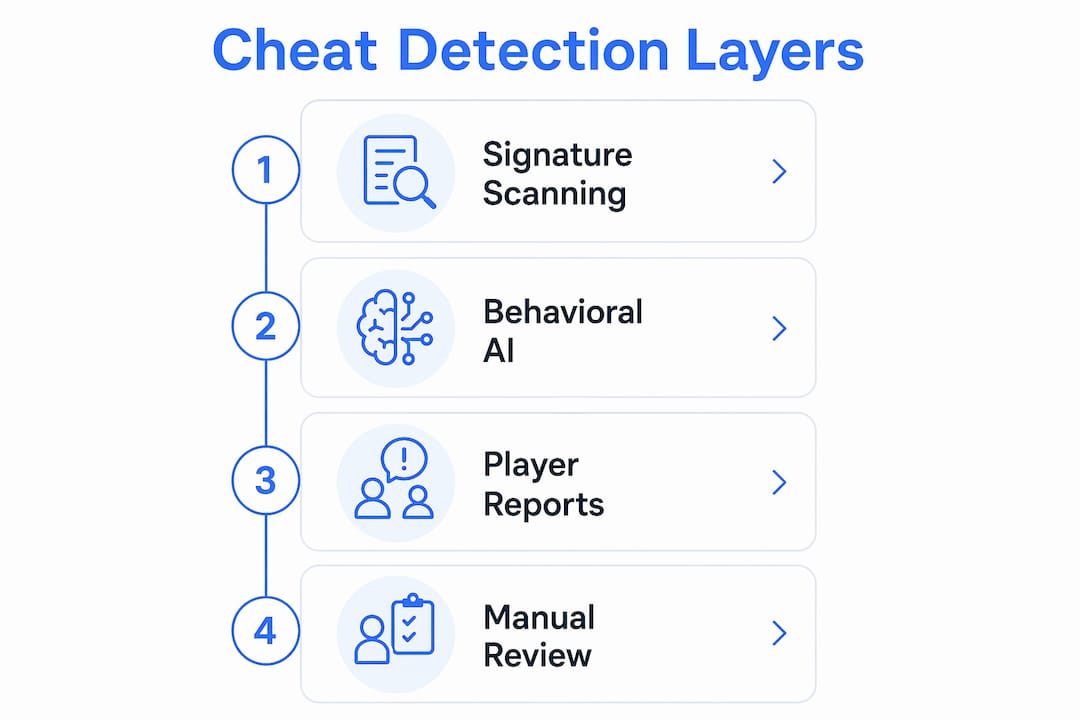
Cheat detection is the process by which game systems identify unauthorized gameplay advantages by scanning for known cheat signatures, monitoring player behavior, and reviewing suspicious activity. Most gamers assume getting caught comes down to bad luck. The reality is more technical: anti-cheat systems run layered detection frameworks combining signature matching, AI behavioral analysis, and community reporting. Understanding why cheats get detected is the first step toward protecting your account. This article breaks down each layer, explains where cheat developers fall short, and shows you what actually puts accounts at risk.
Why cheats get detected: the signature scanning layer
Signature-based detection is the oldest and most direct method anti-cheat systems use. Every piece of cheat software leaves a fingerprint. Anti-cheat engines scan active memory and loaded modules for known byte patterns that match cheat code. When a match is found, the account is flagged.
Public cheats get detected within 7–21 days of release in most cases. That short window exists because anti-cheat teams extract signatures from newly released cheats almost immediately after they appear. Once a signature enters the database, every user running that cheat becomes detectable.
Here is what makes signature detection particularly effective:
- Byte pattern matching: Anti-cheat engines read memory in real time and compare it against a database of known cheat signatures.
- Module scanning: Loaded DLLs and injected code are checked against whitelisted system files.
- Hash verification: Game files are hashed and compared to official versions to catch modified executables.
- Driver inspection: Kernel-level anti-cheat tools check for unauthorized drivers that cheats commonly use.
One tactic anti-cheat systems use to maximize effectiveness is the delayed ban wave. Ban waves gather broad evidence before issuing bans in bulk. This approach serves two purposes: it reduces false positives and it prevents cheat developers from identifying exactly which signature triggered the ban. If bans happened instantly, cheat developers could isolate the detection trigger and patch it within hours.
Pro Tip: If a cheat has been publicly available for more than two weeks without a confirmed update, treat it as already flagged. Signature databases update faster than most cheat developers can respond.
How behavioral analysis and AI catch cheats without signatures
Behavioral analysis is the detection layer that catches cheats even when no signature exists. Anti-cheat systems collect server-side telemetry on every player. That data includes headshot ratios, reaction times, movement paths, and accuracy rates. AI models then compare those metrics against what is statistically possible for a human player.

AI and machine learning models flag anomalies in accuracy and reaction time that exceed human capability. A player landing headshots at a rate that no human reflexes could produce will trigger a flag regardless of whether the cheat software itself was ever detected. The AI does not need to see the cheat. It only needs to see the result.
Several specific behaviors draw AI attention:
- Reaction times below human threshold: Legitimate players average 150–250 milliseconds. Aimbot-assisted reactions can register at under 10 milliseconds.
- Abnormal headshot ratios: Sustained headshot rates far above the player's historical average signal automated aiming.
- Unnatural movement patterns: Perfectly smooth camera tracking or instant 180-degree snaps fall outside normal human input variance.
- Wallhack indicators: Pre-aiming at targets through solid geometry before they become visible is a strong behavioral signal.
Statistical anomaly detection flags accounts with impossible gaming metrics over time. A single great game rarely triggers a review. A sustained pattern of impossible performance across dozens of sessions builds a case that is hard to dismiss.
Cheat developers attempt to counter behavioral analysis through what is called behavioral masking. This means artificially limiting aimbot speed, adding simulated mouse movement variance, and capping accuracy to stay within human-looking ranges. The problem is that masking requires precise calibration. Set the limits too loose, and the AI still flags you. Set them too tight, and the cheat stops providing a meaningful advantage.
Pro Tip: Behavioral masking only works when the cheat is configured conservatively. Running aimbot at full speed in a ranked match is the fastest way to trigger an AI review, even with an otherwise undetected cheat.
How player reporting and manual review lead to bans
Player reporting is the detection layer that most gamers underestimate. It does not require any technical detection at all. Other players watch you play, recognize something is wrong, and report your account. That report enters a queue.
Accumulating 5 or more player reports within a short time window commonly triggers a manual review. Manual review means a human or an AI-assisted system watches your gameplay footage and looks for specific patterns.
Manual reviewers focus on four behaviors in particular:
- Pre-firing: Shooting at a corner before an enemy appears, consistently and accurately, indicates wallhack use.
- Impossible kills: Hitting targets through walls, at extreme distances, or in conditions that rule out legitimate play.
- Scripted movement: Movement that repeats with mechanical precision, lacking the natural variation of human input.
- Reaction kills: Eliminating players the moment they become visible, with no perceptible reaction delay.
Manual review bans depend on gameplay behavior more than on the cheat software itself. This is the critical point most gamers miss. A cheat can be completely undetected by automated scanning and still get your account banned because a human reviewer watched your gameplay and recognized the patterns.
The practical implication is significant. Playing aggressively with a cheat in public lobbies, especially in ranked modes where opponents are paying close attention, generates reports fast. Five reports in a week is not a high bar when you are consistently outperforming everyone in the lobby.
How cheat developers respond to detection and why poor coding causes bans
The relationship between cheat developers and anti-cheat teams is a technical arms race. Anti-cheat systems force cheat developers to use increasingly advanced techniques like kernel-level drivers, hardware exploits, and memory manipulation to stay ahead. Each escalation from the anti-cheat side demands a counter-escalation from cheat developers.
Kernel-mode anti-cheat software monitors low-level system activity. To evade it, cheat developers use techniques like BYOVD (Bring Your Own Vulnerable Driver), which exploits a legitimate but outdated driver to gain kernel access without triggering security alerts. DMA hardware takes this further by reading game memory from a separate physical device, making the cheat invisible to software-based scanning entirely.
The gap between well-coded cheats and poorly coded ones is where most bans originate. Poorly coded cheats create several specific problems:
- Residual memory artifacts: Sloppy injection leaves traces in memory that signature scanners find easily.
- VM obfuscation overhead: Some cheats run inside a virtual machine to hide their code. The performance overhead of this approach creates detectable system behavior.
- Statistical exposure: Cheats that do not implement behavioral masking produce gameplay statistics that flag automated systems within days.
- No update cadence: A cheat that is not actively maintained becomes detectable the moment its signature enters the anti-cheat database.
Data security is another risk that poor cheat providers create. A cheat service leaked 64,000 user accounts including emails and support communications in a single breach. That kind of exposure does not just compromise privacy. It hands anti-cheat teams a list of confirmed cheat users, which can trigger account reviews independent of any technical detection.
Pro Tip: Choosing a cheat provider with a documented update history and a track record of operational security matters as much as the cheat's technical design. A provider that leaks user data or stops updating after a month costs you your account.
Key Takeaways
Cheats get detected through three overlapping systems: signature scanning, behavioral AI analysis, and player-triggered manual review, and no single layer operates in isolation.
| Point | Details |
|---|---|
| Signature scanning is fast | Public cheats are typically flagged within 7–21 days as signatures enter anti-cheat databases. |
| AI catches behavior, not just code | Impossible reaction times and abnormal headshot ratios trigger flags even without a known cheat signature. |
| Reports lead to human review | Accumulating 5 or more reports in a week commonly triggers a manual gameplay review. |
| Poor cheat coding accelerates bans | Memory artifacts, no behavioral masking, and outdated code all increase detection risk significantly. |
| Provider security affects your account | Data breaches at cheat providers can expose user identities directly to anti-cheat teams. |
The part most guides skip entirely
Most articles on cheat detection stop at the technical layer. They explain signatures and AI models, then leave you with the impression that an "undetected" label on a cheat means you are safe. That framing misses the most important variable: your own behavior in the game.
I have seen players burn accounts running cheats that were technically undetected for months. The cheat never triggered a signature scan. The AI never flagged the software. The ban came from a manual review after a string of reports from players who watched the gameplay and knew something was wrong. The cheat was invisible. The player was not.
The discipline required to use a cheat without getting banned is genuinely underestimated. Behavioral masking is not a setting you toggle on. It is a practice. You have to understand what human performance looks like in the game you are playing, and you have to stay inside that range consistently. Running aimbot at full speed in a ranked lobby is not a cheat problem. It is a judgment problem.
The other thing I keep coming back to is provider selection. The Atlas Menu breach that exposed 64,000 accounts is not an isolated case. Cheat providers with poor operational security are a liability that has nothing to do with detection technology. Your account safety depends on who holds your data as much as it depends on the cheat's code quality.
If you are going to use cheats, treat it like any other security decision. Use providers that update regularly, maintain operational security, and have a verifiable track record. The HWID spoofing layer matters too, because hardware bans outlast account bans by a wide margin.
— Fonics
Midnight-market keeps you ahead of detection systems
Understanding detection is one thing. Having tools that are built around it is another.

Midnight-market tests every product daily across titles like Valorant, EFT, and Apex Legends to confirm undetected status before you ever run it. The catalog includes both software cheats and DMA hardware solutions designed to operate outside the reach of kernel-level anti-cheat scanning. Every product ships with live Discord support, so you are never left guessing when an update drops or a detection status changes. For gamers who take account safety seriously, that combination of tested software, hardware options, and real-time support is what separates a reliable provider from one that costs you your account.
FAQ
Why do cheats get detected even when labeled "undetected"?
"Undetected" refers to the cheat's status at a specific point in time. Anti-cheat signature databases update continuously, and behavioral AI flags suspicious gameplay independent of whether the cheat software itself was ever scanned.
How long does it take for a public cheat to get detected?
Most public cheats are flagged within 7–21 days of release. Anti-cheat teams extract signatures from new cheats quickly, making public releases a high-risk option for account safety.
Can you get banned from player reports alone?
Yes. Accumulating 5 or more reports in a short window triggers a manual review focused on gameplay behavior, not cheat software. Impossible kills, pre-firing, and scripted movement are enough to result in a ban.
What is a ban wave and why does it matter?
A ban wave is a delayed, mass enforcement action where anti-cheat systems issue multiple bans at once rather than immediately. Delayed enforcement prevents cheat developers from identifying which specific action triggered detection.
Does using a DMA card prevent detection?
DMA hardware reads game memory from a separate physical device, making it invisible to software-based anti-cheat scanning. It does not prevent behavioral detection or manual review bans, which depend on how you play rather than what software is running.