
Inconsistent gaming cheats are defined as cheat software that fails to maintain reliable, undetected performance across sessions, and they waste money by triggering permanent bans, destroying years of account progress, and forcing repeated purchases. The cost of unreliable cheats goes far beyond the subscription price. Modern anti-cheat systems in 2026 use behavioral analytics, hardware fingerprinting, and server-side audits to catch exactly the kind of erratic performance that inconsistent cheats produce. Mid-sized studios allocate 15–20% of their post-launch budgets to anti-cheat infrastructure, with major studios spending over $50 million annually on detection systems. That level of investment means the house almost always wins. Understanding why inconsistent cheats waste money is the first step toward making smarter decisions with your gaming budget.
Why inconsistent cheats waste money: how modern anti-cheat catches them
Modern anti-cheat systems do not rely on simple signature scans anymore. They analyze behavioral patterns, including aim speed, input timing, and movement consistency, to flag accounts that behave in statistically improbable ways. A player who suddenly snaps to targets with machine precision after 200 hours of average play stands out immediately.
Hardware ID (HWID) bans are the most punishing outcome. Behavioral analytics flag users based on statistical anomalies in input speed and accuracy, not just software signatures. That means a device can be permanently blacklisted even if the cheat loader itself appears undetected at the time of use.

Detection waves make the problem worse. Ubisoft and other major publishers now employ multiple anti-cheat layers with server-side checks and manual reviews. Bans are issued in batches, which makes it harder for cheat providers to isolate and patch the vulnerability before thousands of accounts are wiped.
The key detection triggers include:
- Aim behavior anomalies: Inhuman flick speed or lock-on patterns that no human hand can replicate
- Input timing irregularities: Perfectly timed actions that deviate from natural human reaction curves
- Statistical outliers: Kill-to-death ratios or accuracy rates that sit far outside the player's historical baseline
- Hardware fingerprinting: Device identifiers that match previously banned machines
Each of these triggers is a direct product of cheat inconsistency. A cheat that works perfectly one session and glitches the next creates exactly the kind of erratic data that anti-cheat algorithms are built to catch.
What financial losses come from inconsistent cheats beyond the price tag?
The sticker price of a cheat subscription is the smallest part of the real cost. The impact of inconsistent cheats compounds across multiple financial categories that most gamers do not account for before they buy.
1. Lost cosmetic investments. Skins, battle pass tiers, and limited-edition items purchased with real money disappear permanently when an account is banned. A gamer who spent $300 on Valorant skins over two years loses every dollar of that investment the moment Riot Games issues a ban.
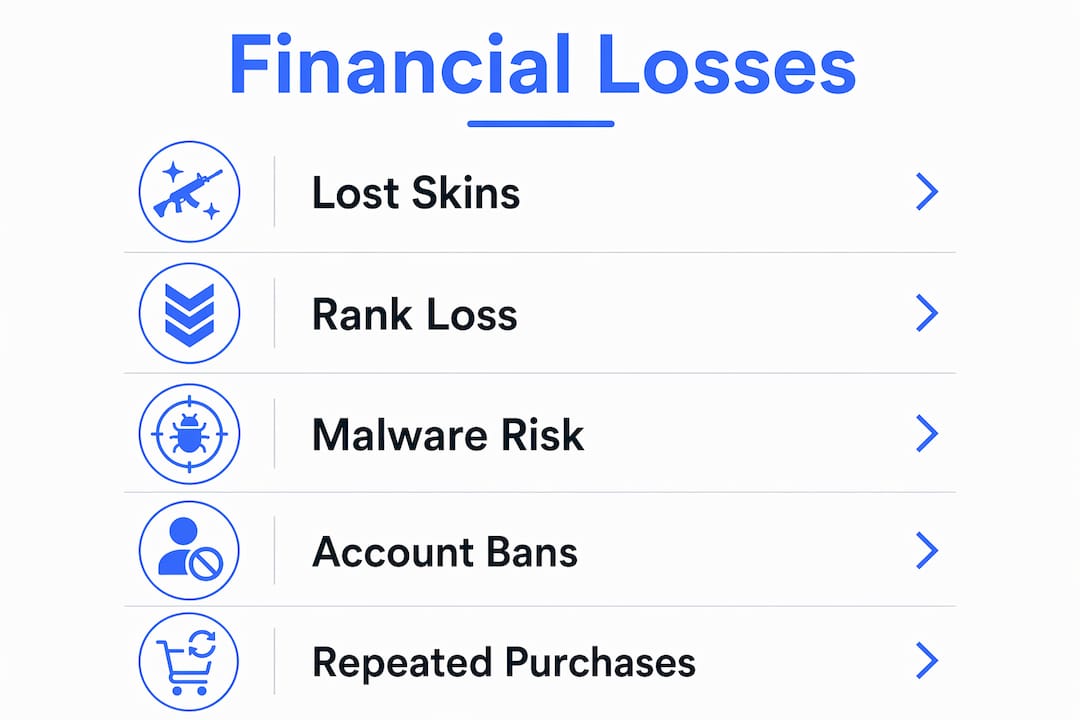
2. Rank and progression loss. Ranked accounts with high ratings carry real value in the gaming community. Some players invest hundreds of hours building a rank. A ban erases that entirely, and rebuilding on a new account means starting from zero.
3. Recurring cheat repurchases. Ban waves serve as a business reset for cheat providers, forcing users to repurchase cheats repeatedly. Each detection wave wipes the user base, and the provider simply sells new subscriptions to the same customers. This cycle adds up to substantial financial waste over months.
4. Hardware replacement costs. A HWID ban locks a specific machine out of a game permanently. Bypassing it requires spoofing hardware identifiers or, in severe cases, replacing components. Neither option is cheap.
"Private cheat builds leverage user trust to distribute malware and crypto miners, making their use financially and personally risky beyond detection penalties." The security risk alone makes low-quality cheat software a liability, not an asset.
Cheat providers bundle malware, keyloggers, and crypto miners with cheat software as a secondary exploitation method. A gamer who installs a "private" cheat from an unknown seller may lose far more than their game account. Stolen banking credentials or a compromised crypto wallet can cost thousands of dollars, dwarfing any in-game advantage the cheat ever provided.
Why do inconsistent cheats fail to deliver lasting competitive advantages?
Cheating is a short-term optimization trap. It prevents genuine skill development and leads to diminished success over time. The data on this is clear and counterintuitive.
Research on chess, a game with precise measurable outcomes, shows that cheating on three well-chosen moves increases win probability from 51% to 84%. That sounds compelling until you see the other side of the finding. Five random cheats yield only a 7.5 percentage point advantage. Inconsistent, poorly timed cheating produces almost no benefit while dramatically increasing detection risk.
University of Michigan 2026 research confirms that systems with gradual difficulty increases reward honest skill development over gaming the system. Cheaters' actual skill converges to zero over time because they never build the underlying competency. When the cheat fails or gets detected, they are left with nothing.
| Factor | Inconsistent cheats | Skill development |
|---|---|---|
| Short-term win rate | High but unstable | Moderate and growing |
| Detection risk | High and increasing | None |
| Long-term performance | Declines to zero | Compounds over time |
| Financial cost | Recurring and escalating | One-time hardware or coaching investment |
| Account security | Permanent ban risk | No risk |
Widespread access to cheat codes flattens competitive advantage across the board. When everyone on a server runs similar cheats, the edge disappears entirely. The players who win at that point are the ones with better judgment, faster decision-making, and stronger game sense. Those are skills cheats cannot replicate.
Pro Tip: Invest $50 in a coaching session or aim-training software like Aimlabs before spending the same amount on a cheat subscription. The skill gain is permanent. The cheat subscription resets to zero the moment a ban wave hits.
What risks do unstable cheat providers create for your finances and privacy?
The cheat software market runs on a model that is structurally designed to extract money from buyers repeatedly. Understanding this model explains why wasting money on cheats is almost guaranteed for anyone using low-quality providers.
Cheat providers profit most before detection waves hit. They sell high volumes of subscriptions, knowing that anti-cheat teams will eventually catch up. When the ban wave arrives, the provider's existing product becomes worthless overnight. The provider then releases an "updated" version and sells it to the same user base again. This cycle repeats every few weeks or months.
The risks stack up fast:
- Cheat leaks: When a private cheat's code leaks publicly, anti-cheat teams can analyze and detect it within days. Every subscriber gets banned.
- Provider shutdowns: Cheat sellers disappear without warning, taking subscription payments and leaving users with nothing.
- Malware bundling: Private cheat builds distribute malware and crypto miners alongside the cheat software, compromising personal data and system security.
- No refunds: Cheat providers rarely offer refunds when their software gets detected. The financial loss is immediate and total.
The secondary exploitation risk is the most underreported danger in the cheat market. A keylogger bundled into a cheat installer can capture passwords, payment details, and two-factor authentication codes. The financial damage from identity theft or stolen accounts far exceeds any gaming advantage the cheat ever delivered.
Pro Tip: Always verify that any cheat software you consider comes from a provider with a documented testing process and a public track record. Anonymous sellers with no community presence are the highest-risk category.
Key Takeaways
Inconsistent cheats cost far more than their subscription price because detection, bans, and security risks compound into losses that dwarf any short-term in-game advantage.
| Point | Details |
|---|---|
| Anti-cheat is sophisticated | Behavioral analytics and HWID bans catch inconsistent cheats even when loaders appear undetected. |
| Financial losses compound | Account bans erase cosmetic purchases, rank, and progression worth hundreds of dollars. |
| Cheat providers exploit buyers | Ban waves reset the market, forcing repeated repurchases from the same user base. |
| Skill beats cheating long-term | Research shows honest skill development outperforms cheating over any sustained period. |
| Security risk is real | Malware and keyloggers bundled in cheat software can cause financial losses far beyond gaming. |
The uncomfortable truth about cheat spending I've seen firsthand
I have watched this play out in gaming communities for years. A player drops $40 on a cheat subscription, runs it for three weeks, and gets hit by a ban wave. They lose a Valorant account with $250 in skins. They buy a new account, repurchase the cheat, and the cycle starts again. By month four, they have spent more money than a full year of legitimate gaming would have cost, and their actual skill is no better than when they started.
The part that frustrates me most is the false economy. Gamers who use inconsistent cheats tell themselves they are saving time. They are not. They are trading a recoverable skill gap for an unrecoverable financial loss. Skill gaps close with practice. Banned accounts and stolen payment credentials do not come back.
The cheating strategies that lose value fastest are the ones built on cheap, unverified software from providers with no accountability. I have seen players get their Steam libraries locked, their Discord accounts compromised, and their banking apps targeted, all because a "private" cheat installer carried a keylogger. The cheat cost $25. The damage cost thousands.
My honest recommendation is to treat cheat spending the way you treat any hardware purchase. Demand proof of testing, a track record, and real support. If a provider cannot show you daily test results and a community of verified users, the risk is not worth it. The gaming community has enough options in 2026 that there is no reason to gamble your account and your financial security on an anonymous seller.
— Fonics
How Midnight-market helps you avoid the cheat trap
Midnight-market is built specifically for gamers who have been burned by unreliable software and want a provider with a real track record. Every product in the Midnight-market store goes through daily testing across titles including EFT and Valorant, so you know the status of your cheat before you run it.
The product lineup includes both software cheats and DMA hardware solutions that operate at the hardware level, reducing software-based detection risk significantly. Live Discord support means you get real answers when something changes, not silence during a ban wave. Hardware warranties add another layer of financial protection that generic providers never offer. If you are going to invest in a competitive edge, invest in one that is tested, supported, and built to last.
FAQ
Why do inconsistent cheats get detected faster than consistent ones?
Inconsistent cheats produce erratic behavioral data that anti-cheat algorithms flag as statistically improbable. Behavioral analytics compare current performance against a player's historical baseline, and sudden unexplained spikes trigger automatic reviews.
Can a HWID ban affect more than one game?
Yes. A hardware ID ban can lock a specific device out of multiple titles simultaneously, depending on the publisher's enforcement policy. Bypassing it requires hardware spoofing or component replacement.
Are "private" cheats safer than public ones?
Private cheats carry higher malware risk because cheat providers bundle keyloggers and crypto miners with the software. A smaller user base does not mean safer code, and private cheats still get detected when their signatures are analyzed.
How much money can a banned account cost a gamer?
The financial loss depends on accumulated purchases, but gamers who invest in cosmetics, battle passes, and ranked accounts over multiple years can lose hundreds of dollars in a single ban. Recurring cheat repurchases after each ban wave add significantly to that total.
Does skill development actually outperform cheating over time?
Research confirms that honest skill improvement yields better outcomes over any sustained period. Cheaters' actual skill converges to zero because they never build the underlying competency that survives detection or account loss.