
DMA cheats are no longer the ghost-in-the-machine they were sold as. In 2026, they're detectable through at least three separate channels: PCIe device fingerprinting, IOMMU and firmware-level enforcement, and server-side behavioral analytics that catch what hardware hides. Vendor moves like Vanguard's firmware disruption and layered telemetry mean the "safe window" for DMA hardware has narrowed considerably. Anyone weighing the risk needs to understand all three fronts, not just the one they've heard about.
TL;DR:
- DMA cheat detection now relies on PCIe device fingerprinting, firmware enforcement, and behavioral analytics to catch hardware-based cheats.
- Spoofing device identifiers is increasingly ineffective due to hardware fingerprinting, firmware disruption, and timing analysis.
- Server-side behavioral detection identifies impossible player reactions and sight-line usage through pattern analysis and AI-assisted review.
- Manual checks like inspecting PCIe device lists and replay analysis can help players and admins spot suspicious hardware or gameplay.
- Continuous updates and layered defenses mean no hardware remains invisible forever, making ongoing testing and support essential.
Table of Contents
- Why Anti-Cheats Shifted Strategy: The Three Detection Fronts
- PCIe Enumeration, Config Space, and IOMMU: How Detection Actually Works
- Catching Cheating by Its Effects: Server-Side Behavioral Detection
- Practical Checks: What Players and Admins Can Look For
- What Detection Still Can't Do, and How Cheat Makers Respond
- Publisher Perspective: What Testing Actually Tells You
- Midnight Market's Hardware and Support: The Honest Version
- Sources
Why Anti-Cheats Shifted Strategy: The Three Detection Fronts
For years, DMA cheating worked because it sat outside the operating system. A card reading memory over PCIe never touched the kernel, never ran a process Windows could flag, and never triggered the signature-scanning that catches software cheats. Anti-cheat vendors adapted by attacking the problem from three angles instead of one.
The first front is the device itself. Anti-cheat software can query the PCIe bus and look for hardware that shouldn't be there or that presents suspicious identifiers, a technique detailed in independent detection vector research.
The second front is the firmware and platform layer. This is where IOMMU enforcement and kernel-level DMA protection come in, forcing devices to prove they belong before they're allowed to read system memory.
The third front doesn't care what hardware you're running at all. It watches what you do in a match: your aim, your reactions, your knowledge of enemy positions you had no legitimate way to see.
Layering these three approaches is what makes DMA riskier today than it was two or three years ago. A cheat that slips past device enumeration can still get flagged by firmware enforcement. One that survives that can still get caught by trust scoring three matches later. The 2026 detection landscape reflects this shift: vendors aren't chasing a single silver bullet, they're closing off every lane at once.
That layered approach shows up in real outcomes:
- Publisher-issued ban waves tied directly to firmware-level detection events, not only player reports.
- Rising scrutiny on PCIe device identifiers during matchmaking and pre-game checks.
- Behavioral flags that trigger reviews even when no hardware signature was ever found.
PCIe Enumeration, Config Space, and IOMMU: How Detection Actually Works
Every PCIe device, including a DMA card, has to announce itself through configuration space. This is a standardized block of data containing a vendor ID, device ID, class code, and a set of Base Address Registers (BARs) that map how the device talks to memory. Anti-cheat software can enumerate this configuration space and cross-reference it against known-good hardware lists, the same way a bouncer checks a badge against a roster.
Here's the technical wrinkle most DMA buyers don't know about: cheap FPGA-based cards often run stock gateware straight from the manufacturer, which means they carry recognizable Xilinx vendor identifiers baked in. That gateware fingerprint is a dead giveaway to anyone scanning for it, and spoofing it convincingly requires custom firmware work that most off-the-shelf cards simply don't have.
Then there's IOMMU, or Input Output Memory Management Unit. This chipset feature can restrict what physical memory a PCIe device is allowed to touch, and Windows' own Kernel DMA Protection builds on it. Riot's Vanguard took this further with an update that actively disrupts DMA firmware over SATA and NVMe-style interfaces, in some documented cases corrupting the FPGA firmware badly enough to brick the device entirely.
Quick numbers that matter: the practical effect of Vanguard's IOMMU push wasn't a ban wave, it was hardware failure. Cards that used to run undisturbed reportedly stopped functioning, or needed a full reflash, after the update shipped.
None of this is airtight, though. Detection still has real gaps:
- Custom gateware that fully emulates a common peripheral avoids the stock-firmware fingerprint problem, at real development cost.
- BAR emulation and timing-analysis countermeasures are technically possible but demand serious engineering skill.
- The pre-boot window before IOMMU protections initialize remains a documented gap that firmware and vendor coordination haven't fully closed.
Catching Cheating by Its Effects: Server-Side Behavioral Detection
You can spoof a device ID. You can't easily spoof having seen through a wall. That's the logic behind server-side behavioral detection, and it's arguably done more damage to the DMA cheating scene than any firmware update.
Anti-cheat backends validate gameplay events against what should be physically or statistically possible. A player who consistently pre-aims through smoke, snaps to targets before they're visually exposed, or reacts in single-digit milliseconds across hundreds of engagements is generating what researchers call impossible-knowledge signals, a pattern documented extensively in behavioral detection writeups.
No single flag results in an instant ban, because any one anomaly could be luck, skill, or a lag spike. Trust scoring solves that by aggregating dozens of soft signals across sessions instead of judging a player on one match. Some vendors now pair this with AI-assisted replay review that surfaces the most suspicious clips for human moderators to confirm before action is taken, which cuts down on false positives dramatically compared to fully automated bans.
The signals that carry the most weight tend to be:
- Sight-line usage that tracks targets through walls, smoke, or foliage.
- Reaction times that beat human physiological limits repeatedly, not once.
- Crosshair placement that snaps to a target's exact position before any visual cue exists.
Practical Checks: What Players and Admins Can Look For
Neither players nor server admins need forensic software to start spotting red flags. A few manual steps go a long way.
- Open Device Manager and switch to "Devices by connection" view to see the full PCIe tree, then look for unfamiliar entries with generic or blank descriptions.
- Check Windows device history for leftover registry entries from PCI hardware that's since been unplugged, since Windows can retain identifiers from devices long after they're removed.
- Admins reviewing a suspicious player should pull match replays and compare reaction timing and sight-line accuracy across multiple sessions, not just one flagged round.
Pro Tip: A single unusual PCIe entry or one clean replay proves nothing on its own. Treat hardware traces and behavioral data as two halves of the same case, and only escalate once both point the same direction.
What Detection Still Can't Do, and How Cheat Makers Respond
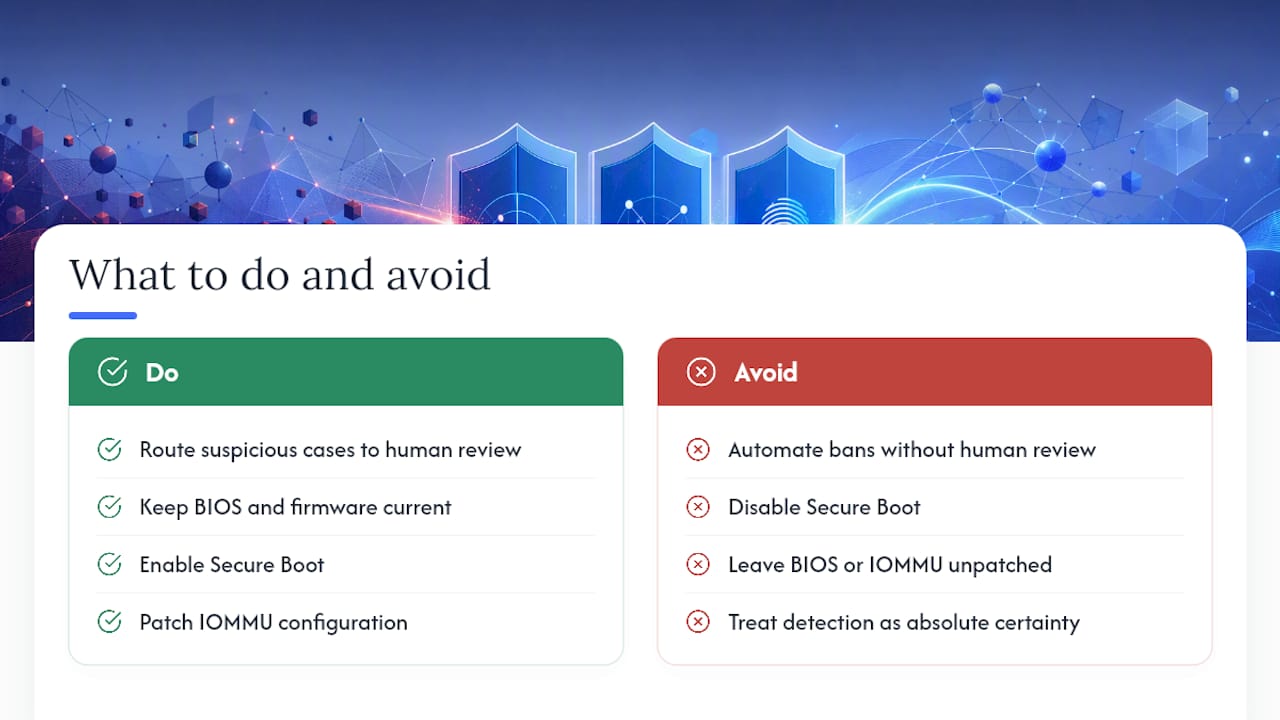
Behavioral detection is probabilistic, not absolute. It flags patterns, not certainties, which is exactly why most systems route suspicious cases through human review before issuing a ban rather than automating the whole pipeline. Cheat developers know this and iterate constantly, patching firmware, tweaking timing behavior, and rotating spoofed identifiers to stay ahead of the last detection update.
That back-and-forth is why keeping your own system current matters even if you're not the one causing trouble. Outdated BIOS settings, disabled Secure Boot, or an unpatched IOMMU configuration widen the exact gaps this whole arms race is fought over.
Publisher Perspective: What Testing Actually Tells You
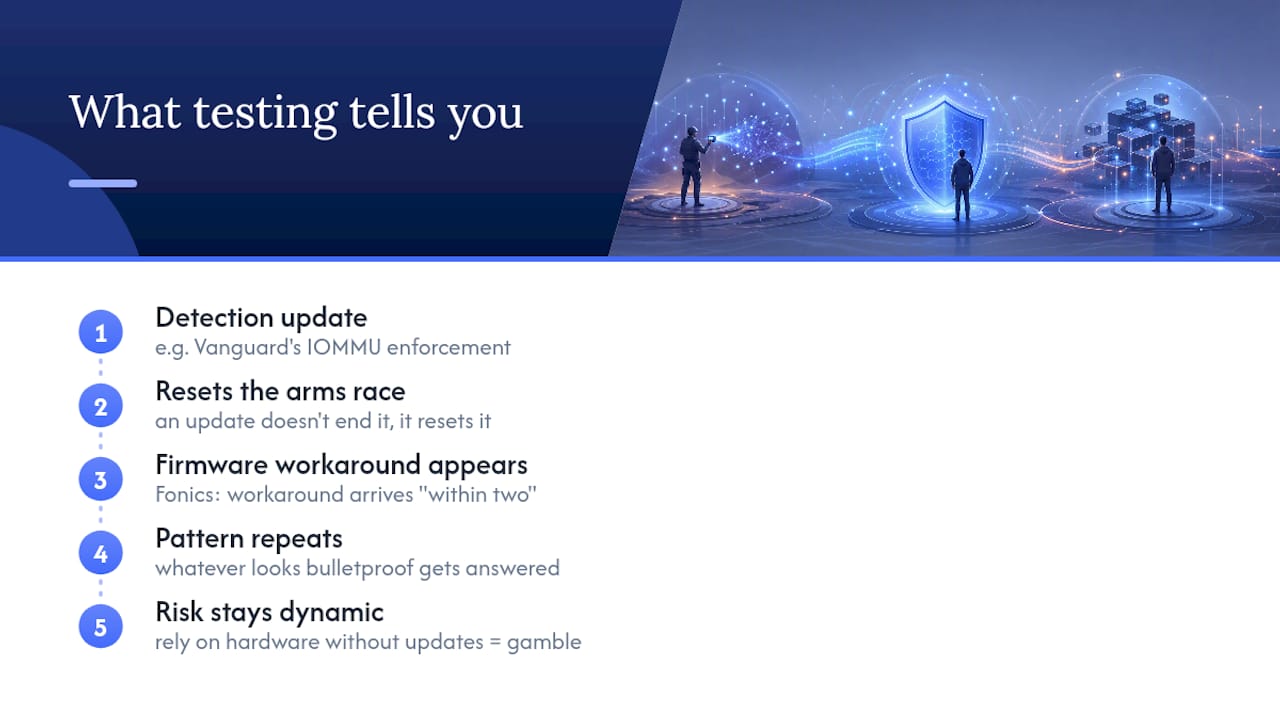
Watching DMA detection evolve for this long changes how you read vendor announcements. A single update, like Vanguard's IOMMU enforcement, doesn't end the arms race. It resets it. Fonics has tracked how quickly firmware countermeasures answer each new detection layer, and the pattern holds: whatever looks bulletproof this quarter gets a workaround within two.
The honest takeaway isn't that DMA is safe or doomed. It's that risk is dynamic, and anyone relying on hardware without watching for vendor updates is gambling on old information.
— Fonics
Midnight Market's Hardware and Support: The Honest Version
If you've read this far, you already know no hardware stays invisible forever. That's exactly why Midnight-market treats detection risk as an ongoing job, not a one-time claim. Every product, from DMA fuser hardware to full cheat bundles, goes through daily testing against current anti-cheat behavior, and hardware purchases come backed by warranty coverage so a bricked card from a firmware update like Vanguard's doesn't leave you stranded.

We won't tell you any product is permanently undetectable, because nothing is, and this article just walked through why. What is offered instead is daily-tested software, live Discord support when something changes overnight, and hardware backed by warranty instead of a disclaimer. If you're deciding whether a DMA setup makes sense for your game, check current product pages and changelogs before you buy, and talk to support first if you're unsure what's still holding up.
Sources
- Detection Vectors
- DMA cheats: how anticheats catch them
- How anti-cheats are actually catching DMA cheats in 2026
- Emerging threats to game integrity: unpacking the DMA cheat conundrum