A Valorant HWID ban ties the penalty to your PC's hardware fingerprint, not just your Riot account, so a new account or a fresh Windows install won't fix it. Realistic recovery comes down to three routes: appeal and wait it out, replace the firmware-bound parts Vanguard reads, or use a kernel-level spoofer. Each option carries its own trade-off between cost, time, and risk.
TL;DR:
- Replacing the motherboard and performing a clean Windows reinstall are often necessary to bypass a HWID ban because the unique firmware-bound identifiers are difficult to change.
- Community estimates suggest a typical HWID ban can last from three to four months, but longer or permanent bans are possible for repeat offenders or severe cheating cases.
- Kernel-level spoofers can temporarily hide hardware identifiers from Vanguard but carry a significant detection and risk of extension to a permanent ban if caught.
- Confirming a HWID ban involves creating a new Riot account on the same machine to see if access is instantly blocked, indicated by specific error codes like VAN 152.
- To avoid re-bans, users should uninstall or sandbox third-party tools, keep a dedicated clean Windows installation, and carefully document hardware changes and timestamps for possible appeals.
Table of Contents
- What a Valorant HWID Ban Is and Why Vanguard Issues Them
- What Happens When Your PC Gets HWID Banned
- How to Confirm You're Actually HWID Banned
- Appealing a HWID Ban Through Riot Support: What Actually Happens
- Realistic Recovery: Waiting It Out vs. Replacing Hardware
- Spoofers and Kernel-Level Tools: How They Work and What They Risk
- Prevention Checklist: Avoiding a Repeat HWID Flag
- Why Firmware-Bound IDs Make These Bans So Hard to Shake
- What This Actually Means for Your Next Move
- Midnight-Market's Tested Spoofers and Hardware Options
- Sources
What a Valorant HWID Ban Is and Why Vanguard Issues Them
An account ban locks a username. An HWID ban locks the machine itself, at the kernel level, which is why it survives password resets, new emails, and even a full account rebuild. Vanguard reads identifiers baked into your hardware and firmware: the SMBIOS UUID, motherboard serial number, drive serials, TPM or BIOS data, and network adapter MAC addresses. These sit below the operating system, so wiping Windows doesn't touch them.
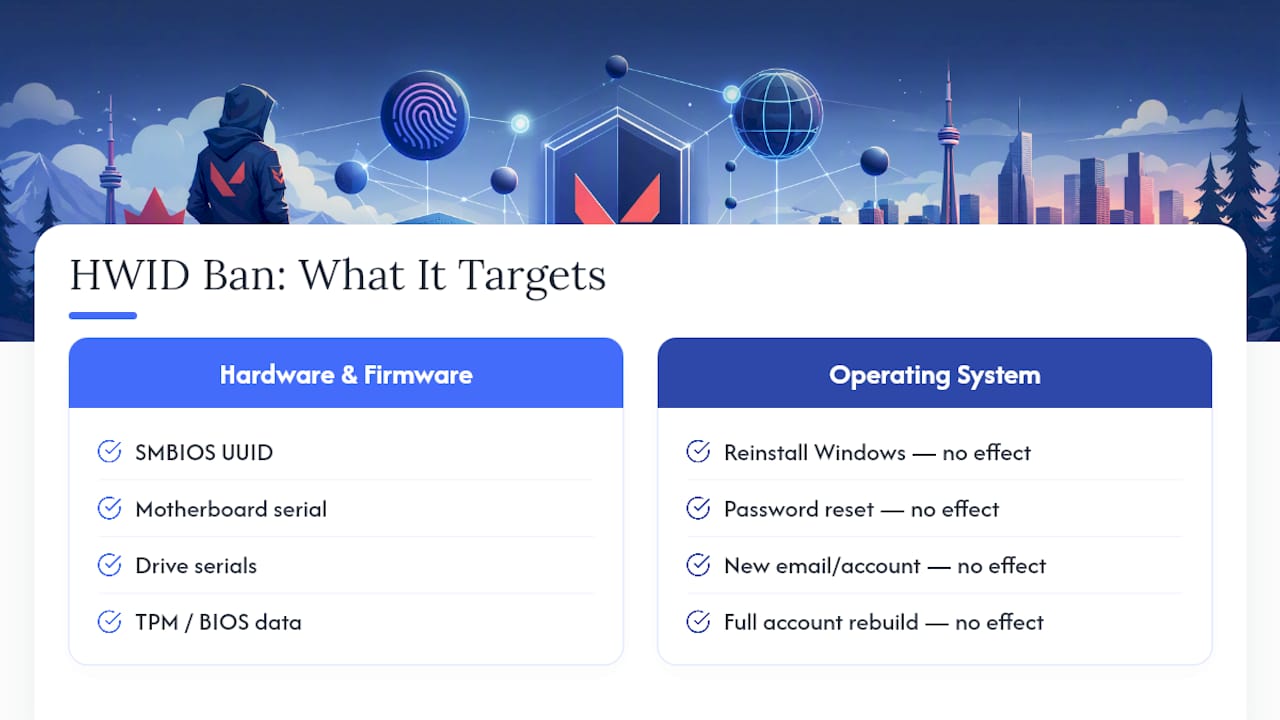
Riot generally reserves HWID bans for repeat offenders, players caught using cheat software, or accounts that show clear evasion attempts after an earlier suspension. It's the escalation tier, not the default penalty. Riot's own support documentation confirms the ban targets the hardware fingerprint specifically, and that standard fixes like reinstalling Windows or routing through a VPN do nothing to lift it.
What Happens When Your PC Gets HWID Banned
The most common symptom is a hard block the instant you launch the client, regardless of which account you're logging into. If you've hit this wall, here's what you'll typically notice:
- The game throws an error immediately at launch, before you reach the main menu.
- A brand new account created on the same machine gets flagged within minutes of first login.
- Existing accounts on that PC show the same restriction simultaneously.
- The block persists across driver updates, cable swaps, or router changes.
Community threads describe this pattern consistently: it's the PC that's flagged, not any single login. Players who share a household or LAN setup often discover the ban when a sibling's or friend's account suddenly can't play on that same tower, even though nothing was wrong with their account history.
How to Confirm You're Actually HWID Banned
Before assuming the worst, verify it. The confirmation process is quick and gives you the evidence you'll need if you decide to appeal.
- Create a brand new, unused Riot account and try logging into Valorant on the same PC. If it's instantly restricted, your hardware is flagged, not the old account.
- Screenshot the exact error code you receive. VAN 152 specifically indicates a hardware ban, as opposed to codes tied to account-level suspensions.
- Note the exact date and time the block first appeared, along with your last few completed matches.
- Pull your match history timestamps and any relevant screenshots from before the ban, since these help establish a timeline if you contact support.
This test is the same one Riot's own documentation points to as the reliable way to distinguish an account issue from a hardware ban, so treat it as your first move, not a last resort.
Appealing a HWID Ban Through Riot Support: What Actually Happens
Submitting a ticket is straightforward. Head to Riot Support, select the penalties category, and lay out your case with the VAN 152 error, the date it started, and your new-account test results.
Set your expectations accordingly. Riot's documentation is clear that appeals tied to cheating are reviewed with skepticism, and the bar for overturning them is high. Community reports back this up, describing agent responses that read as templated rather than a deep log review. That doesn't mean appealing is pointless. It means the quality of your evidence matters more than the tone of your message.
A tight, factual submission with match IDs, timestamps, and a clear timeline gives a human reviewer something concrete to check, rather than a wall of frustration to skim past. Players who report false positives from unrelated background tools, like certain drivers or utilities mistaken for cheat software, tend to have the strongest cases when they can point to exactly what was running and when.
Realistic Recovery: Waiting It Out vs. Replacing Hardware
If you're not appealing, or the appeal fails, you have two real paths: time, or new parts.
Community troubleshooting guides commonly cite a baseline of roughly three to four months for many temporary HWID bans, though repeat offenses or severe cheating cases can run longer or become permanent. If you're willing to sit it out, mark your calendar and simply retest with the new-account method periodically.
Hardware replacement is faster but costs money. Vanguard weighs certain components more heavily than others:
- Motherboard: carries the SMBIOS UUID and is the single most cited part to replace.
- Primary drive: SSD or HDD serials get read and logged.
- Network adapter: MAC addresses are part of the fingerprint, especially on onboard NICs tied to the motherboard.
Pro Tip: Replacing the motherboard alone is often necessary but not sufficient. Pair it with a clean Windows reinstall on a new or wiped drive, since leftover firmware-bound IDs on the old drive can still get flagged.
Spoofers and Kernel-Level Tools: How They Work and What They Risk
There's a real difference between changing a Windows registry value and actually changing what Vanguard reads. User-mode tricks, like editing your MachineGuid or spoofing a MAC address through Windows settings, don't touch firmware-level IDs at all. Vanguard reads straight past them.
Kernel-level spoofers operate at a deeper layer, intercepting or masking the SMBIOS UUID, drive serials, and other firmware identifiers before Vanguard's driver can read the real values. That's why some are effective, at least temporarily.
The catch is detection. Anti-cheat vendors update their fingerprinting logic regularly, and a spoofer that worked last month can get flagged this month.
- Free or leaked spoofers tend to get detected fastest, since they circulate widely and get reverse-engineered.
- Kernel-level tools that aren't maintained daily against anti-cheat updates carry a materially higher renewed-ban risk.
- Using any bypass tool sits outside Riot's terms of service, and getting caught while running one can extend a temporary ban into a permanent one.
There's no independently published detection rate for spoofers specifically, so treat any claim of guaranteed safety with suspicion. The honest framing is risk management, not risk elimination.
Prevention Checklist: Avoiding a Repeat HWID Flag
Getting back in is only half the job. Staying in matters more.
- Uninstall or fully sandbox third-party overlays, injectors, and kernel-mode drivers before ever launching Vanguard, since some legitimate tools get mistaken for cheat software.
- Keep a dedicated, clean Windows install reserved for competitive play, free of unrelated system utilities and monitoring software.
- Never share accounts or pay for boosting services, since shared logins are a common trigger for account-level review that can escalate.
- Periodically check your startup items and installed drivers for anything flagged as high-risk by the broader anti-cheat community.
Treat your competitive rig the way you'd treat a work laptop: minimal, purpose-built, and free of anything you can't explain if asked.
Why Firmware-Bound IDs Make These Bans So Hard to Shake
Firmware identifiers exist precisely because they're difficult to change casually, which is the whole point from an anti-cheat engineering standpoint. That same durability is what makes a HWID ban so much harder to walk away from than a simple account suspension.
Midnight-market's daily testing routine on spoofer products exists because of that exact reality: fingerprinting logic shifts often enough that a tool validated last week needs rechecking this week. Warranty support on hardware products reflects the same logic. Firmware-level changes are technical enough that most players benefit from a tested product and someone to ask questions to, rather than trial and error on a $2,000 build.
The practical tip worth remembering: whatever route you choose, document everything before you touch a single component. You'll want that record whether you're appealing, reselling old parts, or troubleshooting a new flag six months from now.
What This Actually Means for Your Next Move
The conventional advice you'll find in most threads treats appealing, waiting, and hardware swaps as the complete menu of options, and stops there. That's incomplete. It leaves out the fact that a kernel-level spoofer is a legitimate technical path for players who've weighed the ToS risk and decided the cost of new parts isn't worth it compared to a tested tool with active support behind it.
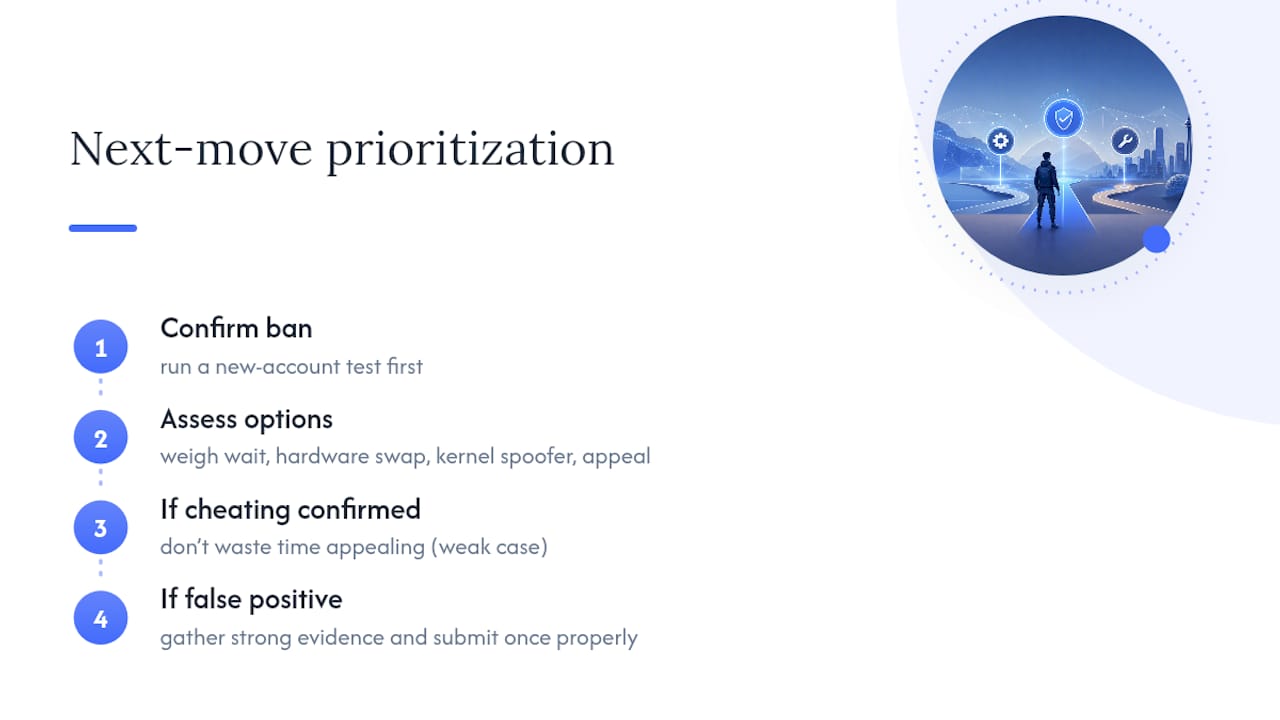
Where conventional advice falls short is in treating "wait three or four months" as a universal answer. For a competitive player mid-season, that's not a neutral suggestion. It's a real cost. The honest prioritization looks like this: confirm the ban with the new-account test first, always. Then decide based on your own risk tolerance and budget, not on what a forum thread assumes you should be comfortable with.
If cheating triggered the ban, don't waste time on an appeal you already know is weak. If it was a false positive, build the strongest evidence file you can and submit it once, properly, rather than spamming tickets.
— Fonics
Midnight-Market's Tested Spoofers and Hardware Options
If waiting three or four months isn't an option and you've decided a spoofer or hardware swap is your path, Midnight-market gives you a tested route instead of a gamble on a leaked tool from a random Discord server.

Midnight-market runs daily detection testing on its spoofer products, including options like the Reported Temp Spoofer, rather than shipping a tool once and hoping it stays undetected. Some orders ship with instant delivery and live Discord support, so if something looks off after a Vanguard update, customers can talk to support instead of digging through outdated guides. Hardware buyers may get warranty coverage, which matters when spending money on parts meant to change a firmware fingerprint. Read the fine print either way: using any bypass tool sits outside Riot's terms of service, and detection risk is never zero.
Browse the full product catalog to see what's currently tested and available, or check the support channels for guidance on which option fits your specific ban situation before you buy.
Sources
- Understanding Hardware ID (HWID) Bans - Riot Games Support
- VAN 152 in Valorant: the hardware ban explained | HWIDChanger
- How does HWID ban work? bought a used motherboard ... - Reddit