Stop logging into the flagged account right now. That single move buys you time to diagnose the problem instead of feeding an active investigation more data. Next, figure out whether you're dealing with an account ban or a machine ban, because the fix for each is completely different.
If the enforcement is machine level, HWID bans that follow you across new accounts, you need the right spoofing workflow. That means:
- Session spoofing for a quick, memory-resident fix that clears at reboot
- Persistent rewrite when you need identifiers to survive restarts
- Following the exact pre-flight order (spoof before launch, never after)
- Understanding your motherboard's IOMMU, Secure Boot, and TPM state if DMA hardware is involved
Get the sequence wrong and you'll re-trigger the same detection that got you banned the first time.
Key Takeaways
Fixing frequent cheat ban issues requires correctly diagnosing account versus hardware enforcement, then applying the matching spoofing method in the exact pre-flight order every session.
| Point | Details |
|---|---|
| Diagnose before you spoof | Test with a fresh account first; a survived session points to account-level, not hardware, enforcement. |
| Match the spoof to the need | Use session spoofing for one-off sessions and persistent rewrite for setups you'll reuse across reboots. |
| Sequence matters most | Reboot, confirm anti-cheat services are stopped, spoof, verify, then launch the game, in that exact order. |
| Layer your hardware defenses | IOMMU, TPM, and Secure Boot each close a different gap; no single setting guarantees safety against DMA detection. |
| Midnight-Market provides the tested path | Daily-tested builds, instant delivery, hardware warranties, and live Discord support back up this entire workflow. |
Table of Contents
- How Do I Fix Frequent Cheat Ban Issues by Diagnosing the Right Cause?
- What's the Safest Way to Set Up an HWID Spoofer or Kernel Mapper?
- Why Does DMA Hardware Change the Ban Risk Equation?
- What's the Correct Startup Order for a Spoofed DMA Setup?
- How Often Should You Test and Update Your Cheat Setup?
- Which Methods Actually Reset a Fingerprint Tied to Past Bans?
- Can a Virtual Machine or Sandbox Reduce Your Ban Risk?
- What Are the Legal Risks Beyond Getting Banned?
- What Actually Stops the Ban Cycle, and What Doesn't
- How Midnight-Market Supports This Workflow With Tested Tools and Live Help
- Sources
How Do I Fix Frequent Cheat Ban Issues by Diagnosing the Right Cause?
Most repeat bans happen because the player fixes the wrong problem. You spoof your HWID, buy new tooling, and still get flagged three days later because the actual issue was never hardware in the first place.
Run through this checklist before touching any spoofer:
- Log in from a new account on the same machine. If it survives a few sessions, your last ban was likely account-based, not hardware-based.
- Check whether you switched networks or ISPs recently. A sudden IP change alongside a ban can point to network-level flags rather than device fingerprinting.
- Look for cross-game flags. Some anti-cheat vendors share detection signals across titles they protect, so a ban in one game showing up as a flag in another is a hardware or platform-level signal, not a coincidence.
- Read the actual ban message. Generic "cheating detected" language usually means server-side statistical detection. A hardware ID or device reference points to kernel-level enumeration.
Kernel-level and hardware detection tends to be silent until the ban lands, while account-level enforcement often follows visible reports or match flags. Prioritize your fix based on what you find: hardware signals call for spoofing and containment, account signals call for a clean identity and behavior change.
Pro Tip: Screenshot every ban notice before appealing or acting. The exact wording tells you which detection layer flagged you, and that detail disappears once support closes the ticket.
What's the Safest Way to Set Up an HWID Spoofer or Kernel Mapper?
Session spoofers rewrite identifiers in memory and vanish on reboot. Persistent rewrites modify the values at a deeper level so they survive a restart. Neither actually erases a publisher's ban record, a point TraceX Spoofer makes clear: spoofing changes what the game sees, not what the publisher already knows about your account.
Use session spoofing for a single high-stakes match or a device you're testing. Use persistent rewrite when you're setting up a machine for regular play and don't want to re-spoof every boot.
Before running anything:
- Disable VBS and HVCI if your mapper requires it. These Windows protections block the vulnerable-driver techniques most kernel mappers rely on.
- Confirm no anti-cheat driver or service is already loaded.
- Run the mapper first, launcher second, game client last.
Mapper failures traced to Memory Integrity settings are common enough that community trackers on projects like the hwid-spoofer repository document them as a recurring support issue, not an edge case.
File hygiene matters more than most players assume. Keep temp paths ASCII-only, randomize service and driver names between sessions, and wipe logs securely rather than just deleting them. Sloppy leftovers are what turn a clean spoof into an inconsistent fingerprint.
Verify success across every read layer, not just what Task Manager shows you. A spoofer that looks clean in user mode can still leak the original hardware values to anything querying at the kernel level, which is exactly the gap that gets "successfully spoofed" accounts banned anyway.
Why Does DMA Hardware Change the Ban Risk Equation?
DMA cards read and write system memory directly, bypassing the CPU in ways that make cheats harder to detect through normal process scanning. That same directness is why anti-cheat vendors have shifted focus toward the hardware layer itself instead of chasing the software artifacts DMA leaves behind.
Modern anti-cheat now enumerates PCIe devices and checks configuration space and timing characteristics, looking for a device that behaves like a capture card or spoofed peripheral instead of the specific game-related hardware it expects. A handful of platform features shape how well that enumeration works against you:
- IOMMU controls which memory regions a PCIe device can actually touch, and interrupt remapping limits what a rogue device can trigger.
- TPM measured boot creates a record of what loaded during startup, which platform attestation checks can later compare against.
- Secure Boot blocks unsigned bootloaders and drivers from ever running in the first place.
Anti-cheat is shifting from "did we catch a device" to "can this system prove its protections were active from the moment it powered on." That's a much harder bar to clear quietly.
Firmware and BIOS updates matter here in a way most players skip. Vendors patch IOMMU behavior and device authentication routines constantly, and an outdated BIOS can leave gaps that newer anti-cheat builds are specifically designed to probe.
None of this is absolute. A well-documented catalogue of IOMMU bypass techniques shows containment strategies exist on both sides of this fight, which is exactly why no single toggle, IOMMU on, Secure Boot enabled, guarantees safety. You need layers, not a switch.
What's the Correct Startup Order for a Spoofed DMA Setup?
Skipping steps here is the number one cause of same-session re-detection. Follow this sequence every single time, not just when you remember to:
- Reboot the machine with no launchers or background game services running.
- Confirm every anti-cheat service is fully stopped, not just minimized or closed to tray.
- Run your mapper or spoofer with administrator privileges.
- Verify the spoof actually took, checking values at more than one read layer.
- Only then launch the game client.
Test persistence honestly. Reboot the machine and re-scan the identifiers you spoofed before you trust the setup for a ranked session. A value that looked spoofed pre-reboot but reverts afterward means you were running a session spoof when you needed a persistent one.
Keep a simple log of your BIOS/UEFI version, Windows build number, and current driver blocklist state. Community setup guides consistently point to pre-flight sequencing as the single most common fix for otherwise unexplained detection, and having that log means you're not troubleshooting blind the next time something breaks after a patch.
Pro Tip: Keep a screenshot of your working BIOS and driver versions the moment a setup is confirmed stable. When a Windows update breaks your mapper, that reference cuts your troubleshooting time from hours to minutes.
How Often Should You Test and Update Your Cheat Setup?
Test after every OS update, every game patch, and at minimum once a week even if nothing obvious changed. Anti-cheat vendors push silent updates constantly, and a build that was clean on Monday can be flagged by Thursday.
- Run a low-stakes account through a full session before trusting your main account on new tooling.
- Watch your own behavior, not just your software. Inhuman flick speed or perfectly consistent reaction times feed behavioral models that operate independently of hardware detection.
- Avoid crowded shared cheat servers where dozens of accounts run identical builds. Ban waves tend to cluster around exactly that pattern.
- Stop using a build the moment you see unexplained bans clustering around it, even before you have confirmation. Waiting for certainty costs you the account.
Which Methods Actually Reset a Fingerprint Tied to Past Bans?
Wiping a fingerprint means more than changing your HWID once and hoping for the best. Anti-cheat and platform vendors track identifiers across multiple layers, and missing even one leaves a thread back to your banned history.
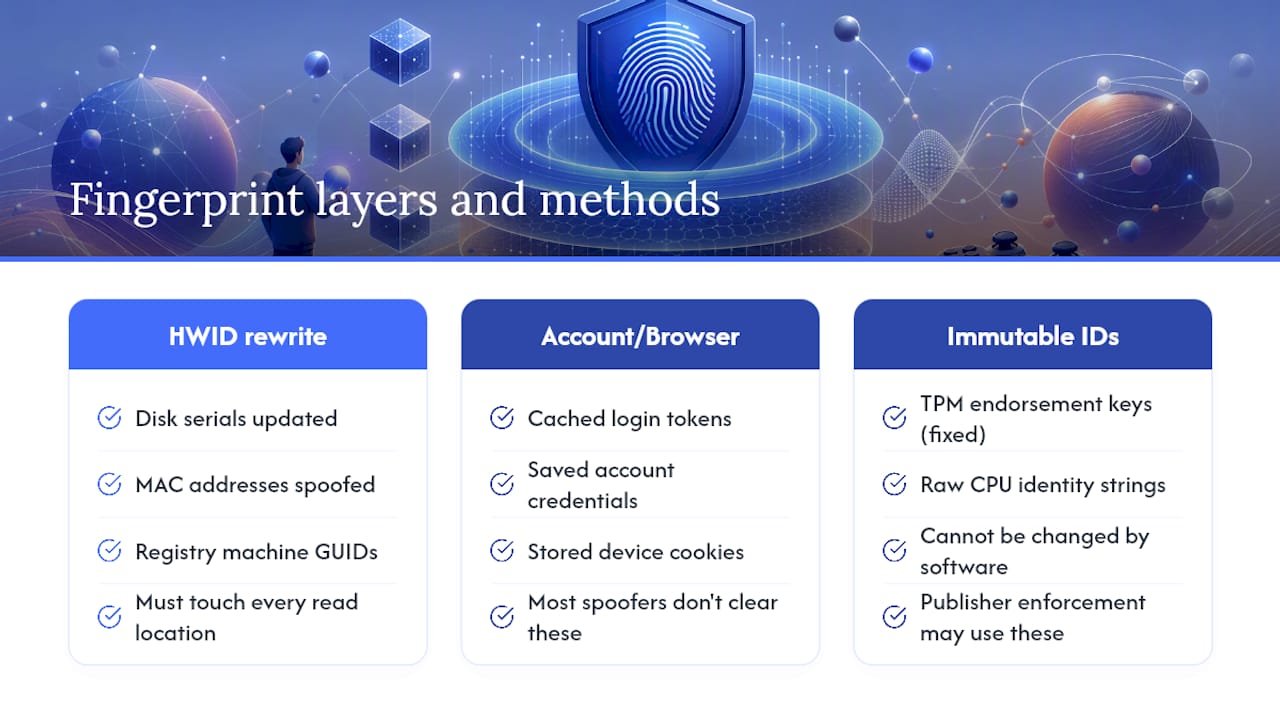
Start with the obvious layer: disk serials, MAC addresses, and registry-stored machine GUIDs. A persistent rewrite handles most of these, but only if it touches every location the game or platform actually reads, not just the ones a basic tool checks by default.
Browser and platform-level fingerprints matter too. Cached login tokens, saved credentials, and stored device cookies tied to your gaming platform account can re-link a "new" machine to an old one faster than any hardware ID. Clear these separately from your spoofing tooling, since most HWID spoofers don't touch browser storage at all.
Immutable identifiers are the wall you can't get around. TPM endorsement keys and raw CPU identity strings are burned into the silicon and don't move, which is why TraceX is blunt about the limit: spoofing changes what software reports, not what's physically true about the chip. If a publisher's enforcement leans on those fixed roots specifically, no software rewrite gets you fully clean.
Secure wiping matters as much as the rewrite itself. Deleted log files and temp directories can still hold traces a forensic scan picks up. Use a proper secure delete pass on anything your mapper or spoofer touched, not a standard file deletion, and randomize service names and file paths between setups so nothing repeats predictably across sessions.
Can a Virtual Machine or Sandbox Reduce Your Ban Risk?
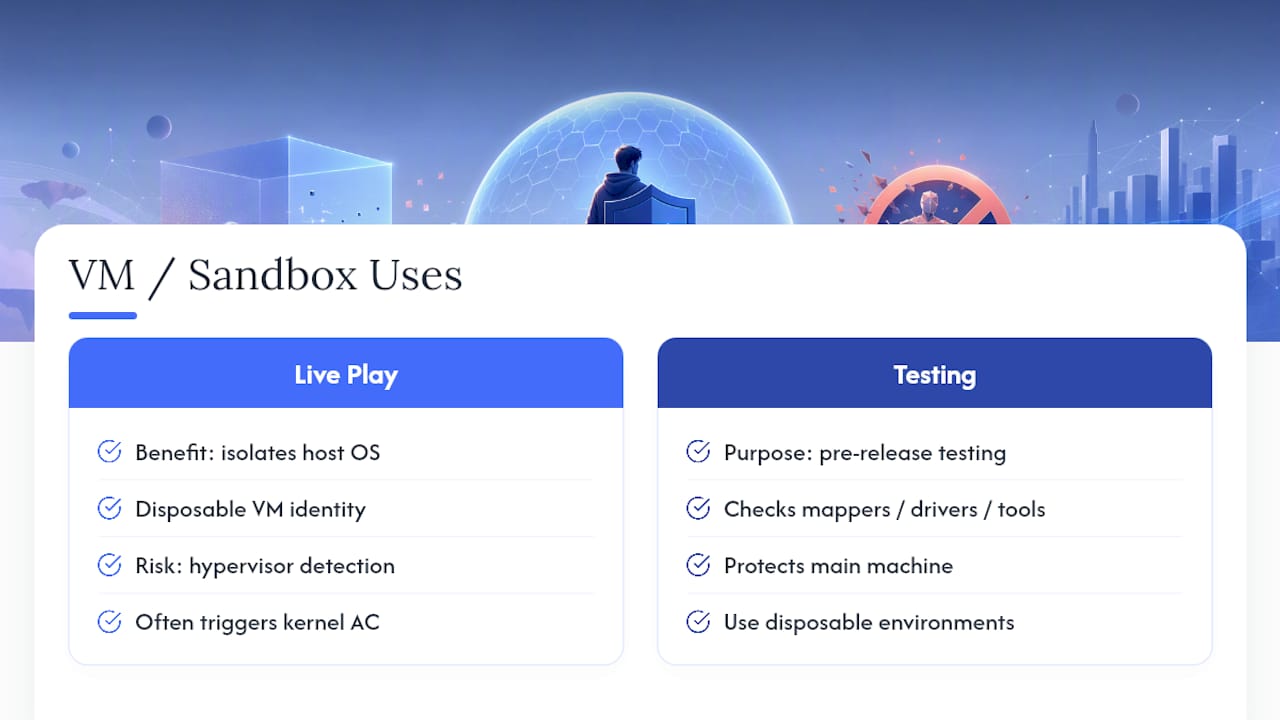
Isolating cheat activity inside a VM sounds like a clean solution on paper, and it does solve real problems: a compromised sandbox environment doesn't touch your daily-driver OS, and a banned VM identity is disposable in a way your main install isn't.
The catch is that most kernel-level anti-cheat is specifically built to detect virtualization. Hypervisor-aware anti-cheat checks for VM-specific CPU flags, timing artifacts, and driver signatures that don't exist on bare metal, and a lot of the tooling that flags spoofers also flags virtual environments by default. Running a cheat inside a VM against a game with kernel-level anti-cheat is often a faster route to detection, not a slower one.
Where sandboxing genuinely helps is testing, not live play. Spin up a disposable environment to test whether a new mapper build loads cleanly, whether a driver conflicts with your host system, or whether a spoofing tool behaves as advertised, all before you ever touch your real gaming setup. That containment protects your main machine from bad drivers and unstable builds without pretending a VM is a shield against detection during actual matches.
If you're going to sandbox anything, sandbox the testing phase and keep live play on bare metal with proper spoofing in place instead.
What Are the Legal Risks Beyond Getting Banned?
A ban is the visible consequence. It's rarely the only one. Most game publishers' terms of service explicitly prohibit third-party software that modifies game memory or client behavior, and violating those terms can trigger account termination across an entire platform ecosystem, not just the specific title you were caught in.
Payment disputes are the quieter risk. Chargebacks tied to a banned account can flag your payment method with the platform provider, occasionally affecting purchases on unrelated accounts tied to the same payment details.
There's also a fairness dimension worth being honest about, separate from any legal exposure. Competitive integrity is the entire premise of ranked and tournament play, and using undetected tooling shifts outcomes for other players who have no visibility into why they lost a close match. That's a real cost even when no ban ever lands.
None of this means the tooling doesn't have legitimate uses, testing anti-cheat robustness, private servers, or single-player modification are common and largely uncontroversial. But deploying cheats on live competitive accounts carries risk that extends past the account itself, and going in with clear eyes about that is part of managing the whole workflow responsibly.
What Actually Stops the Ban Cycle, and What Doesn't
Most advice on this topic treats HWID spoofing as a universal fix, spoof once, ban problem solved. That's backwards. The research is consistent on one point: spoofing changes what your machine reports, not what the publisher already has on file about your account. If your last ban was account-level, driven by a report pattern or a statistical flag, a hardware ID change does nothing. You'll burn a fresh identity fixing a problem that was never hardware in the first place.
The overrated fix is the single toggle. Enabling IOMMU or updating Secure Boot alone won't hold if you're still loading a driver with sloppy hygiene or running behavior a detection model flags in an hour. The underrated fix is sequencing. Getting reboot order, service confirmation, and spoof verification right, every single time, prevents more bans than any premium tool bought without that discipline.
Prioritize diagnosis first, workflow discipline second, and hardware upgrades last. Most players do it backwards, buying new tooling before they've confirmed what actually broke last time.
— Fonics
How Midnight-Market Supports This Workflow With Tested Tools and Live Help
Midnight-Market runs daily testing and QA across its cheat builds specifically because the detection landscape shifts that fast. A tool that passed yesterday's check doesn't get treated as safe today until it's been verified again. That daily cadence is the difference between a build that quietly gets you flagged and one that's actually been checked against current anti-cheat behavior.

Every order comes with instant key delivery, so you're not stuck waiting while a session window closes, and live Discord support means you can walk through the exact pre-flight sequence, spoof verification, and driver hygiene covered above with someone who handles this setup daily, not a support ticket queue. Hardware products carry warranty coverage, which matters given how much of this guide depends on getting IOMMU, firmware, and driver states right the first time. If you're rebuilding a setup after a ban cycle, start at the Midnight-Market store and get the current build for your title plus setup help in the same session, instead of piecing together mismatched tools and troubleshooting alone.
Sources
For deeper troubleshooting, review Riot's HWID ban documentation, the IOMMU bypass catalogue, and Midnight-Market's setup best practices guide.