
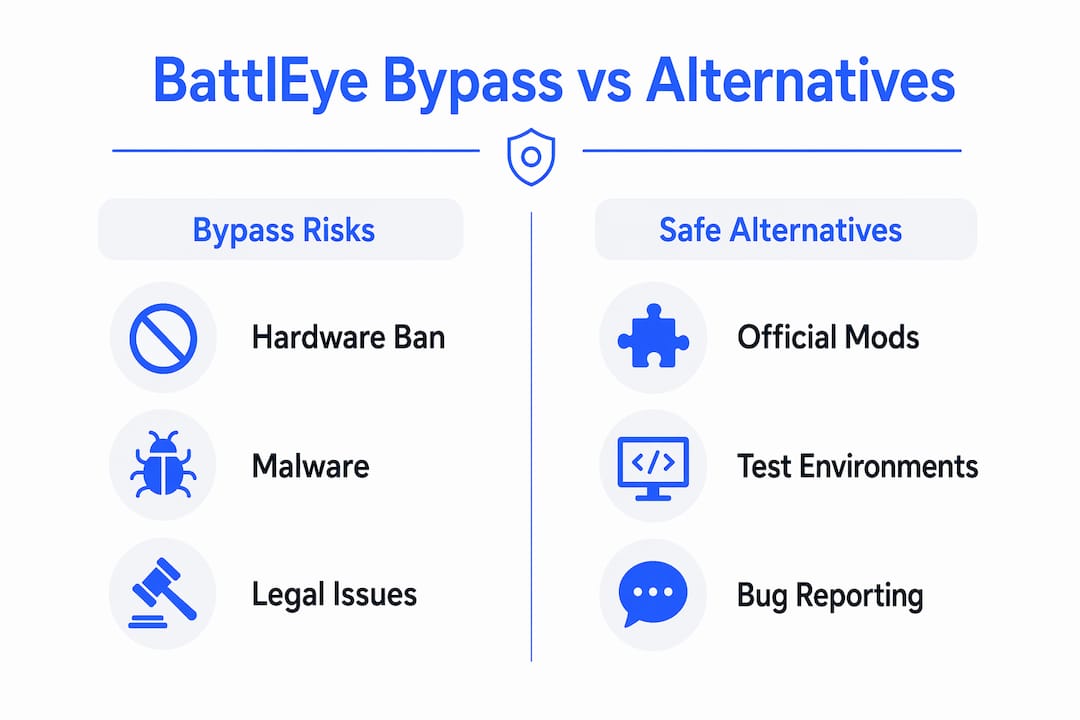
Trying to bypass BattlEye is not worth it for the vast majority of gamers and modders. The short version: public bypass tools get you banned fast, often at the hardware level, and many carry malware. The safer path is single-player modding, official mod APIs, or responsible vulnerability disclosure. If you are already banned, there is an appeal process worth trying before you do anything drastic.
- Permanent HWID bans tie the ban to your machine, not just your account
- Malware risk is high with publicly distributed bypass binaries
- Legal and ToS exposure under U.S. computer fraud statutes and EULA terms is real
- Safe alternatives exist: single-player mods, developer-supported tools, private test servers
Pro Tip: Before trying anything that touches BattlEye, back up your game library receipts and account credentials. If a ban lands, you will want clean documentation for an appeal.
Table of Contents
- How does BattlEye actually work at the kernel level?
- Why do public BattlEye bypass tools fail so quickly?
- What does an HWID ban actually cost you?
- What are the U.S. legal and terms-of-service risks?
- What are the safe alternatives for modding games?
- How do you report a BattlEye vulnerability responsibly?
- What should you do if you think you were wrongly banned?
- Key Takeaways
- The gap between what bypass guides promise and what actually happens
- Midnight-market's tested approach for serious gamers
- Authoritative sources and further reading
How does BattlEye actually work at the kernel level?
BattlEye is a kernel-level anti-cheat that runs three interlocking components. BEService handles server-side communication and certificate verification. BEDaisy.sys is the kernel driver, the piece that operates below the operating system's user layer and monitors everything from process callbacks to memory integrity. BEClient.dll is the user-mode module that interfaces with the game itself.
The kernel driver is where most of the real enforcement happens. BEDaisy registers callbacks through Windows kernel APIs, protecting handles and watching for unauthorized code injection or memory manipulation. It also monitors thread creation, process loading, and driver activity in real time. Getting past it is not a matter of flipping a switch.
"Attempting to remove or disable BattlEye will typically prevent the game from starting or cause immediate disconnection; there is no legitimate 'off' switch for supported games." — secret.club analysis
A few technical realities worth knowing:
- Debugger detection is baked in; attaching a standard debugger to a BattlEye-protected process triggers alerts immediately
- Driver obfuscation makes static analysis difficult; BEDaisy.sys uses runtime-resolved API tables and heavy obfuscation
- VBS and DSE interactions mean that Windows Virtualization-Based Security, now standard on most modern PCs, adds another layer that software-only bypass attempts have to contend with
- Handle protection blocks naive injection attempts at the kernel level before they reach the game process
The practical upshot: BattlEye is not a simple DLL you can rename or a service you can stop. Its kernel integration means any meaningful bypass attempt requires operating at the same privilege level, which is exactly where Windows security features are designed to stop you.
Why do public BattlEye bypass tools fail so quickly?
The core problem with any publicly shared bypass is visibility. The moment a working method gets posted to GitHub, a forum, or a Discord server, anti-cheat developers add its signatures to their detection database. Public bypass tools become ban magnets almost immediately after release, because BattlEye's update cycle is fast enough to catch known code within days.
"Security researchers emphasize the constant 'cat and mouse' dynamic: a bypass that works today may be patched by the next anti-cheat update; public tools are therefore short-lived and high-risk." — Reversing BEDaisy.sys
There are also structural reasons public tools break fast:
- Signature scanning catches known binary patterns; past public bypasses relied on detectable heuristics like file-size checks that BattlEye patched quickly
- Driver integrity checks mean that bypass POCs requiring DSE disabling or pre-loaded unsigned drivers are system-invasive and conspicuous
- Callback table manipulation (targeting ObRegisterCallbacks or PspLoadImageNotifyRoutine) often crashes the game or triggers detection if the implementation is off by even a small margin
- Community kernel driver projects on GitHub require constant maintenance; defenders adapt quickly and the projects fall behind within weeks
Then there is the malware problem. A bypass binary distributed publicly has no chain of custody. You have no way to verify what else is bundled with it. Backdoors, keyloggers, and crypto miners have all been documented in publicly shared cheat tools. The obfuscation and detection-evasion techniques that make a bypass hard for BattlEye to catch also make it hard for your antivirus to catch.
Pro Tip: Never run an unsigned binary from an anonymous repository on your main gaming machine. If you want to test something, use an isolated VM with no access to your primary accounts or payment credentials.
What does an HWID ban actually cost you?
A hardware ID ban is categorically different from an account ban. When BattlEye flags your hardware identifiers, creating a new account on the same machine often triggers an immediate re-ban because the hardware fingerprint is already in the detection database. The ban follows the machine, not the login.
What gets flagged typically includes motherboard serials, disk drive identifiers, network adapter MACs, and GPU identifiers. Changing one is not enough; BattlEye cross-references multiple identifiers. If you want to understand the full scope of what an HWID ban means for your setup, the breakdown at first-time HWID ban guide covers the specifics in detail.
The practical costs stack up fast:
- Lost game licenses on the banned account, including DLC and in-game purchases, are not refunded
- Progress wipe means ranked placements, unlocked cosmetics, and campaign saves are gone
- Hardware remediation is complex; spoofing every relevant identifier correctly requires tools that themselves carry detection risk if sourced from untrusted vendors
- Time cost of rebuilding an account from scratch, including ranked grind and unlocks, can represent hundreds of hours
The re-ban timeline for a naive new account on banned hardware is often measured in minutes, not days. BattlEye's detection runs at game launch, so the window between creating a new account and getting flagged again is extremely short without a clean hardware profile.
What are the U.S. legal and terms-of-service risks?
The ToS consequences are the most immediate risk. Every major game publisher's EULA explicitly prohibits modifying game files, injecting code, or using third-party software to gain advantages. Violating those terms gives the publisher grounds to terminate your account and keep every dollar you spent on it. There is no consumer-protection carve-out for digital purchases lost to a ToS ban in most U.S. states.
Beyond ToS, the Computer Fraud and Abuse Act (CFAA) is the relevant U.S. federal statute. The CFAA broadly prohibits unauthorized access to computer systems, and courts have interpreted "unauthorized access" expansively. Distributing bypass tools or using them in ways that affect other users' experience has been the basis for civil suits by game publishers. Criminal exposure under the CFAA is generally reserved for cases involving financial harm or distribution at scale, but civil liability is a real risk even for individual users.
"EULA violations can result in account termination, loss of digital purchases, and civil remedies — and U.S. courts have consistently upheld publisher rights to enforce these terms." — general legal consensus reflected in published EULA enforcement cases
Additional marketplace risks:
- Platform enforcement (Steam, Epic, Xbox) can extend bans across linked accounts and payment methods
- Chargeback attempts after a ban rarely succeed and can result in payment processor flags
- Third-party service suspensions tied to your email or payment identity can follow a high-profile ban
This article is general information, not legal advice. For questions about your specific situation, consult a qualified attorney familiar with U.S. computer law.
What are the safe alternatives for modding games?
The good news is that a lot of what modders actually want, whether that is custom visuals, gameplay tweaks, or testing new mechanics, is achievable without touching BattlEye at all.
Legitimate modding approaches:
- Single-player mode or offline play — Many BattlEye-protected games have an offline or single-player component where anti-cheat is not active. Mods applied there carry no ban risk.
- Developer-supported mod tools — Games like Arma 3 and DayZ have official modding SDKs. Mods built through these tools are explicitly permitted and often have their own workshop distribution.
- Private servers — Some titles allow community-hosted servers where server operators control which mods run. This is the legitimate path for multiplayer modding.
- Official APIs and scripting layers — Where a game exposes a scripting API (Lua, Python, or a proprietary scripting layer), using it is always safer than binary injection.
For hardware-based approaches: DMA (Direct Memory Access) hardware operates outside the game process entirely, which is why it is used differently from software injection. Understanding how hardware cheat devices work is worth doing before you invest in any hardware solution, because setup and compliance details matter.
Do and don't checklist for modders:
- ✅ Test mods in single-player or offline modes first
- ✅ Use developer-provided mod tools and APIs
- ✅ Check the game's official modding policy before distributing anything
- ✅ Use sandboxed or virtual environments for experimental testing
- ❌ Do not inject unsigned DLLs into a running BattlEye-protected process
- ❌ Do not use public bypass repositories for multiplayer sessions
- ❌ Do not disable Windows security features (VBS, DSE) on your main machine
Pro Tip: Set up a dedicated test machine or VM for any experimental modding work. Keeping it separate from your main gaming account means a mistake there does not cost you your primary library.

How do you report a BattlEye vulnerability responsibly?
If you have found a genuine security gap in BattlEye or a game's anti-cheat implementation, responsible disclosure is the right move. It protects you legally and actually improves the ecosystem.
- Document the issue reproducibly. Capture logs, screenshots, and a clear description of what triggers the behavior. Do not include working exploit code in your initial notes.
- Find the vendor's security contact. BattlEye's parent company, Battleye Innovations, has contact information on their official site. Game publishers often have a dedicated security disclosure email or a HackerOne/Bugcrowd program.
- Submit through private channels. Email or a bug-bounty platform submission keeps the details out of public view until a patch is ready.
- Follow coordinated disclosure timelines. The standard is 90 days from initial contact before public disclosure, giving the vendor time to patch. If they are unresponsive, document your attempts.
- Do not publish exploit details or distribute bypass tools while the issue is unpatched. Doing so removes your good-faith protection and creates legal exposure.
What to include in a report:
- Game version and operating system details
- Reproducible steps (without working exploit code)
- Logs or crash dumps if available
- Your contact information for follow-up
Bug-bounty programs exist for some publishers. Even where no formal program exists, documented good-faith disclosure has historically been treated favorably compared to public posting.
What should you do if you think you were wrongly banned?
A wrongful ban is frustrating, but the appeal process is the only legitimate path. Here is the order of operations:
- Gather your account details. Transaction receipts, account creation date, and any in-game purchase history all strengthen an appeal.
- Screenshot or export your ban notification. The exact wording and timestamp matter.
- Contact publisher support directly. Most publishers have a dedicated ban appeal form. Submit a clear, factual timeline: when you last played, what you were doing, and why you believe the ban was in error.
- Include any relevant logs. Some publishers accept Windows Event Viewer logs or game client logs as supporting evidence.
- Wait for the response before escalating. Most publishers have a stated review window of 7–14 days.
What not to do while an appeal is pending:
- ❌ Do not use an HWID spoofer from an unknown source — it can compound the ban and undermine your appeal
- ❌ Do not create new accounts on the same hardware before the appeal resolves
- ❌ Do not post publicly about the ban in ways that could be read as admitting to rule violations
- ❌ Do not run public bypass tools; a second detection during an active appeal will almost certainly close it
For account hygiene practices that reduce the risk of future flags, maintaining a clean account covers the practical steps in detail.
When to escalate: If the publisher denies your appeal and you believe you have a strong case, contact the platform marketplace (Steam, Epic, PlayStation Store) with your purchase receipts. For disputed charges, your payment provider's dispute process is a last resort, though it rarely reverses a ban decision.
Key Takeaways
Attempting a BattlEye bypass carries permanent hardware bans, malware risk, and U.S. legal exposure that far outweigh any short-term gain for most gamers and modders.
| Point | Details |
|---|---|
| Public bypass tools fail fast | Signatures get added within days; public tools become ban magnets almost immediately after release. |
| HWID bans follow the machine | Creating a new account on banned hardware triggers rapid re-detection; hardware remediation is complex and risky. |
| U.S. legal exposure is real | CFAA civil liability and EULA enforcement can mean lost purchases and potential legal action, not just a ban. |
| Safe modding alternatives exist | Single-player mods, official mod APIs, and private servers let you modify games without touching anti-cheat. |
| Midnight-market offers daily-tested solutions | For gamers who want reliable, detection-aware tools, Midnight-market tests products daily and provides live Discord support. |
The gap between what bypass guides promise and what actually happens
Most bypass tutorials online are written by people who got lucky once, then never updated the guide after BattlEye patched it. The gap between "this worked in a YouTube video" and "this works on your account today" is enormous, and it is a gap that costs real money.
What the conventional wisdom gets wrong is the assumption that the risk is primarily technical. The technical failure rate of public bypass tools is high, yes. But the more consequential risk is the one that hits before you even know the tool failed: the HWID ban that lands silently, the malware that runs in the background, the CFAA exposure that most people do not think about until a publisher's legal team does.
The modding community has genuinely good options that do not require any of this. Single-player environments, official SDKs, and private servers cover most of what modders actually want to do. The people who end up in the bypass rabbit hole are usually looking for a multiplayer edge, not a modding tool, and that is a different conversation with different stakes.
If you are in the modding camp, the official tools are better than they used to be. If you are in the competitive-edge camp, the risk calculus has shifted significantly as kernel-level anti-cheat has matured. The tools that actually stay undetected are not the ones posted publicly.
Midnight-market's tested approach for serious gamers
If you have read this far, you know the public bypass route is a fast path to a hardware ban and a compromised machine. Midnight-market exists for gamers who want a real competitive edge without the roulette of untested public tools.
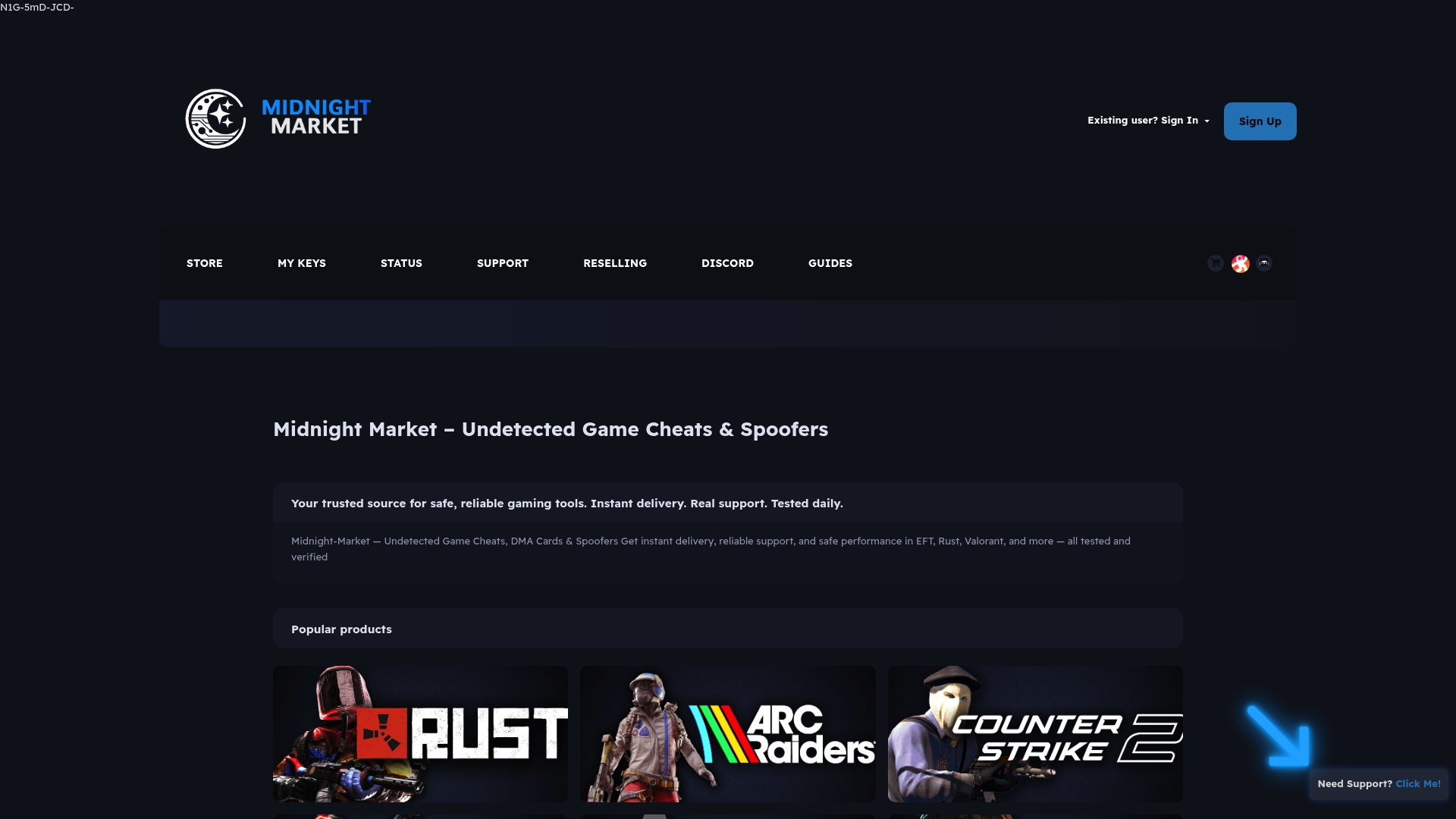
Every product in the Midnight-market catalog is tested daily against live detection environments, including BattlEye-protected titles like Escape from Tarkov and Valorant. That is not a marketing claim; it is the operational model. When a detection update drops, the team identifies it and updates the product before most users ever see a ban. Hardware solutions like Valorant DMA cheats operate outside the game process entirely, which is a fundamentally different risk profile from software injection. Live Discord support means you are not troubleshooting alone at 2 AM. Browse the full catalog at Midnight-market's store and see what daily-tested actually looks like in practice.
Authoritative sources and further reading
These are the primary sources used in this article. Each one is worth reading if you want technical depth or need to navigate the official appeal process.
- Battling The Eye: Exploring the Anti-Cheat Techniques of BattlEye (ACM) — Peer-reviewed academic analysis of BattlEye's architecture, detection methods, and bypass research. The most authoritative technical source available on how the system actually works.
- Reversing BEDaisy.sys: Static Analysis of BattlEye's Kernel Anti-Cheat Driver — Detailed static analysis of the kernel driver, covering obfuscation, callback registration, and HWID-linked ban behavior. Useful for understanding why public tools break quickly.
- BattlEye Anti-Cheat: Analysis and Mitigation (secret.club) — Security research covering BattlEye's integration depth, startup dependencies, and how public bypass tools become detectable. Explains the ban-magnet dynamic clearly.
- Publisher support pages — For ban appeals, go directly to the support portal of the game's publisher (Ubisoft, Bohemia Interactive, Battlestate Games, etc.). Each has a dedicated ban appeal form; links are on their official support sites.
- BattlEye official site (battleye.com) — Lists supported games and provides contact information for security disclosures. The starting point for responsible vulnerability reporting.
This article is general information only. For legal questions about your specific situation, consult a qualified attorney. For ban appeals, use official publisher support channels.