Crypto is the standard for pseudonymous cheat purchases, virtual credit cards protect your bank details from merchant breaches, and cash-bought prepaid cards work best for anonymous in-person buys. Each comes with a catch: crypto transfers cannot be reversed once confirmed, and virtual card providers still run their own identity checks. Before you check out anywhere, do two things right now:
- Send a tiny test payment first, whatever method you use, to confirm the address or card actually works.
- Turn on a VPN and set up a burner email or phone number before you touch the checkout page.
Canadian consumer guidance is blunt about the tradeoff: digital currency transactions are pseudonymous but permanent once the blockchain confirms them. There's no chargeback, no dispute form, no customer service line that undoes a mistyped address. That single fact should shape every payment decision you make for cheats, spoolers, or DMA hardware.
Key Takeaways
Secure payment for cheats depends on matching the payment method to the purchase, verifying the seller before sending money, and protecting the download and keys afterward.
| Point | Details |
|---|---|
| Match method to purchase | Use VCCs for small digital keys and cold wallet crypto or privacy coins for high-value hardware. |
| Test before committing | Send a small test transaction or verify a VCC works before paying the full amount. |
| Layer anonymity tools | Combine a VPN, burner email/phone, and cash-bought prepaid cards to reduce your trail. |
| Vet the seller first | Check for live support, clear pricing, and proof of prior deliveries before paying anyone. |
| Secure everything after payment | Store keys encrypted, verify checksums, scan for malware, and keep hardware warranty proof separate. |
| Choose a supported vendor | Midnight-market pairs daily-tested products with live Discord support and hardware warranties, reducing the risk unsupported sellers leave entirely on you. |
Table of Contents
- Secure Payment For Cheats: Comparing Your Options
- How Do You Send Crypto Without Losing Money?
- Staying Anonymous During Checkout and Delivery
- What Are the Warning Signs of a Cheat Scam?
- Securing Your Keys and Verifying Downloads After You Pay
- Why Vendor Transparency Matters for Buyer Safety
- The Real Tradeoff Nobody Explains Clearly Enough
- Get Cheats and Hardware From a Vendor That Actually Backs Them Up
- Sources
Secure Payment For Cheats: Comparing Your Options
No single payment method wins across every scenario. Small value digital keys and high-value DMA cards demand different levels of caution, and the right choice depends on what you're buying and how much traceability you can tolerate.
Cryptocurrency gives you the strongest pseudonymity of the group, but "pseudonymous" isn't the same as anonymous. Bitcoin and Ethereum run on transparent ledgers, meaning anyone with the right tools can trace a wallet's transaction history. Privacy coins like Monero obscure sender, receiver, and amount by design, which is why they've become the default choice for buyers who actually want to break the trail rather than just hide behind a wallet address. Custody matters too: a hot wallet on your phone is convenient but exposed to malware, while a cold wallet keeps your keys offline and dramatically cuts theft risk for anything beyond small, routine purchases.

Virtual credit cards mask your real card number from the merchant, so a data breach on the seller's end doesn't expose your actual bank account. The catch is that VCC providers still collect your identity during signup and enforce their own KYC limits, so you're trading merchant-side risk for provider-side data collection. They work well for smaller digital key purchases where speed matters more than total anonymity.
Prepaid and gift cards bought with cash are close to untraceable at the point of purchase, but they come with real limits: activation caps, regional restrictions, and some sellers won't accept them for high-value hardware.
Quick guidance:
- Small digital keys: VCC or a mainstream crypto with a small test transfer.
- High-value hardware or bundles: cold wallet crypto or a privacy coin, given the irreversible nature of the payment.
- One-off, low-stakes buys: cash-bought prepaid cards.
How Do You Send Crypto Without Losing Money?
Most crypto losses in this space come from typos, not hacks. A wrong character in an address sends funds to a stranger's wallet permanently, and there's no support ticket that gets it back.
- Use self-custody where possible. Keeping coins in your own wallet instead of an exchange account limits your exposure if that exchange gets breached.
- Copy and paste every address. Never type one manually. Kraken's own security guidance recommends copying addresses and sending a small test transaction first before committing the full amount.
- Confirm chain and coin compatibility. Sending an ERC20 token to a wallet expecting a different network standard can strand your funds.
- Account for fees and congestion. Network fees spike during high traffic periods, so check current conditions before sending anything time-sensitive.
- Enable 2FA and set withdrawal whitelists on any exchange account you use, and store your seed phrase offline where no screenshot or cloud backup can leak it.
Pro Tip: Keep a small "test" balance in your hot wallet specifically for verifying new addresses, and move everything else into cold storage between purchases.
Staying Anonymous During Checkout and Delivery
Payment method is only half the equation. What you do around the transaction, browser, contact info, and delivery address, determines how traceable the whole purchase really is.
- Run a paid VPN and a private browser session for the entire checkout process, and avoid installing anything on your primary phone just to complete a purchase.
- Set up a burner email and a temporary phone number for order confirmations and support tickets.
- For hardware shipments, a parcel locker or PO box keeps your home address out of shipping records.
- Buy prepaid or gift cards with cash at a store rather than online, since card-linked purchases create a paper trail back to you.
None of this makes you invisible. Store CCTV, card activation logs, and delivery carrier records all still exist. The Cybernews guide to anonymous payment methods makes the same point: layered privacy tools reduce exposure, they don't eliminate it.
Pro Tip: Treat your burner contact info as disposable. Once a purchase and its support window are closed, retire the email and number rather than reusing them for the next order.
What Are the Warning Signs of a Cheat Scam?
Scam sellers in this market follow a predictable pattern, and most of it shows up before you ever pay.
- Pricing that's too good. A cheat priced at a fraction of what every established seller charges is almost always a stolen key, a leaked build, or a straight-up scam.
- Insistence on personal wallet transfers instead of a proper checkout system, with no invoice and no order record.
- No verifiable support channel. If there's no Discord, no documented warranty terms, and no way to reach a human before you pay, that's a red flag worth walking away from.
- No proof of prior deliveries or working keys when you ask for one.
Before paying anything beyond a small test amount, ask for an invoice, request confirmation of a checksum for the download, and verify the seller has a track record you can actually check. If you do get scammed, save every screenshot, receipt, and message immediately. Crypto payments offer essentially no recourse once confirmed, and formal reporting options for cross-border digital scams are limited and slow.
Securing Your Keys and Verifying Downloads After You Pay
The payment isn't the finish line. A clean transaction followed by a corrupted or backdoored download undoes all the caution you just took.
- Store invoices and license keys in an encrypted password manager rather than a plain text file or email inbox.
- Verify every download against its published SHA-256 checksum, and scan it with updated antivirus before running anything.
- For hardware, photograph the box and serial number, and keep that documentation separate from your main identity records.
- Run new binaries on an isolated machine or a wiped virtual machine before touching your main setup, and use a burner support channel for troubleshooting.
Our hack download guide walks through checksum verification step by step if you want the full process.
Pro Tip: Keep transaction proof in the same encrypted folder as your license keys. If you ever need a warranty claim, having both ready saves you a support back-and-forth.
Why Vendor Transparency Matters for Buyer Safety
Anonymous sellers with no support history put the entire risk on you. Midnight-market's model closes that gap with a handful of concrete signals:
- Daily testing across supported titles, so what you buy reflects the current detection landscape, not last month's.
- Instant delivery with no waiting period that leaves you guessing.
- Live Discord support for real-time troubleshooting instead of a ticket queue.
- Hardware warranties on DMA products, covering you if a unit fails outside normal use.
- An active user community that surfaces problems fast when something breaks.
Vendors that publish clear pricing and checksum-verifiable downloads cut buyer risk dramatically compared with anonymous sellers who refuse to provide either. For more on picking vendors that hold up over time, see our guide on finding consistently working cheats.
The Real Tradeoff Nobody Explains Clearly Enough
Most guides on this topic treat anonymity as the only variable that matters. It isn't. The bigger risk for most buyers isn't getting identified, it's getting scammed by a seller who never had a working product to begin with. A perfectly anonymous crypto payment sent to a seller with no support channel and no track record is just an untraceable way to lose your money.
The conventional advice, "use Monero, use a VPN, done," skips the step that actually protects you: verifying the seller before the payment method even matters. A test transaction only helps if there's a legitimate product waiting on the other end. File checksums only matter if the download is real software rather than a wrapper for malware.
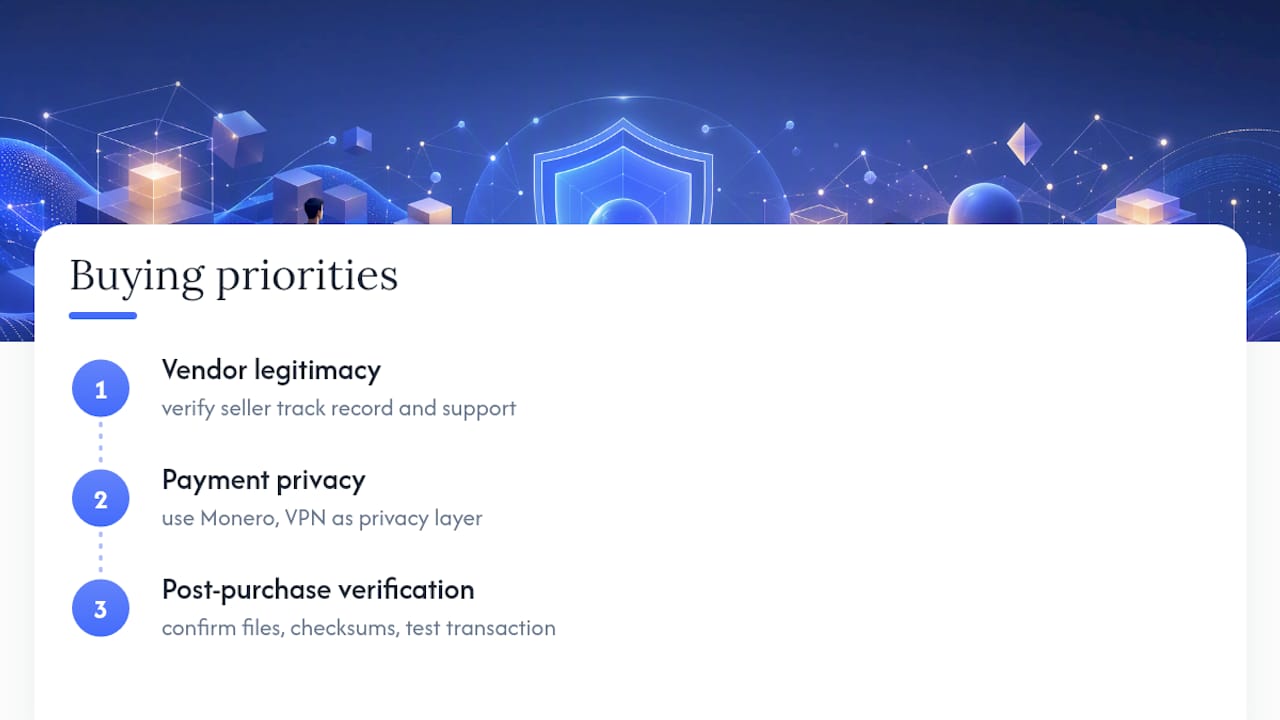
Prioritize in this order: vendor legitimacy first, payment privacy second, post-purchase verification third. Anonymity tools are worth using, but they're a layer on top of a good decision, not a substitute for one. Buyers who skip straight to privacy tactics and skip the vetting step are the ones who end up with a wallet address they can't trace and a product that never existed.
— Fonics
Get Cheats and Hardware From a Vendor That Actually Backs Them Up
Midnight-market is the direct alternative to anonymous, unsupported sellers for cheats, spoofers, and DMA hardware. You get daily-tested products, instant key delivery, live Discord support, and hardware warranties on top, so the vetting work this guide just walked you through is already built into the vendor relationship instead of resting entirely on you.
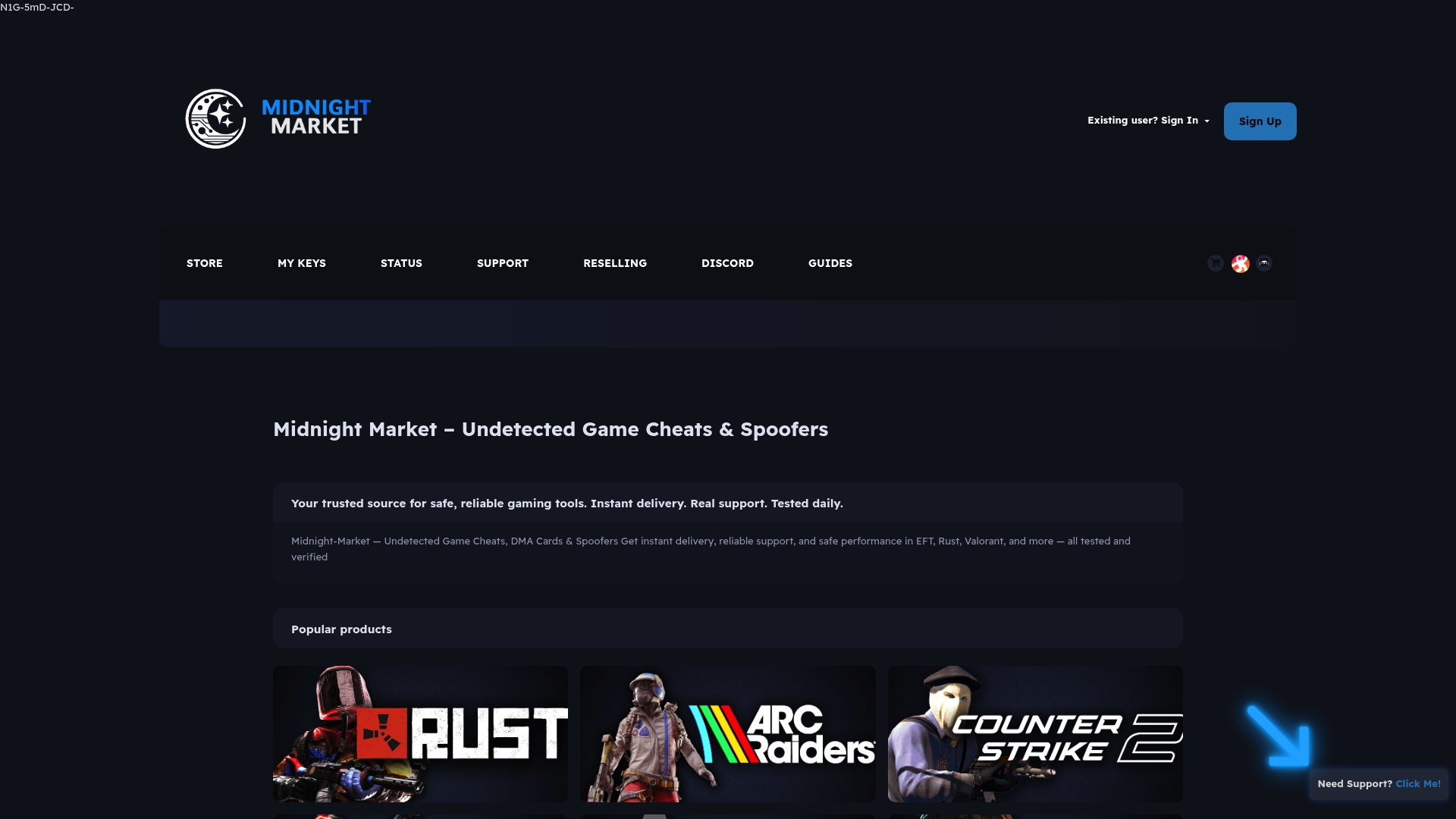
Every product listing includes clear pricing and support documentation before you commit to a payment method. Browse the full store lineup to see current cheats and bundles, or check the Godlike 10th Gen Fuser if you're weighing DMA hardware backed by an actual warranty. Pick a product, follow the payment steps above, and you'll have a supported purchase instead of a gamble.
Sources
- Digital currency — Financial Consumer Agency of Canada
- How to safely send and receive cryptocurrency — Kraken Learn
- The ultimate guide to safe and anonymous online payment methods — Cybernews
- How does cryptocurrency work — Coursera article