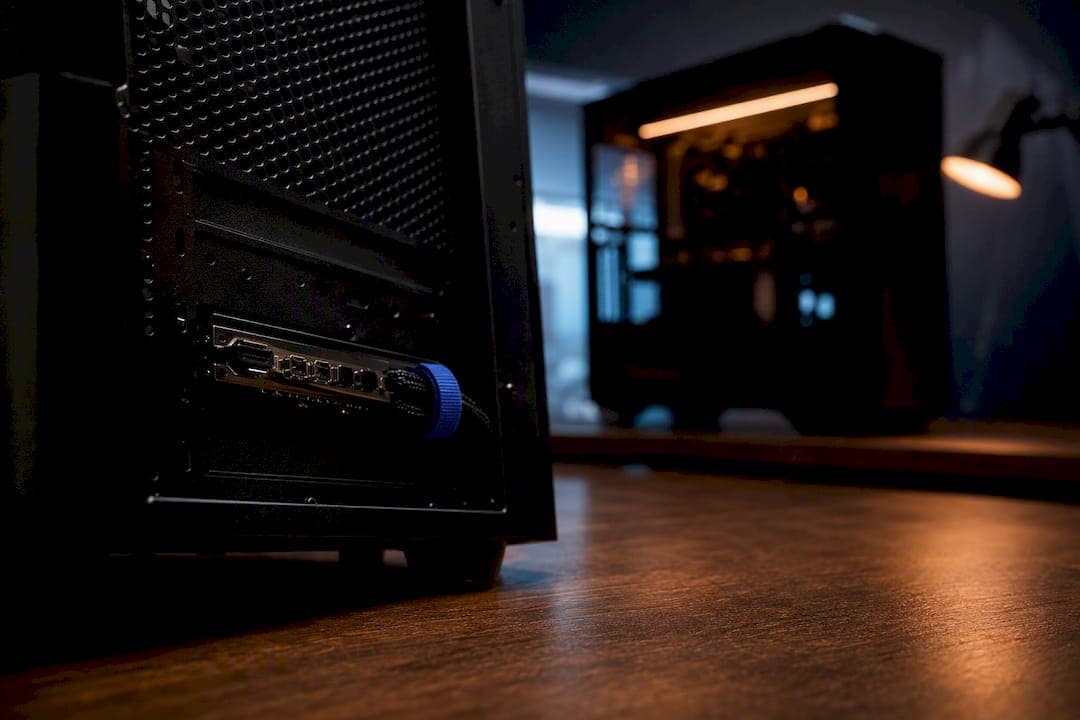
DMA cheats are no longer a reliable path to undetected aim assistance in Valorant. Riot's Vanguard update now enforces IOMMU, Secure Boot, TPM 2.0, VBS, and HVCI at the platform level, and those checks interfere directly with DMA firmware. The practical result: ban waves, disabled devices, and a hardware investment that can exceed $6,000 with no guarantee it survives the next patch.
TL;DR:
- Enabling platform security features like IOMMU, Secure Boot, TPM 2.0, VBS, and HVCI blocks DMA cheat firmware from functioning properly and risks hardware failure.
- The cost of high-end DMA setups can exceed $6,000, with ongoing expenses for firmware updates and the risk of hardware becoming unusable for Valorant.
- Modern anti-cheat now detects DMA devices through firmware-state checks, fault logging, and behavioral telemetry, making undetectable setups highly unreliable.
- Riot's enforcement often results in device bricks and permanent account bans, with hardware often irreparably damaged for Valorant but potentially recoverable for other uses.
- Platforms pushing for advanced security features suggest DMA cheating will become an increasingly shrinking niche due to higher costs and platform-level detection.
Table of Contents
- How Do Valorant DMA Cheats Actually Work?
- What Vanguard Changed: IOMMU, Secure Boot, TPM, and HVCI Explained
- Is There Real Evidence DMA Devices Are Getting Disabled?
- What Does a DMA Setup Actually Cost, and Is It Worth It?
- How Does Anti-Cheat Actually Detect DMA Devices?
- What Happens If Vanguard Catches a DMA Setup?
- What Does Midnight Market Test and Support Right Now?
- Is Using DMA Cheats Actually Legal?
- DMA Cheats vs. Software Cheats: What's the Real Difference?
- Could Future Tech Make DMA Viable Again?
- How Has the Community Responded to DMA Cheating?
- Why the "Undetectable DMA" Myth Needed to Die
- Where to Go From Here for Tested Valorant Cheats
- Sources
How Do Valorant DMA Cheats Actually Work?
Direct Memory Access cheating never touches the game's process the way a typical software hack does. That's the entire pitch, and it's why DMA earned a reputation as the "unbeatable" method for years.
A DMA setup reads your PC's memory from an external device rather than injecting code into Valorant's process space. Here's the physical chain most setups follow:
- A PCIe DMA card (commonly a Squirrel or similar FPGA based board) plugs into your gaming PC and reads memory directly over the PCIe bus.
- A second PC receives that memory data and runs the actual cheat logic, aimbot calculations, and ESP rendering, completely isolated from the machine you're playing on.
- A KMBox or similar input emulator translates aim adjustments into mouse and keyboard signals that look like real hardware input rather than software-injected commands.
- Custom firmware flashed onto the DMA card is the piece that decides whether the whole setup gets flagged, since it controls how the card identifies itself and behaves on the bus.
That firmware is the single most important variable. Generic or off-the-shelf firmware behaves predictably, and predictable behavior is exactly what anti-cheat engines learn to fingerprint. A technical breakdown of DMA cheat architecture notes that because reads happen externally, on hardware Valorant's process never touches, DMA setups historically avoided the injection signatures that catch software cheats. That's precisely the gap Vanguard's newer checks were built to close.
What Vanguard Changed: IOMMU, Secure Boot, TPM, and HVCI Explained
Riot didn't patch around DMA. It changed the platform requirements for playing Valorant at all, and that shift is the real story behind the "possible" question.
According to Riot's own Vanguard security requirements, the game now requires several Windows security features to be active before it will even launch:
- IOMMU (Input Output Memory Management Unit): a chipset-level feature that governs which devices can access which parts of system memory, instead of letting any PCIe device read anything it wants.
- Secure Boot: verifies that only trusted, signed code runs during startup, which closes off a common path attackers used to load unsigned drivers early.
- TPM 2.0 (Trusted Platform Module): a hardware chip that stores cryptographic keys and helps the OS confirm the machine's boot state hasn't been tampered with.
- VBS (Virtualization Based Security): isolates sensitive OS processes inside a virtualized container, walling them off from kernel-level manipulation.
- HVCI (Hypervisor Protected Code Integrity): checks that every driver loaded into the kernel is properly signed, which directly targets the kind of custom firmware drivers DMA cheats depend on.
IOMMU is the one doing the most damage to DMA effectiveness. It restricts a PCIe card's memory access to only the regions it's explicitly permitted to touch. When a DMA card's firmware tries to read outside those boundaries, the system throws repeated page faults, and analysis of the update shows those faults can corrupt or destabilize the firmware itself rather than simply blocking the read.
Vanguard's policy is blunt about it: these features must be enabled to run the game, and Riot reserves the right to flag accounts and configurations that look like they're working around them. A complementary breakdown of how Vanguard operates covers how deep the kernel-level driver actually sits in your system to enforce this.
Is There Real Evidence DMA Devices Are Getting Disabled?
This isn't theoretical. Public reporting over the past patch cycles shows Vanguard's enforcement actually breaking hardware in the field, not just blocking it in principle.
Multiple outlets covered players losing functional use of their DMA cards after the update rolled out. Riot's own social messaging leaned into the moment, and coverage of the fallout describes setups worth thousands of dollars getting reduced to unusable "paperweights" for Valorant specifically.
Community reporting adds texture, though it comes with caveats:
- Forum and social posts describe DMA cards that stopped functioning correctly the moment Vanguard's updated checks went live.
- Several threads report account bans landing shortly after IOMMU related crashes or freezes during matches, consistent with the enforcement pattern Riot described.
- Public claims about exact ban counts or device failure rates aren't independently verified, so treat viral screenshots as anecdotal rather than confirmed statistics.
One nuance matters here: the hardware itself often isn't permanently destroyed. Reporting on the Vanguard update's effect on DMA firmware indicates the cards can sometimes be restored or reflashed for use outside Riot's ecosystem. They just stop working for Valorant, Riot's League of Legends, or anything else Vanguard protects, which for most buyers defeats the entire purpose of owning one.
What Does a DMA Setup Actually Cost, and Is It Worth It?
The math on DMA has always been rough for the average player, and Vanguard made it worse. Here's a realistic breakdown of what a premium setup runs, based on current component and service pricing:
Add it up and a full premium build regularly clears $6,000 once you count the second PC, card, input emulator, and firmware together.
That number doesn't include ongoing maintenance. DMA setups need per-game firmware updates as anti-cheat engines evolve, and each update carries retesting overhead. Worse, firmware architecture research points out that widely shared firmware creates a detection shortcut: if hundreds of users run identical or near-identical firmware, anti-cheat only needs to flag that signature once to catch all of them in the same sweep.
For most competitive players, the arithmetic doesn't work. You're paying thousands of dollars for a system whose core advantage, invisibility, has been directly targeted by the platform requirements you now have to enable just to launch the game.
How Does Anti-Cheat Actually Detect DMA Devices?
Detection has moved well past scanning a process list. Modern anti-cheat treats DMA as a hardware and behavioral problem, not just a software one, and that shift is why "undetectable" claims from cheat sellers age so fast.
Three signal categories matter most:
- Firmware-state and device-identity checks: Vanguard can verify what a PCIe device claims to be against how it actually behaves, catching mismatches that generic firmware produces.
- IOMMU-generated fault logging: repeated page faults from a device reaching outside its permitted memory range are themselves a forensic signal, and technical reporting on the update confirms this pattern shows up before a device fails outright.
- Behavioral telemetry: statistically improbable reaction times, tracking precision, or flick patterns get cross-referenced against known cheat profiles, a method industry analysis describes as a deliberate move away from single-sensor detection.
Security researchers interviewed on the topic describe this as an arms race that's shifted from hiding a process to defeating platform-level attestation entirely, a much harder problem for cheat developers to solve, according to commentary on Riot's anti-cheat strategy. A deeper look at how detection systems flag hardware covers how these signals get correlated in practice.
Pro Tip: Firmware uniqueness matters more than firmware quality. A cheat that works flawlessly but shares its firmware fingerprint with thousands of other buyers is statistically easier to catch in a single ban wave than a mediocre cheat running one-of-a-kind code.
What Happens If Vanguard Catches a DMA Setup?
The consequences go beyond a single ban, and they hit at both the account and hardware level.
- Account and competitive consequences: a Vanguard flag typically means a permanent ban, and any ranked or tournament progress tied to that account is gone, along with any reputation built in a competitive scene where bans get noticed.
- Device-level consequences: IOMMU-triggered faults can leave a DMA card unusable specifically for Vanguard protected titles. The card usually isn't physically destroyed, but reports of it becoming a "brick" for Valorant purposes are consistent with what enforcement is designed to do.
- The trade-off that matters: thousands of dollars and hours of setup time, against a near-certain eventual ban and a device that stops working for the game you bought it for.
If the goal is genuinely climbing rank, structured practice, VOD review, or coaching tends to move a player's actual skill further than a cheat that has a shelf life measured in patches.
What Does Midnight Market Test and Support Right Now?
Certain cheat providers run daily testing on their Valorant products, including titles like Evo and Sensory, specifically because anti-cheat updates like Vanguard's IOMMU enforcement change the risk profile overnight. That daily cycle is the operational answer to a problem this article has spent several sections describing: firmware that worked yesterday can get flagged today.
Here's what that support structure actually includes:
- Daily detection testing across supported titles, refreshed as anti-cheat behavior changes.
- Live Discord support for setup questions, troubleshooting, and real-time status updates when a game patches.
- Hardware warranties covering DMA products against defects and certain failure scenarios.
- A product lineup that spans Valorant options like Evo and Sensory, alongside titles like Nightfall and Eden Arc for other games.
None of this changes the underlying physics. Daily testing and responsive support reduce operational risk and shorten the gap between an anti-cheat update and a fix, but no provider can promise permanent invisibility against a security model built around IOMMU and platform attestation. Riot controls the checkpoint, and every vendor is reacting to it.
Is Using DMA Cheats Actually Legal?
DMA cheating sits in a gray zone that's more about contract law than criminal law, and that distinction matters for how you think about the risk.
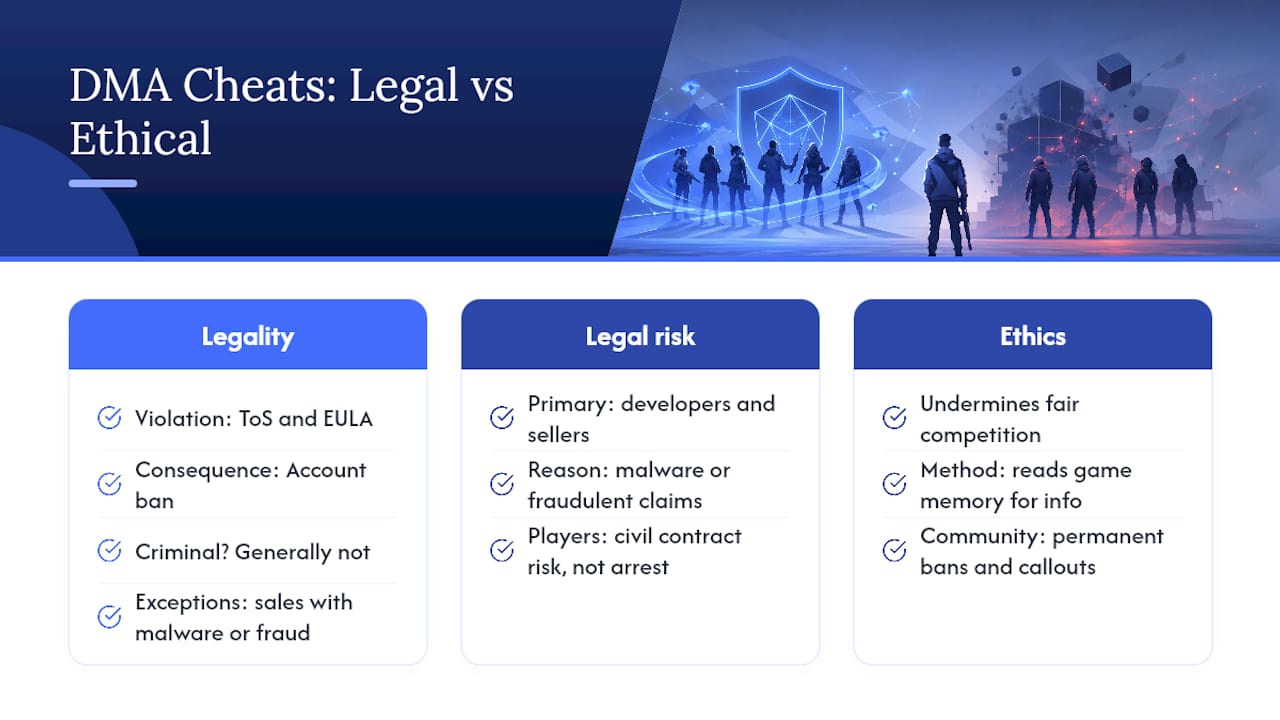
Using a DMA cheat in Valorant isn't illegal in the way that, say, credit card fraud is illegal. It's a violation of Riot's Terms of Service and End User License Agreement, both civil contracts you agreed to when you installed the game. Breaking that agreement gets your account banned. It doesn't get you arrested. That said, some jurisdictions have started treating cheat sales and distribution differently, particularly when cheat software bundles malware or when sellers make fraudulent claims to buyers, so the legal exposure tends to sit more with developers and sellers than with individual players.
The ethical picture is more straightforward. Competitive Valorant runs on the assumption that every player is working with the same information: what they can see, hear, and react to. DMA cheats break that assumption at the memory level, reading enemy positions, item states, and utility timing that the game never intended to show you. That's a different category of unfairness than a smurf account or a lucky peek, and most of the competitive community treats it accordingly, with permanent bans and public callouts when someone gets caught.
DMA Cheats vs. Software Cheats: What's the Real Difference?
Software cheats inject code or hook into Valorant's process directly, which is exactly why Vanguard's kernel-level driver was built to catch them fast, often within a single patch cycle. DMA cheats route around that by reading memory externally through a separate hardware device, which historically dodged those injection signatures entirely.
That gap used to make DMA the gold standard for serious cheaters. It's narrowed considerably. Software cheats are cheaper, sometimes free or under $50 a month, and require zero extra hardware, but they get detected fast and bans tend to cluster quickly after a signature update. DMA cheats cost thousands, take real technical skill to set up, and used to offer months of runway before detection. Now, with IOMMU and HVCI enforcement in place, that runway has shrunk dramatically, and the cost gap no longer buys the safety gap it once did.
The practical difference today is less about which method is "better" and more about which failure mode you're willing to accept: a cheap, fast ban on software, or an expensive, slower one on hardware that can leave a $6,000 rig unusable for the one game you bought it for.
Could Future Tech Make DMA Viable Again?
Anti-cheat and cheat development have always moved in lockstep, each side reacting to the other's last move, and DMA's story so far follows that pattern closely.
Firmware developers will keep trying to spoof device identity in ways that dodge IOMMU fault logging, and some will likely find short-lived success before Riot's telemetry catches the pattern. On the defensive side, expect anti-cheat to lean harder into machine learning behavioral models that flag statistically improbable play regardless of how clean the hardware layer looks, a direction security researchers already describe as the next phase of this fight. Broader platform attestation, the kind Microsoft is pushing through Windows 11's security baseline, will likely tighten further too, making it harder to run Valorant at all on a system with IOMMU or Secure Boot disabled.
The realistic trajectory points toward DMA becoming a shrinking niche rather than a comeback story. Each round of enforcement raises the technical bar and the cost bar simultaneously, and the players most exposed to bans are the ones buying mass-produced firmware rather than custom-built solutions that few others share.
How Has the Community Responded to DMA Cheating?
Reaction split along predictable lines once the ban waves hit. Cheat forums saw immediate posts from users reporting bricked cards and lost accounts, with a noticeable drop in confidence around DMA vendors who hadn't updated their firmware fast enough to handle IOMMU checks.
Riot leaned into the moment publicly, using social channels to highlight the update's effect on expensive hardware rather than staying quiet about enforcement, a tone reflected in coverage of the update. That messaging choice was deliberate: publicizing that DMA hardware got disabled discourages new buyers far more effectively than a quiet ban ever could. Competitive players and content creators largely welcomed the crackdown, given how much DMA's reputation for invisibility had already spread among the game's cheating population. The net effect has been a visible chilling effect on DMA marketing claims across cheat-adjacent forums, with sellers now hedging language around "current" detection status rather than promising permanent safety.
Why the "Undetectable DMA" Myth Needed to Die
The conventional wisdom that DMA is inherently safer than software cheats was true for years and stopped being true the moment Riot tied platform security to game launch itself. That's the part most cheat-selling forums still won't say plainly, because the old narrative sells better than the current one.
What actually matters now isn't the delivery method, it's whether the anti-cheat model has closed the specific gap your method depends on. Vanguard didn't get incrementally better at spotting DMA. It changed the rules so that IOMMU, a chipset feature most players never thought about, became the deciding factor in whether a $6,000 setup even boots the game correctly. That's a categorically different kind of countermeasure than a signature update.
If there's one thing competitive players should prioritize, it's treating "detection status" as a moving target measured in weeks, not a fixed property of a method. Anyone selling a DMA setup as permanently safe in 2026 is selling last year's platform assumptions.
— Fonics
Where to Go From Here for Tested Valorant Cheats
If you're weighing the cost and risk of a DMA build against something with a faster path to actually playing, Midnight Market's approach is built around daily testing rather than a one-time detection claim that ages badly against the next Vanguard patch. That matters more than ever now that platform-level checks like IOMMU can flip a product's status overnight.

Midnight Market runs its Valorant lineup, including Evo and Sensory, through daily testing cycles and backs hardware purchases with warranty coverage, so a failed device isn't automatically a total loss. Live support via Discord can provide real-time assistance when a patch lands, rather than waiting on a ticket queue while a setup sits offline. For players who've read this far and are still weighing DMA against a tested alternative, the smarter move is checking current product status directly rather than relying on a forum post from three months ago. Head to the Midnight Market store to see what's currently active and supported before you commit to a build.
Sources
- Valorant update turns expensive cheating hardware into a $6,000 problem
- Vanguard security requirements
- Valorant's Vanguard anti-cheat now destroys DMA cheat firmware
- DMA and AI are the next frontier of online cheating, but Riot has a plan