
A cheat download system delivers code in one of two forms: instructions that run inside the game's own process, or inputs generated outside it entirely. That single distinction, internal versus external, determines almost everything about how cheat systems operate and which layer of anti-cheat has any chance of catching them.
Four battlegrounds decide whether a cheat survives contact with a live match:
- Usermode, where signature scans and module checks look for known bad code.
- Kernel space, where drivers watch memory and processes at ring 0.
- Server-side systems, where telemetry and statistical models flag outliers.
- Hardware, where DMA devices and capture cards operate outside the operating system's view entirely.
The part most players never think about is the download itself. Before any of that runtime cheating happens, the reader has already run an installer, and that installer is where backdoored cheat engines and modding tools have repeatedly delivered malware instead of, or alongside, the promised aimbot.
Key Takeaways
Cheat download systems succeed or fail based on where their code runs, and the download chain itself is usually the weakest, most exploited link in the entire setup.
| Point | Details |
|---|---|
| Internal vs. external matters most | In-process injection and manual mapping trigger different detection than external memory reads or kernel drivers. |
| The installer is the real risk | Staged downloads and bundled loaders are where malware most often hides, not the cheat's runtime code. |
| Kernel defenses have real limits | Callbacks and VAD walks catch software cheats but can't see DMA or capture-card hardware setups. |
| Server-side telemetry catches behavior | ML-based outlier detection flags suspicious patterns even when no client-side signature exists. |
| Midnight Market tests daily | Daily automated testing, instant delivery, and live Discord support address the download-chain risks this article covers. |
Table of Contents
- How Cheat Download Systems Work at the Installer Stage
- Cheat System Functionality: Internal, External, Kernel, and Hardware Models
- How Anti-Cheat Systems Detect Cheats Across Every Layer
- Malware Risk in Cheat Downloads: Real Incidents and Mitigations
- What the Download Chain Reveals About the Whole Cheat Ecosystem
- Where Midnight-Market Fits If You Want This Done Right
- Sources
How Cheat Download Systems Work at the Installer Stage
Most cheat downloads don't hand you the full payload up front. You get a small stub whose only job is to phone home and pull the real software from a cloud host. That two-stage design isn't laziness. It lets a seller swap out the payload after a patch without forcing every customer to redownload from scratch, and it keeps the initial file small enough to avoid tripping size-based heuristics.
The mechanics usually follow a repeatable pattern:
- Stub execution: a loader runs first, checks system architecture and antivirus presence, then reaches out to a content delivery network.
- Staged fetch: the actual cheat DLL or driver downloads over HTTPS, frequently from CDN infrastructure that mimics legitimate cloud traffic, which is exactly the kind of setup Cheat Engine's own issue tracker documents when users report failed downloads tied to reputation-based blocking on CloudFront-style hosts.
- Bundling: the installer drops helper services, runtime libraries (Visual C++ redistributables are common cover), and sometimes a second loader whose only function is to decrypt the first.
- Persistence: for kernel-level products, this step installs a driver, often through a scheduled task or a Windows service configured to survive reboots.
Bundling extra runtime components isn't just about convenience. Wrapping the real payload inside legitimate-looking libraries and helper processes complicates static detection because antivirus engines have to unpack multiple layers before they see anything resembling the actual cheat code. Some sellers add a second cryptor pass specifically to defeat automated sandboxes that only inspect the first stage.
Pro Tip: Before running any cheat installer, check whether it demands driver signature enforcement be disabled, or whether it wants to install a service with SYSTEM privileges. Legitimate testing environments flag those requests, and a request you weren't expecting is the clearest signal something downstream isn't what it claims to be.
A few red flags show up across nearly every risky installer: obfuscated or randomized fetch URLs that change on each run, unsigned or test-signed kernel drivers, and installers that specifically try to disable Windows Defender or add exclusions before the real payload lands. None of those steps are necessary for a driver that's actually clean. Community threads about installation failures also show users routing around blocked downloads with VPNs or alternate mirrors, which is precisely the confusion attackers rely on to swap in a compromised binary while the user assumes it's just a hosting hiccup.
Cheat System Functionality: Internal, External, Kernel, and Hardware Models
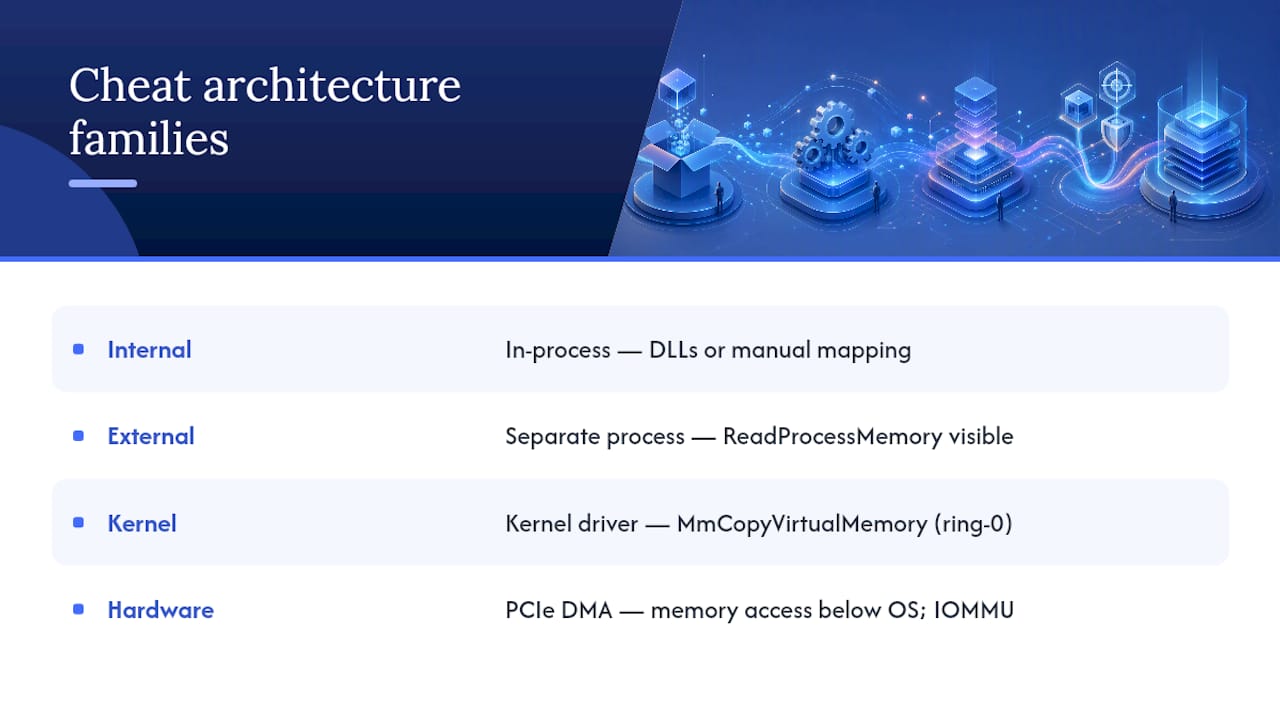
Every cheat, no matter how it's marketed, falls into one of four architectural families. Understanding cheat downloads means understanding which family you're dealing with before you even look at detection.
Internal (in-process) cheats run their code inside the target game's address space. The classic method is DLL injection, where a loader forces the game process to load a malicious library. More sophisticated tools use manual mapping or reflective injection, writing executable code directly into memory without ever calling LoadLibrary or registering the module in the process's module list. That absence of a normal module entry is itself a fingerprint. Anti-cheats that walk the Virtual Address Descriptor tree can spot executable memory regions with no file backing, which is exactly what manual mapping produces. Once inside, the cheat walks pointer chains through known offsets to find player coordinates, health values, or weapon state, then renders an overlay in the same process or a linked one.

External cheats keep their code in a completely separate process, using Windows APIs like OpenProcess and ReadProcessMemory to peek into the game's memory from outside. This is safer for the cheat developer because a crash in the reader process doesn't crash the game, and it avoids injecting code directly into a protected process. The tradeoff is that these API calls themselves are visible to anything monitoring handle requests, which is why external cheats often pair with a lightweight injector or a helper service talking over local sockets or named pipes.
Kernel-mode cheats operate at ring 0, the same privilege level as the operating system itself. Instead of calling usermode APIs that anti-cheat can intercept, a kernel driver calls privileged routines like MmCopyVirtualMemory directly, or reads physical memory to bypass process handle restrictions entirely. This is also where Bring Your Own Vulnerable Driver techniques come in: rather than writing a custom driver from scratch, an attacker loads a legitimately signed but exploitable driver and abuses its own privileged functions to read or write memory it was never meant to expose.
The moment a cheat moves from usermode API calls to a kernel driver calling MmCopyVirtualMemory directly, it has stepped outside the entire category of protections that rely on watching process handles and API hooks.
Hardware and DMA cheats skip software entirely. A PCIe DMA device, physically plugged into the target machine, can read host memory over the bus itself, and that access happens below the operating system, which is why no purely software-based anti-cheat can see it unless an IOMMU is active and configured correctly. Pair a DMA reader with a capture card and a second, physically separate PC running aim-assist software on the captured video feed, and you get a setup functionally invisible to anything running inside the gaming machine. As kernel anti-cheat has gotten more aggressive, this shift toward hardware-based methods has become one of the more predictable trends in the space. A dedicated hardware guide covers the physical setup in more depth if you want to see how these devices are actually configured.
How Anti-Cheat Systems Detect Cheats Across Every Layer
Detection isn't one system. It's four separate systems stacked on top of each other, each built to catch a different architecture from the section above, and each with its own blind spot.
Usermode detection is the oldest and weakest layer. It relies on file hashes, known signatures, and module integrity checks that compare loaded DLLs against a whitelist. This layer catches unmodified, publicly leaked cheats almost instantly, since their hashes are already known. It does close to nothing against a fresh manual-mapped injection or a cheat compiled the same day it's sold, because there's no signature to match yet.
Kernel defenses are where the real fight happens now. Modern anti-cheat drivers use ObRegisterCallbacks to intercept and strip access rights from handle requests aimed at the game process, which is the direct countermeasure to external OpenProcess-based reading. They walk VAD trees looking for executable memory with no backing module, hash .text sections of loaded drivers looking for tampering, and run minifilter drivers to watch file-system activity for suspicious writes. Some anti-cheats load as boot-start drivers specifically so they initialize before other drivers, giving them visibility into anything that tries to load later, including a BYOVD attempt.
Server-side controls don't care what's running on your machine at all. They validate what the client reports against what's physically plausible: timing between inputs, geometry of headshot angles, movement speeds, aim snap patterns. Heuristic and machine-learning telemetry flags statistical outliers in aggregate, catching cheats that never trip a single client-side signature because the behavior itself, not the code, is the anomaly.
That layered structure leaves consistent gaps:
- Kernel and usermode scanning can only see what runs on the machine, so DMA and capture-card setups fall entirely outside their reach.
- Server-side heuristics work on probability, which means a cheat tuned to stay within "human-plausible" ranges can survive for a while even under aggressive telemetry.
- Signed driver requirements raise the bar for kernel cheats but don't eliminate BYOVD abuse of drivers that were signed for legitimate purposes.
The industry's proposed long-term fix for the hardware gap is remote attestation and cloud-based game streaming, where the actual game logic runs on a server the player never touches, but that shift is still years from being standard across competitive titles.
Malware Risk in Cheat Downloads: Real Incidents and Mitigations
The download stage, not the runtime cheat, is where most real damage happens. Security researchers have documented backdoored cheat engines and modding tools used as delivery mechanisms for remote access trojans, with attackers wrapping payloads in obfuscated loaders specifically built to survive casual antivirus scanning. One campaign used a VB6-based cryptor and a packed multi-stage loader to smuggle in XtremeRAT, a full remote-access tool with keylogging and file exfiltration built in, hidden inside what looked like a routine cheat installer.

The operational fallout from a compromised download isn't limited to a banned account. A working RAT gives an attacker persistent access, meaning credential theft, saved payment data, and lateral movement to other accounts or devices on the same network.
Four checks meaningfully cut that risk if you're testing or evaluating cheat software yourself:
- Run it isolated: use a dedicated VM with no access to real credentials or personal files, snapshotted before every test.
- Check hashes before execution: compare file checksums against a known-good source when one is published.
- Watch network calls: a tool that opens connections it doesn't need, or reaches out to domains unrelated to license verification, deserves a hard stop.
- Segment your network: keep untrusted binaries off any subnet with shared drives or other devices.
Pro Tip: Static analysis alone misses packed or encrypted payloads. Pair it with a short dynamic run in an isolated sandbox and actually watch the process tree, not just the antivirus verdict, before deciding a download is clean.
Testing standards and safe handling in practice
Responsible testing looks less like a one-time scan and more like a maintained pipeline. Daily automated checks against current anti-cheat signatures, sandbox execution before anything ships, and integrity verification on every build catch the kind of drift that turns a working cheat into a bricked account overnight. Live monitoring after release matters just as much, since detection updates on the anti-cheat side can invalidate a payload within hours.
Midnight Market builds its process around exactly that cycle: daily testing of every product, instant delivery once a purchase clears, and live support through Discord for anything that comes up after. Sandboxing and daily automated test harnesses reduce, though never fully eliminate, the risk of shipping a backdoored or broken payload, which is the same standard any technically serious buyer should hold a provider to.
A provider's testing cadence tells you more about real-world safety than any marketing claim about being "undetected," because detection status changes daily and only ongoing verification catches that shift before you do.
None of this removes the underlying account and hardware risk that comes with using any cheat software. That risk belongs to the customer, and it's worth weighing against the specific game's enforcement history before buying anything.
What the Download Chain Reveals About the Whole Cheat Ecosystem
The conventional advice treats cheat detection like a single wall to get past. It isn't. It's four independent systems, and the research here shows the real vulnerability usually sits at the download stage, not the runtime architecture everyone obsesses over.
Here's what gets underweighted: a technically excellent kernel driver is worthless if the installer that delivered it also dropped a RAT. Buyers and developers alike spend enormous energy on evading ObRegisterCallbacks and VAD walks while treating the download link itself as an afterthought. That's backwards. The Talos research on backdoored cheat engines makes clear that supply-chain compromise, not detection sophistication, is where most real damage originates.
The second underrated point: hardware-based cheating isn't a fringe tactic anymore, it's the predictable next step once kernel anti-cheat gets good enough. Anyone treating DMA and capture-card setups as exotic is behind the actual trend line.
If you take one thing from this: verify the delivery chain before you evaluate the runtime technique. A clean installer with a mediocre cheat beats a brilliant cheat riding a compromised loader every time.
— Fonics
Where Midnight-Market Fits If You Want This Done Right
Everything above points to one practical conclusion: the download and testing pipeline matters as much as the cheat's technical design. Midnight Market builds around that exact problem, running daily automated testing across its catalog for titles like Escape from Tarkov, Valorant, and Counter-Strike 2, with instant key delivery so you're not waiting through a multistage installer chain that gives an attacker room to swap payloads. Live Discord support means when a title patches and something breaks, you're talking to a person, not guessing at a forum thread.

If hardware-level play interests you after reading how DMA and capture-card setups sidestep software detection, Midnight Market's DMA hardware lineup comes with warranty coverage most sellers don't offer. Whether you're after a tested software license or a full DMA setup, the current product catalog is the place to check what's available and verified today.
Sources
For deeper technical detail, the kernel anti-cheat deep dive covers callback registration and boot-start drivers in full. Talos's analysis of backdoored cheat engines documents the malware incidents referenced above, and the Cheat Engine issue tracker shows real installer behavior in the wild.
- How Kernel Anti-Cheats Work: A Deep Dive into Modern Game Protection
- Cheating the cheater: How adversaries are using backdoored video game cheat engines and modding tools
- How Kernel Anti-Cheats Work: A Deep Dive into Modern Game Protection