
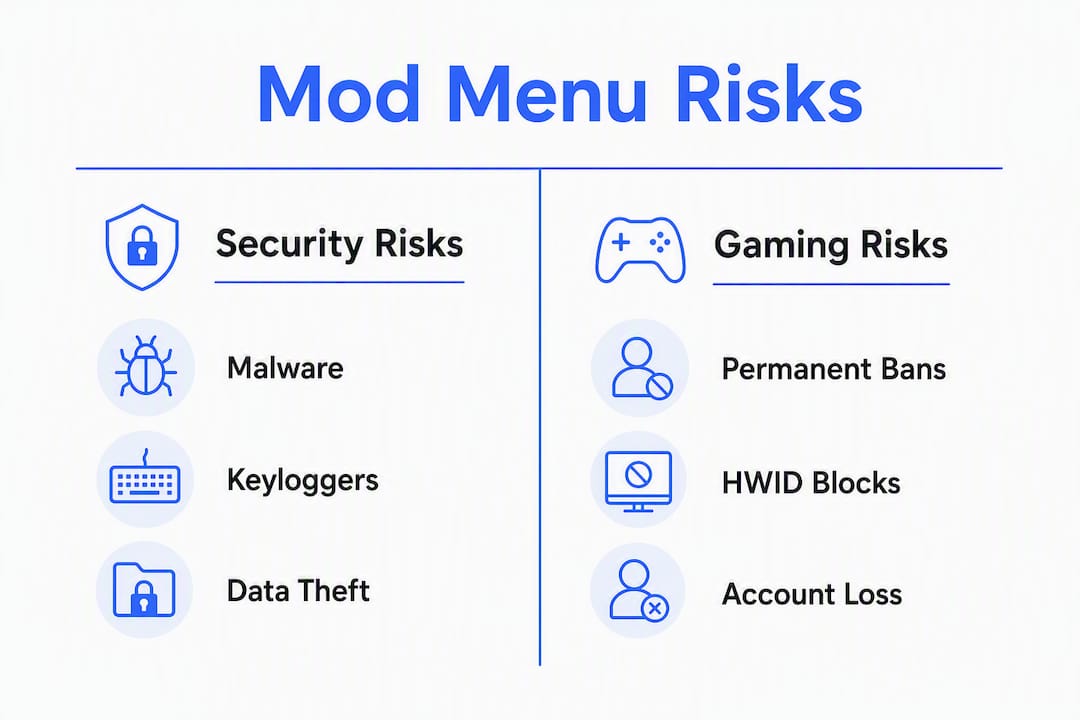
Don't download "undetected" mod menus from anonymous sources. The security, account, and legal risks are severe enough that most competitive gamers who go this route end up worse off than when they started. Security researchers have found keyloggers, backdoors, and ransomware bundled inside anonymous cheat installers that request kernel-level access — meaning the software you install to gain an edge can hand a stranger full control of your machine. Anti-cheat systems now operate across client signatures, kernel hooks, and server-side behavioral analytics simultaneously, so the "undetected" label on any free mod menu download is almost always temporary. If you're researching this because you want a real competitive advantage, the sections below explain exactly what you're risking and what actually works instead.
The core risks at a glance:
- Malware (keyloggers, ransomware, credential stealers) bundled in cheat installers
- Permanent HWID bans that survive account resets
- Server-side behavioral detection that flags you even without local cheat files
- Financial loss from stolen Steam tokens or payment credentials
- Hardware bricking from failed firmware flashing on DMA rigs
Table of Contents
- What downloading cheat software actually does to your security
- How modern anti-cheat systems actually catch you
- What HWID spoofers and DMA hardware actually do
- How to spot a malicious cheat download before it's too late
- Safer alternatives that actually give you a competitive edge
- What to do if your system or account is already compromised
- Publisher disclosure: what Midnight-market offers and how to reach support
- Key Takeaways
- The real cost of the shortcut
- Midnight-market: tested, supported, and warranty-backed
What downloading cheat software actually does to your security
The biggest threat from a game mod download isn't getting banned. It's what happens to your machine before the ban ever comes.
Kernel-level cheat tools operate at Ring 0 — the deepest privilege layer in Windows, where code can read game memory, hide from process enumeration, and run completely below user-mode security tools. That same access is exactly what malware authors want. When a cheat installer asks you to disable Windows Defender or load an unsigned driver, it has everything it needs to install a persistent backdoor alongside the cheat itself.
"Cheat software itself is often the biggest security risk — many tools from unverified sources contain malicious code that requires elevated privileges, giving attackers kernel-level access to the entire system." — CSWatch security research
The financial exposure is real. Steam session tokens, saved payment methods, and platform credentials all sit in memory that a kernel-mode process can read freely. Ransomware variants have been documented in cheat packages targeting exactly this attack surface. And because the malware installs at the driver level, a standard antivirus scan often misses it entirely.
Account consequences compound the damage. Permanent HWID bans lock your hardware identifiers — disk serials, motherboard UUID, SMBIOS data — not just your account. Losing thousands of hours of progress in Escape from Tarkov or Valorant, plus any purchased skins or items, is a financial hit that dwarfs whatever the cheat cost.
How modern anti-cheat systems actually catch you
Anti-cheat detection runs on three simultaneous layers, and bypassing one doesn't protect you from the others.

Client-side detection scans running processes, loaded modules, and memory regions for known cheat signatures. Kernel-level detection — used by Vanguard (Valorant) and BattlEye (Rainbow Six Siege, DayZ) — loads at boot and can enumerate drivers, hook system calls, and detect unauthorized kernel modules before the game even opens. Vanguard's kernel component loads at system boot, not at game launch, which means it sees everything that happened before you started playing.
Server-side behavioral analysis is where the "undetected" promise fully breaks down. Anti-cheat systems inspect gameplay inputs, aim angles, and reaction-time patterns server-side to flag anomalous behavior — no local file scan required. A player snapping to heads at inhuman speeds gets flagged regardless of whether any cheat software appears on their PC.
Pro Tip: "Undetected" is a timestamp, not a guarantee. Anti-cheat vendors push detection updates in ban waves that catch thousands of users simultaneously — often weeks after the cheat was already flagged internally. You can be playing on a "clean" tool and get banned retroactively.
Server-side analysis means behavioral detection can identify cheaters regardless of whether local cheat files are present on the gaming PC — the cheat ecosystem's arms race has moved beyond client-side evasion.
Understanding why cheats get detected at the technical level is the first step toward making an informed decision about any cheat software you consider.
What HWID spoofers and DMA hardware actually do
HWID spoofers are software tools that mask hardware identifiers — disk serials, motherboard UUID, SMBIOS strings — to make a banned machine appear as a new one to anti-cheat systems. Most effective spoofers operate at the kernel level (Ring 0); user-mode spoofers are largely insufficient against modern anti-cheat. Some go further and flash firmware directly, making the spoof persist across reboots — but improper flashing can permanently brick the device.
DMA (Direct Memory Access) hardware takes a different approach entirely. A secondary PC connects to the gaming machine via PCIe and reads game memory externally. From the gaming PC's perspective, no cheat software is present — the cheat logic and overlays run on the second machine. This bypasses most client-side detection. However, effective DMA setups require custom firmware that makes the FPGA card appear as a generic peripheral to avoid hardware blacklists, and improper firmware flashing carries a real bricking risk.
| Risk Type | Account Ban Likelihood | Technical Complexity | Potential Cost | ToS/Legal Exposure |
|---|---|---|---|---|
| Malware in cheat installer | N/A (security risk) | Low (passive) | High (credentials, ransomware) | Criminal liability possible |
| Kernel-mode cheat | High | Medium | Account + hardware ban | ToS violation, civil risk |
| HWID spoofer (software) | Medium | Medium | Account loss if detected | ToS violation |
| DMA hardware rig | Lower (client-side) | Very high | — | ToS violation; server-side still flags |
| Firmware flashing | Medium (if detected) | Very high | Bricked hardware (permanent) | ToS violation |
For a deeper look at how hardware cheat devices work mechanically, this guide covers the technical architecture without the vendor marketing spin.
How to spot a malicious cheat download before it's too late
Most scam cheat vendors follow recognizable patterns. Knowing them takes about 30 seconds to apply.
Installer red flags:
- Requires you to disable Windows Defender or any real-time protection
- Loads an unsigned kernel driver with no verifiable publisher
- Requests elevated permissions with no clear technical justification
- Distributed via anonymous Discord DMs or Telegram bots with no public changelog
Vendor red flags:
- Crypto-only payment with no refund policy
- Claims of "permanent undetectability" (no such thing exists against behavioral detection)
- No verifiable reputation, forum history, or public community
- Aggressive countdown timers and "limited slots" pressure tactics
Pro Tip: Any tool that requires kernel drivers or firmware flashing should be treated as high-risk for both security and permanent hardware damage — regardless of how polished the website looks. The attack surface at Ring 0 is the same whether the developer is malicious or just careless.
Safer alternatives that actually give you a competitive edge
The competitive impulse behind searching for a free mod menu is legitimate. The delivery method is the problem.
Legal, low-risk options that work:
- Aim trainers (Aim Lab, KovaaK's) build genuine muscle memory that transfers directly to ranked play
- Coaching platforms offer VOD review and real-time feedback from ranked players
- Hardware upgrades — higher-refresh monitors, low-latency peripherals — provide measurable advantages with zero ban risk
- Single-player modding in titles that explicitly support it (Skyrim, Fallout 4) satisfies the modding interest without any ToS exposure
- HWID hardware replacement is the correct permanent solution after a hardware ban, not a spoofer
| Alternative | Detection Risk | Ban Risk | Cost | Skill Required |
|---|---|---|---|---|
| Aim trainer | None | None | Free–$10/mo | Medium |
| Coaching/VOD review | None | None | — | Low |
| Hardware upgrade | None | None | — | Low |
| Single-player mods | None | None | Free | Low–Medium |
| HWID hardware swap | None | None | Hardware cost | Low |
If you've already received an HWID ban and need to understand your options, hardware replacement is almost always the cleaner path forward compared to stacking spoofers on a flagged machine.
What to do if your system or account is already compromised
Isolate the affected machine immediately and change critical credentials from a different, known-clean device.
Step-by-step containment:
- Disconnect the affected PC from the internet
- From a clean device, change passwords for Steam, Battle.net, Epic, email, and any linked payment accounts
- Enable two-factor authentication on every platform account
- Revoke active platform sessions (Steam has a "deauthorize all devices" option)
- Run a full scan with a reputable endpoint tool (Malwarebytes, Windows Defender offline scan)
- If a kernel driver was installed, consider a full OS reinstall — kernel-level persistence can survive standard removal attempts
- Restore from a known-good backup if one exists
If you see signs of persistent kernel activity, ransomware behavior, or unauthorized financial transactions, contact a computer security specialist rather than attempting manual removal. The attack surface at Ring 0 is deep enough that DIY cleanup often misses residual components.
For ongoing account hygiene after recovery, this guide on maintaining a clean account covers the practical steps in detail.
Publisher disclosure: what Midnight-market offers and how to reach support
Midnight-market sells digital game cheats, HWID spoofers, and DMA hardware for PC titles including Escape from Tarkov, Valorant, Apex Legends, Counter-Strike 2, Fortnite, Rust, DayZ, and Rainbow Six Siege. Every product is tested daily for detection status before keys are distributed.
What buyers get:
- Daily-tested cheat licenses with current detection status disclosed
- Instant digital key delivery at checkout
- Live support via Discord for setup questions and status updates
- Hardware warranties on DMA products
- Transparent product pages with game-specific compatibility information
If you're considering HWID spoofer options or DMA hardware, Midnight-market's support team can walk you through compatibility and setup before you buy.
This article is published by Midnight-market, a seller of the products discussed. It is general information, not legal or security advice. Confirm current ToS rules with your platform and consult a qualified security professional for incident response.
Key Takeaways
Downloading undetected mod menus from anonymous sources carries malware, permanent ban, and hardware risks that outweigh any short-term competitive gain.
| Point | Details |
|---|---|
| Kernel-level malware risk | Anonymous cheat installers frequently bundle keyloggers, backdoors, and ransomware at Ring 0. |
| "Undetected" is temporary | Ban waves catch flagged tools retroactively; server-side behavioral analysis flags anomalous play regardless of local files. |
| DMA complexity is high | Effective DMA rigs require custom FPGA firmware; improper flashing can permanently brick hardware. |
| Legal alternatives exist | Aim trainers, coaching, and hardware upgrades deliver real competitive gains with zero ban or malware risk. |
| Midnight-market's approach | Daily-tested products, instant key delivery, and live Discord support give buyers accurate detection status before and after purchase. |
The real cost of the shortcut
The conventional wisdom in competitive gaming communities treats cheating as a calculated risk — weigh the ban odds, pick an "undetected" tool, and play. That framing misses the actual worst case entirely.
Getting banned is recoverable. Losing your hardware to a bricked firmware flash, or handing a stranger kernel-level access to your machine, is not. The security research is consistent: the cheat software itself is frequently more dangerous than the anti-cheat it's trying to evade. That asymmetry is what most discussions in cheat forums never acknowledge, because the people selling tools have no incentive to say it plainly.
There's also a community dimension worth naming. Every lobby with a cheater is a lobby where legitimate players quit the game a little earlier. The competitive integrity that makes ranked play worth anything depends on most players choosing not to cheat. That's not a moral lecture — it's just the mechanics of why competitive games stay alive.
The pragmatic case for going through a vetted, warranty-backed provider rather than a random free mod menu download is straightforward: you get current detection status, real support when something goes wrong, and hardware coverage. The alternative is a forum post and a bricked PC.
Midnight-market: tested, supported, and warranty-backed
Serious competitive gamers who've done the research on cheat software know the difference between a random free download and a product with daily detection testing behind it. Midnight-market's store covers the full range — digital cheat licenses for titles like Escape from Tarkov, Valorant, and Counter-Strike 2, plus DMA hardware with manufacturer warranties and live Discord support from day one.
The concrete difference: every product in the Midnight-market store is tested daily for detection status, and that status is disclosed before you buy. No guessing whether your key is already flagged. No anonymous Discord seller who disappears after payment. If something changes post-purchase, support is live and the warranty covers hardware. Browse the current catalog and check detection status for your game at midnight-market.ca/store.