
Spoofing software manipulates digital identifiers — IP addresses, hardware IDs, TLS handshakes, browser headers — to make a system appear as something it is not. The blunt verdict for serious gamers: using it to cheat carries real account, financial, and legal risk in the United States, and most implementations fail faster than their sellers admit.
Before you read further: The Computer Fraud and Abuse Act (CFAA) and the Digital Millennium Copyright Act (DMCA) both create legal exposure for unauthorized system manipulation. Account bans are the least of your problems if you get this wrong.
Top immediate risks:
- Account bans and lost purchases — permanent termination with no refund on games, skins, or subscriptions
- Malware and data theft — unverified cheat tools frequently bundle credential harvesters or backdoors
- Legal exposure under U.S. law — CFAA violations and DMCA reverse-engineering claims are not hypothetical
Table of Contents
- What types of spoofing software actually exist?
- How modern spoofing techniques work at a high level
- How anti-cheat systems catch spoofing in practice
- Account, security, and legal risks for U.S. gamers
- Safe paths for security researchers studying spoofing
- Legitimate alternatives that actually improve your game
- How to spot dangerous or scammy cheat vendors
- Key Takeaways
- The ethics of curiosity and the cost of shortcuts
- Midnight-market: tested hardware solutions for serious gamers
- Useful sources and further reading
What types of spoofing software actually exist?
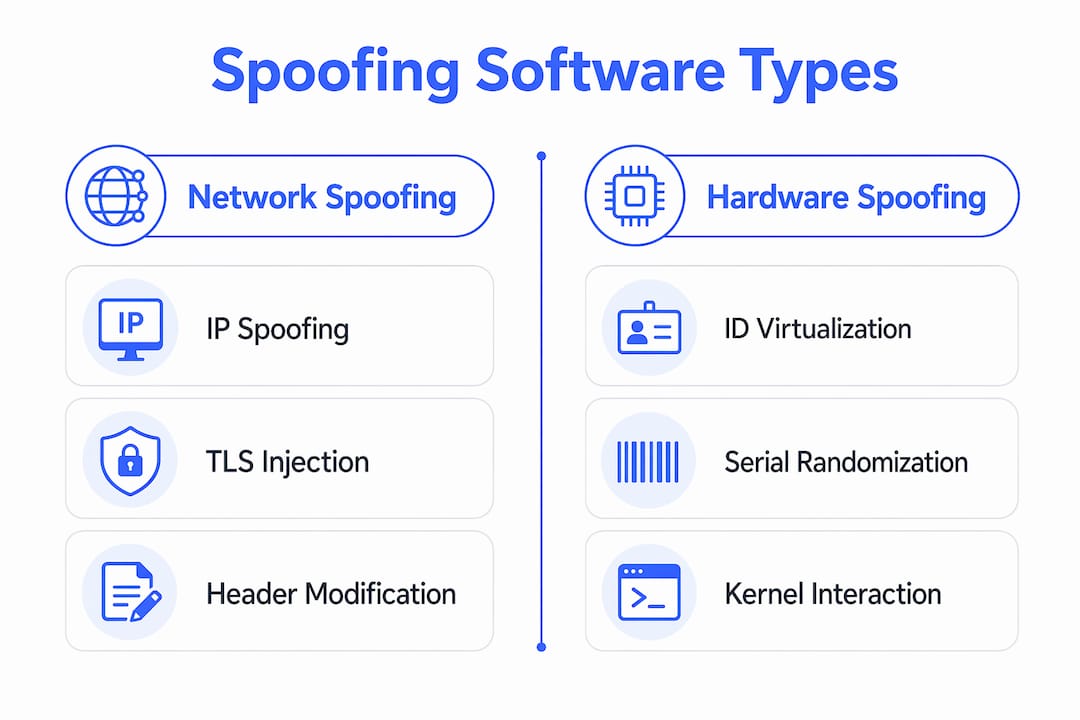
The term covers a wider range of techniques than most gamers realize. Here is a plain-language map of the main categories.
| Type | What it does | Common legitimate use |
|---|---|---|
| IP spoofing / bidirectional tunnels | Forges source IP addresses in packets | Network stress testing, red-team exercises |
| MAC / HWID spoofers | Randomizes hardware identifiers at the OS level | Authorized penetration testing, privacy research |
| SNI / TLS ClientHello injection | Injects a fake server name during TLS handshake | Censorship research, DPI bypass studies |
| HTTP / browser header spoofing | Modifies request headers before they leave the browser | Web compatibility testing, accessibility audits |
| Hardware identity virtualization | Virtualizes component serials (GPU, motherboard, disk) at the kernel level | Security lab environments, VM identity research |
Each category has legitimate research applications. The same tools used by red-teamers in authorized lab environments are the ones sold to gamers as "undetected forever" cheats — the difference is authorization and intent, not the code itself.
Pro Tip: Classification is for awareness, not instruction. Understanding what a tool does helps you assess risk; it does not mean you should run it on a live game server.
How modern spoofing techniques work at a high level
SNI / TLS ClientHello injection
DPI-bypass tools inject a fake TLS ClientHello packet during the TCP handshake so that deep packet inspection devices see a decoy hostname while real traffic routes to the intended destination. The technique works because DPI reads the ClientHello before the encrypted tunnel is established. Stability depends heavily on packet timing and repeat counts — fine-tuning those parameters is the difference between a working bypass and a dropped connection.
Browser header modification
Chrome's declarativeNetRequest API (Manifest V3) modifies headers at the network layer before requests leave the browser, making it more reliable than JavaScript injection. The catch: accurate impersonation requires matching Client Hints fields, viewport sizes, and network signals simultaneously — not just swapping a User-Agent string.
Bidirectional IP-spoof tunnels
Mutual bidirectional spoofing requires both endpoints to forge source IPs so return traffic routes correctly. A unidirectional spoof almost always fails because replies go to the spoofed address, not the real sender. Some tools blend control traffic into benign-looking protocols (ICMP echo, for example), but upstream BCP 38 filtering and router policies block spoofed packets at the ISP level regardless.

Kernel-level hardware identity virtualization
Advanced hardware spoofers interact with the OS hardware abstraction layer to randomize or virtualize component serials — motherboard, GPU, disk — producing identities that persist across reboots. This is the category most relevant to anti-cheat evasion, and it is also the category with the deepest kernel access requirements.
| Technique | Primary technical limitation |
|---|---|
| SNI / TLS injection | Packet timing instability; DPI can detect injection artifacts |
| Browser header spoofing | Coherence failures across 20+ correlated header variables |
| Bidirectional IP tunnel | Return-route failure without mutual spoofing; BCP 38 filtering |
| Hardware identity virtualization | Kernel access requirements; behavioral anomalies across reboots |
How anti-cheat systems catch spoofing in practice
Modern anti-cheat platforms do not rely on a single detection signal. They correlate dozens of variables simultaneously, which is why changing one identifier rarely works.
Detection reality: High-quality header spoofers run automated coherence checks across 20+ header variables because a single inconsistency — mismatched Client Hints, impossible viewport, wrong TCP timestamp behavior — is enough for a modern detector to flag the session.
Detection categories defenders use:
- DPI signatures — characteristic packet shapes from known injection tools
- Fingerprint coherence checks — cross-referencing User-Agent, Client Hints, TCP/IP stack behavior, and hardware IDs for internal consistency
- Behavioral and heuristic anomalies — impossible latency patterns, inhuman input timing, statistical outliers in movement data
- Server-side cross-validation — comparing reported hardware against historical session data and account behavior
Changing only the User-Agent while leaving Client Hints, viewport, and network fingerprint intact creates contradictions that flag immediately. The same principle applies to hardware spoofers: randomizing a GPU serial while leaving motherboard timing signatures unchanged is a coherence failure waiting to be caught.
Account, security, and legal risks for U.S. gamers
The consequences stack fast, and they are not reversible.
- Permanent account bans — Valorant, EFT, and most major titles use hardware bans that survive account resets
- Lost purchases — games, DLC, skins, and subscriptions are gone with no recourse under most ToS agreements
- Malware from shady vendors — credential harvesters and backdoored executables are common in unverified cheat markets; account safety depends on source verification
- Hardware warranty voids — kernel-level tools can compromise system integrity in ways that void manufacturer warranties
- Privacy and data-security exposure — intercepted credentials, session tokens, and payment data are realistic outcomes when running unknown executables with elevated privileges
On the legal side: the CFAA prohibits unauthorized access to protected computer systems, and the DMCA restricts reverse-engineering of copy-protection mechanisms. ToS violations can also trigger civil claims from publishers. These are not edge cases — they are the standard legal framework U.S. courts apply to unauthorized game modification.
Legal disclaimer: This article is general information only, not legal advice. Laws vary by jurisdiction and fact pattern. Consult a qualified attorney for guidance specific to your situation.
Safe paths for security researchers studying spoofing
Legitimate security research on spoofing techniques is valuable work. The difference between research and rule-breaking is authorization and environment.
Lab environment basics: Test exclusively on isolated networks with no connection to live game servers or production systems. Virtualized environments with snapshots let you roll back cleanly. Document every test with timestamps, reproduction steps, and logs kept within the isolated environment.
Before contacting a vendor for coordinated disclosure, prepare: a clear proof-of-concept summary, reproduction steps that work in your isolated lab, logs showing the behavior, and a proposed severity assessment. Use the platform's official vulnerability disclosure channel — not social media or public forums.
Pro Tip: Follow NIST's vulnerability disclosure guidelines (NIST SP 800-216) and the platform's published bug bounty policy before running any test. Data minimization and written authorization are non-negotiable starting points.
Legitimate alternatives that actually improve your game
Spoofing and cheating carry compounding risk with diminishing returns. These alternatives do not.
- Hardware upgrades — a high-refresh monitor (144Hz or 240Hz), a low-latency mouse, and an SSD cut real response time without any ban risk
- GPU and CPU upgrades — stable high framerates reduce input lag in ways no software workaround replicates
- Sanctioned in-game settings — optimizing graphics settings, network configuration, and keybinds is legal, free, and often underused
- Coaching and VOD review — platforms like Metafy and Gamer Sensei connect you with ranked coaches for title-specific skill development
- Private scrims and performance analytics — tools like Tracker Network provide match analytics that identify real skill gaps
- Permitted mods — many titles have official mod support; using sanctioned mods improves experience without ToS risk
The cost-benefit math is straightforward: a $200 monitor upgrade pays off across every session indefinitely. A cheat subscription that gets your account banned costs you the account, the games, and potentially more.
How to spot dangerous or scammy cheat vendors
The cheat marketplace has a high density of fraudulent and malicious actors. These red flags are consistent across bad vendors.
Warning: Credential harvesting and backdoored executables are common in unverified cheat markets. Running an unknown executable with admin privileges on your gaming PC is handing a stranger the keys to your accounts, payment data, and personal files.
Red flags to watch for:
- "Undetected forever" or "100% guaranteed" claims — no tool maintains that status indefinitely
- Anonymous support, slow response, or no Discord presence
- Requests for full system access or antivirus disabling before installation
- Bundled executables from sources outside the vendor's verified domain
- No refund policy or vague "all sales final" language
- Review patterns that look purchased or templated
Pro Tip: Verify file signatures before running anything. Use a separate test account and, ideally, a separate device for any evaluation. Prefer vendors with verifiable community presence, transparent daily testing logs, and hardware warranties — the kind of accountability structure that scam operations cannot fake.
Key Takeaways
Spoofing software is high-risk for U.S. gamers: most implementations fail detection, and the legal and account consequences are permanent.
| Point | Details |
|---|---|
| What spoofing software is | Tools that forge digital identifiers — IP, hardware IDs, TLS handshakes, browser headers — to misrepresent a system's identity. |
| Why detection is nearly certain | Modern anti-cheat correlates 20+ variables simultaneously; changing one identifier creates coherence failures that flag sessions. |
| U.S. legal exposure is real | CFAA and DMCA create genuine legal risk beyond account bans; consult counsel before any unauthorized system access. |
| Legitimate alternatives exist | Hardware upgrades, coaching, and analytics tools improve performance without ban or legal risk. |
| Midnight-market's approach | Midnight-market offers daily-tested hardware solutions with live Discord support and warranties — a vetted alternative to unverified cheat vendors. |
The ethics of curiosity and the cost of shortcuts
The technical side of spoofing is genuinely interesting. Understanding how a fake TLS ClientHello fools a DPI device, or how kernel-level hardware virtualization produces persistent identities, is the kind of knowledge that makes good security researchers. The problem is not the curiosity. The problem is the gap between what cheat vendors promise and what actually happens when you run their tools on a live account.
Most "undetected" tools have a shelf life measured in weeks, not months. Anti-cheat teams update detection logic continuously, and the moment a tool gets flagged, every account running it gets swept. The gamers who lose the most are the ones who invested the most — accounts with years of purchases, rare skins, high-rank history — gone permanently.
Midnight-market operates differently from the anonymous vendors that dominate this space. Daily testing, live Discord support, hardware warranties, and a transparent product catalog — including the Reported Temp Spoofer — reflect the kind of accountability structure that separates a real operation from a credential-harvesting front. That does not make every risk disappear, but it does mean you are not handing your system to an anonymous actor. For researchers and serious gamers alike, the responsible path starts with knowing exactly who you are dealing with.
Midnight-market: tested hardware solutions for serious gamers

If you have read this far, you already know the difference between a vetted hardware solution and a random executable from a forum post. Midnight-market's store carries daily-tested cheats and DMA hardware for titles like Valorant and EFT, backed by live Discord support and hardware warranties — the accountability layer that anonymous vendors structurally cannot offer. Every product goes through testing before it reaches a customer, which is the only honest answer to "will this get my account banned." Check the current catalog and connect with the support team on Discord to find the right fit for your setup.
Useful sources and further reading
Reputable resources for researchers and gamers who want to go deeper — for education and authorized testing only.
- NubleX/ID-Spoofer — Cross-platform identity spoofing toolkit for authorized penetration testing; illustrates MAC randomization and wire-level TCP/IP persona projection
- xvzc/SpoofDPI — DPI-bypass implementation demonstrating TLS ClientHello injection at a technical level
- ParsaKSH/spoof-tunnel — Bidirectional IP spoofing tunnel with built-in packet testing; illustrates mutual spoofing requirements
- Masquerade-Spoofer — Browser header spoofing extension with coherence checking; demonstrates the complexity of accurate fingerprint impersonation
- MailSpoof — Open-source email spoofing framework for authorized red-team and security awareness exercises
- NIST SP 800-216 — Federal vulnerability disclosure guidelines; the baseline standard for coordinated disclosure in the U.S.
- U.S. Department of Justice CFAA overview — Primary legal resource for understanding computer fraud exposure under federal law
| Source | Why it matters |
|---|---|
| NIST SP 800-216 | Sets the U.S. federal standard for responsible vulnerability disclosure |
| DOJ CFAA guidance | Defines federal criminal and civil exposure for unauthorized computer access |
| Platform bug bounty policies | Each major game publisher publishes official disclosure channels — use them |
| GitHub research repositories | Non-operational reference for understanding technique mechanics and limitations |