
A kernel driver cheat runs code at Ring 0, the highest privilege level in the Windows architecture, to read and write a game process's memory directly, bypassing every user-mode protection a game can deploy. That single capability is why these tools are both powerful and extraordinarily dangerous.
The two most important entities you need to know before going further:
- Easy Anti-Cheat (EAC) and BattlEye both operate at the kernel level themselves, actively monitoring for unsigned drivers, suspicious memory access patterns, and structural artifacts left by common mapping tools.
- Microsoft Windows Driver Kit (WDK) is the official, lawful toolkit for learning and building Windows kernel drivers, and it is the right starting point for anyone who wants to understand this space without legal exposure.
The bottom line: kernel-level access gives a cheat capabilities that user-mode tools simply cannot match, but modern anti-cheat systems are built specifically to hunt these techniques. The risk profile covers system crashes, permanent account bans, and real U.S. legal exposure under computer fraud statutes.
Table of Contents
- What a kernel driver actually does at Ring 0
- How modern anti-cheat systems detect kernel-level cheats
- What you actually risk: technical, account, and U.S. legal exposure
- Why public kernel drivers get caught so fast
- How to learn kernel and driver development the lawful way
- Safer alternatives for customization, testing, and competitive play
- How to do kernel and anti-cheat research responsibly
- Key Takeaways
- The security-first case for understanding this space
- Authoritative resources for further learning
- Midnight-market offers tested hardware alternatives
What a kernel driver actually does at Ring 0
Windows divides execution into privilege rings. User-mode applications, including games, run at Ring 3. The operating system kernel, hardware drivers, and security software run at Ring 0. The gap between them is not cosmetic: Ring 0 code has unrestricted access to physical memory, hardware registers, and every running process on the machine.

A kernel driver is a software component that runs in this privileged space. Legitimate drivers handle hardware communication, file systems, and networking. A kernel driver cheat exploits the same architecture to perform memory read/write operations on a game process from a position the game's own protection layer cannot see or block.
The conceptual flow looks like this:
- A user-mode application (the cheat client) sends a request via an IOCTL (I/O control code) to a kernel driver.
- The driver, running at Ring 0, accesses the target game process's virtual memory directly.
- It reads game state (player positions, health values) or writes values (ammunition, visibility flags) without going through any user-mode API the game monitors.
- Results are passed back to the user-mode client for rendering or input injection.
The communication pattern between user-mode and kernel-mode via IOCTL is standard, well-documented, and, critically, well-known to anti-cheat engineers.
The canonical learning resources here are the Microsoft Windows Driver Kit (WDK), available at learn.microsoft.com, and the book Windows Internals by Mark Russinovich and colleagues. Both cover the architecture in depth without crossing into exploitation territory.
How modern anti-cheat systems detect kernel-level cheats
EAC and BattlEye do not just watch user-mode behavior. Both vendors run kernel-mode components that inspect the same privilege layer a cheat driver would occupy. The detection surface is wide.
Common detection signals anti-cheats monitor:
- Unsigned or improperly signed drivers. Windows requires kernel drivers to carry a valid Microsoft-issued signature. Any driver loaded without one triggers immediate flags.
- PiDDBCacheTable entries. Windows caches metadata about loaded drivers here. Manual mappers that load unsigned code leave entries that persist even after the driver unloads.
- MmUnloadedDrivers list. The kernel maintains a rolling list of recently unloaded drivers. Artifacts in this list are a classic fingerprint for manual mapping tools.
- KernelHashBucketList traces. A less-discussed structure that records driver hashes; scrubbing it requires explicit effort most public tools skip.
- Suspicious memory access patterns. Repeated cross-process memory reads from a non-game module are behaviorally anomalous and flagged by heuristic engines.
- Test-signing mode detection. Enabling Windows test-signing to load unsigned drivers is itself a detectable system state.
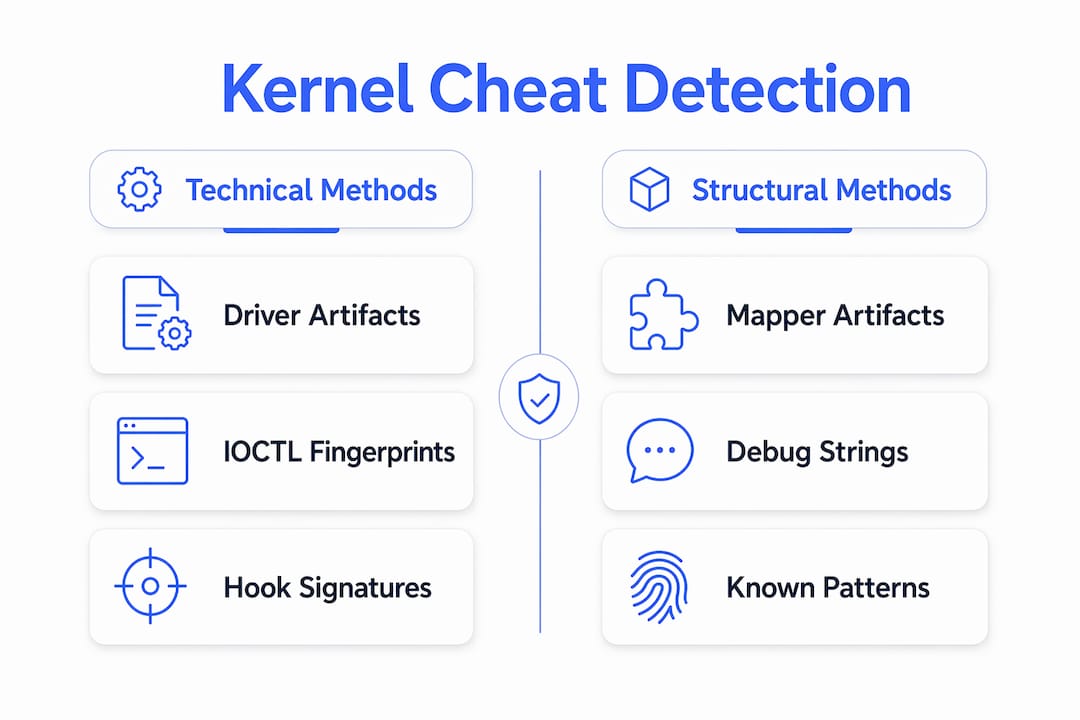
- IOCTL fingerprinting. Standard device control interfaces used by public cheat bridges carry recognizable patterns that are trivially signature-scanned.
The table below maps each detection vector to how it is observed and which anti-cheat category typically applies it.
| Detection vector | How it is observed | Vendor relevance |
|---|---|---|
| Unsigned driver load | Driver signature enforcement check at load time | EAC, BattlEye, generic kernel AC |
| PiDDBCacheTable entry | Kernel structure scan post-load | EAC, BattlEye |
| MmUnloadedDrivers artifact | Rolling list inspection | EAC, BattlEye |
| Test-signing mode active | System boot configuration flag | Generic kernel AC |
| IOCTL pattern match | Device name and control code signature scan | EAC, BattlEye |
| Cross-process memory access | Behavioral heuristic on handle and read frequency | EAC, BattlEye |
| Known module hash | Static hash comparison against public cheat builds | EAC, BattlEye |
"Anti-cheat vendors increasingly signature-scan kernel memory and known public cheat modules. The arms race is continuous, and public or open-source drivers are the highest-risk category because their artifacts are already catalogued." — HITB Security Conference, Bypassing Anti-Cheats & Hacking Competitive Games (Rohan Aggarwal)
For a broader look at how detection vectors stack up in practice, the Midnight-market blog covers why cheats get detected at a level that complements the kernel-specific picture here.
What you actually risk: technical, account, and U.S. legal exposure
The capability argument for kernel-level access is real. The risk argument is just as real, and it operates on three separate levels simultaneously.

System-level risks
A kernel driver runs with no safety net. A single null pointer dereference, a race condition, or a bad memory write causes an immediate Blue Screen of Death (BSOD). Security researchers at HITB have documented that a malicious or buggy driver can compromise the entire operating system, not just the game session. When you load a public cheat driver you did not write yourself, you are trusting an anonymous author with Ring 0 access to your machine. That is a significant trust assumption.
Account and platform risks
EAC and BattlEye detections typically result in permanent hardware bans, not just account suspensions. Steam and Epic Games both reserve the right to terminate accounts and revoke game licenses for anti-cheat violations under their terms of service. A hardware ban means the ban follows the machine, not just the account. The consequences of low-quality cheat implementations extend beyond the obvious account loss.
U.S. legal exposure
- Computer Fraud and Abuse Act (CFAA). Unauthorized access to a computer system, including a game server's protected environment, can fall under federal statute. The CFAA has been applied in gaming contexts before.
- Terms of service breach and civil claims. Game publishers have successfully pursued civil litigation against cheat developers and distributors. The legal theory is breach of contract (the TOS) combined with tortious interference.
- Distribution liability. Writing a kernel driver cheat for personal use is different from distributing it. Distribution raises the legal exposure substantially, including potential CFAA criminal referral.
Why public kernel drivers get caught so fast
The detection problem for public cheat drivers is structural, not just technical. Every artifact a public tool leaves behind has already been catalogued.
Known mapper artifacts. Tools like kdmapper are widely used to load unsigned drivers by exploiting a vulnerable signed driver. The problem is that kdmapper and similar tools clear some traces automatically but leave others, including PoolBigPageTable entries, that require explicit manual cleanup. Anti-cheat engineers know exactly what kdmapper leaves behind because the source code is public.
PiDDBCacheTable and MmUnloadedDrivers neglect. Public projects frequently document which structures need scrubbing, which means anti-cheat vendors read the same documentation. A community project may note that manual mapping clears some traces but not all; the anti-cheat vendor's response is to scan the ones that are not cleared.
IOCTL fingerprinting. The simplest kernel drivers expose a device interface and accept IOCTLs from user-mode. That pattern, including the device name, the control code values, and the communication cadence, is trivially fingerprinted. Once a public driver's IOCTL signature is in the anti-cheat's database, every copy of that driver is detected on load.
Reused shellcode and hooks. Mid-function hooks and shellcode stubs from public repositories carry byte-level signatures. Signature scanning at the kernel level means a hook copied from a GitHub project is detected the moment the anti-cheat scans kernel memory.
Debug artifacts. Leaving debug strings, predictable device names, or compile-time constants in a driver build creates static signatures that survive across versions. Anti-cheats scan for these strings directly.
The CheatDriver repository illustrates how even projects that attempt to address these issues still leave detectable patterns, because the anti-cheat side updates faster than the public cheat side.
How to learn kernel and driver development the lawful way
If the underlying interest is kernel development, security research, or reverse engineering, there are legitimate, well-resourced paths that do not carry the legal and account risks described above.
Primary study materials:
- Microsoft WDK (learn.microsoft.com): the official toolkit for Windows kernel driver development. Includes sample drivers, documentation, and the build environment. Start here.
- Windows Internals (Russinovich, Solomon, Ionescu): the authoritative book on Windows kernel architecture. Covers memory management, process internals, and driver loading in the depth a serious developer needs.
- Windows SDK (developer.microsoft.com): complements the WDK for user-mode/kernel-mode interface work.
- DebugView (learn.microsoft.com): Sysinternals tool for capturing kernel debug output without a full kernel debugger setup.
Safe lab configuration:
- Run all kernel development in a dedicated virtual machine, never on a production machine. Snapshots are your rollback mechanism.
- Use WinDbg over a serial or named-pipe connection for kernel debugging. Kernel debugging requires out-of-band tools because a crash takes down the entire machine you are debugging on.
- For Linux driver work, the kernel documentation recommends DebugFS, tracepoints, and compile-time sanitizers for safe development.
- Keep your test environment air-gapped from any gaming account or platform client.
Conference and course content:
HITB, DEF CON, and Black Hat regularly publish driver security and anti-cheat research papers. These are the right venue for understanding the detection landscape from a defensive research perspective. University security programs and corporate security teams also offer structured kernel research environments with legal cover built in.
Pro Tip: Set up a dedicated Windows VM with a snapshot taken before any driver load. If a driver crashes the VM, revert in seconds. Pair it with WinDbg attached over a named pipe from your host machine so you can read crash dumps without rebooting your development environment.
Safer alternatives for customization, testing, and competitive play
Most of the goals people associate with kernel driver cheats can be approached through legitimate channels that do not require Ring 0 access or anti-cheat evasion.
Official mod APIs and SDKs. Many games ship with official modding support. Bethesda's Creation Kit, Valve's Source SDK, and Unreal Engine's modding framework all provide sanctioned ways to modify game behavior. These tools operate within the game's intended architecture and carry no ban risk when used as designed.
User-mode debugging and instrumentation. For developers testing game behavior, user-mode tools like Cheat Engine (in a single-player, offline context), x64dbg, and API Monitor provide process inspection without kernel access. These are standard reverse engineering tools used in security research and game development.
Overlay techniques. External overlays that render information without injecting into the game process sit entirely in user-mode and avoid the kernel attack surface. The technical differences between overlay and kernel approaches are worth understanding before choosing a path.
DMA hardware for isolated testing. Direct Memory Access cards allow memory reads from a physically separate machine, which sidesteps kernel driver loading on the target system entirely. This is a hardware-level approach with its own detection profile and platform policy considerations. The mechanics of hardware cheat devices cover this in more depth. Using DMA hardware in any online multiplayer context still violates platform terms of service and carries ban risk.
Open-source security research projects. Contributing to or studying open-source anti-cheat projects, game security research, or driver development projects on GitHub provides hands-on kernel knowledge in a context that is clearly educational and often welcomed by the security community.
How to do kernel and anti-cheat research responsibly
Security research on anti-cheat systems and kernel drivers is legitimate work. The difference between research and exploitation is process, documentation, and permission.
- Define and scope your research. Write down exactly what you intend to study, what systems are in scope, and what outcomes you are looking for. Vague scope is how research drifts into unauthorized access.
- Get legal review before you start. Have a lawyer review your research plan, especially if it involves probing a commercial game's anti-cheat system. Many universities and corporate security programs have in-house counsel for exactly this.
- Set up a safe, isolated lab. No production accounts, no live game clients, no network connections to platform servers during active testing. Use dedicated hardware or VMs with no link to your gaming identity.
- Avoid publishing exploit code. Documenting a vulnerability conceptually is different from publishing working exploit code. The security community standard is to describe the class of vulnerability without providing a ready-to-deploy payload.
- Coordinate with vendors via responsible disclosure. EAC and BattlEye both have security contact channels. If you find a genuine vulnerability, report it privately before publishing. Most vendors have a disclosure window (typically 90 days) and some run bug bounty programs.
- Document everything. Timestamps, methodology notes, and correspondence with vendors protect you legally and establish good faith.
Pro Tip: If you are a student or early-career researcher, look for institutional partnerships before starting kernel security research. University security labs and corporate red teams provide legal infrastructure, mentorship, and equipment that make the work both safer and more credible.
Key Takeaways
Kernel driver cheats offer Ring 0 memory access that no user-mode tool can match, but modern anti-cheat systems from EAC and BattlEye are built specifically to detect the artifacts they leave, and the legal, account, and system risks in the U.S. make them a high-cost approach for any purpose outside lawful security research.
| Point | Details |
|---|---|
| Ring 0 access is the core capability | Kernel drivers read and write game memory with privileges no user-mode tool can reach. |
| Detection is structural, not just technical | EAC and BattlEye scan PiDDBCacheTable, MmUnloadedDrivers, and IOCTL patterns that public tools always leave behind. |
| U.S. legal exposure is real | CFAA and civil TOS claims have been applied in gaming contexts; distribution raises the risk substantially. |
| Lawful learning paths exist | Microsoft WDK, Windows Internals, and isolated VM labs provide full kernel knowledge without legal risk. |
| Midnight-market | Midnight-market offers daily-tested, hardware-based alternatives for gamers who want competitive tools without kernel driver exposure. |
The security-first case for understanding this space
There is a version of this conversation that treats kernel driver cheats as purely a technical puzzle, and another that treats them as purely a legal threat. Both miss the point.
The more interesting question is why the detection arms race has reached the kernel level at all. Anti-cheat vendors moved to Ring 0 because user-mode protections were comprehensively defeated. Cheat developers followed. The result is a security contest happening inside the most privileged layer of the operating system, on machines belonging to ordinary players who have no idea their kernel is a battleground.
What that means practically: the risk is not just to the cheater. A poorly written kernel driver, or a malicious one distributed through a cheat marketplace, is a rootkit-class threat to every machine it runs on. The fact that it is packaged as a game cheat does not change its technical profile. This is why the security-first framing matters. Understanding how these tools work, how they are detected, and what they risk is genuinely useful knowledge for developers, security researchers, and technically sophisticated gamers alike. The goal of this primer is to make that knowledge accessible without providing a recipe.
Midnight-market's approach to this space reflects the same logic: rigorous daily testing, hardware-based solutions, and live support exist precisely because the alternative (untested, kernel-level tools from anonymous sources) is a system security problem, not just a ban risk.
Authoritative resources for further learning
The sources below are the primary references for the technical claims in this article. Each is annotated with what it covers and why it is worth your time.
| Resource | Annotation |
|---|---|
| Microsoft WDK documentation | Official toolkit and documentation for Windows kernel driver development. The correct starting point for any lawful driver work. |
| Windows SDK download | Complements the WDK; covers user-mode and kernel-mode interface development. |
| DebugView (Sysinternals) | Lightweight tool for capturing kernel debug output; useful for early driver development without a full WinDbg setup. |
| HITB 2023: Bypassing Anti-Cheats & Hacking Competitive Games | Conference paper by Rohan Aggarwal covering the detection arms race, kernel structure traces, and system compromise risks. The most directly relevant security research paper for this topic. |
| Linux kernel driver debugging guide | Covers safe debugging practices including DebugFS, tracepoints, and sanitizers. Applicable to kernel development discipline generally. |
| Kernel driver basics (kernel.org) | Foundational reference for kernel driver architecture and Ring 0 concepts. |
| kdmapper (GitHub) | Manual mapping tool; referenced here as a research artifact showing how unsigned driver loading works and what traces it leaves. Not a how-to recommendation. |
| CheatDriver (GitHub) | Sample project illustrating kernel cheat communication patterns and detection surface. Cited for conceptual illustration only. |
Midnight-market offers tested hardware alternatives
If this primer clarified one thing, it is that kernel driver cheats carry a risk profile most gamers are not equipped to manage: system compromise, permanent hardware bans, and real legal exposure under U.S. computer fraud law. The technical ceiling is high, but so is the cost of getting it wrong.
Midnight-market is built around a different approach. Every product in the store is tested daily against live anti-cheat systems, including EAC and BattlEye, before it reaches a customer. The focus is on hardware-based DMA solutions and externally-delivered tools that keep your system clean and your account intact. Live Discord support means you are not troubleshooting alone at 2 AM with a bricked driver.

For gamers who want a real competitive edge in titles like Valorant and EFT without loading unsigned kernel code on their machines, the Midnight-market store is the practical next step. Browse the current lineup, check what is tested and active today, and reach out via Discord if you have questions before purchasing.