Kernel-level anti-cheat is security software that runs inside Windows itself, at the same privilege tier as the operating system core, rather than alongside your game as an ordinary program. Vendors use it because cheats that hide in kernel space or run through DMA hardware are invisible to anything operating at a lower privilege level. The trade-off is real: you get far stronger cheat detection, but you also hand a third-party driver the same access a Windows bug or a malicious actor would want most.
TL;DR:
- Kernel anti-cheat requires signed drivers loaded at boot time, which increases security but also raises risks if vulnerabilities in the driver are exploited.
- It can detect hardware cheats, hypervisor-based threats, and memory manipulation techniques that user-mode tools cannot see or prevent.
- The risks include potential privilege escalation, system crashes, and privacy violations due to the broad access drivers have to system data and processes.
- To reduce these risks, users should enable Secure Boot, keep systems patched, and avoid unsigned or untrusted drivers, while vendors can adopt less persistent solutions.
- Despite their power, kernel defenses alone do not fully eliminate cheat markets, and platform security measures like patching and Secure Boot offer more reliable protection.
Table of Contents
- What Is Kernel Anti Cheat, Technically Speaking?
- What Can Kernel Anti-Cheat Detect That User-Mode Tools Miss?
- What Security Risks Come With Kernel-Level Monitoring?
- How Can You Reduce the Risk of Running Kernel Anti-Cheat?
- How Midnight-market Approaches Kernel-Level Risk
- Where to Verify the Technical Details Yourself
- What Should You Actually Take Away From This?
- Sources
What Is Kernel Anti Cheat, Technically Speaking?
Modern CPUs enforce four privilege rings, but Windows really uses only two: Ring 3 for ordinary applications and Ring 0 for the kernel. Anything running in Ring 0 can read and write any process's memory, intercept hardware calls, and override decisions made by software running below it. That is precisely why anti-cheat vendors want a presence there: a cheat running in user mode (Ring 3) can hide from another Ring 3 program, but it cannot hide from something with equal or greater privilege.
Getting code into Ring 0 legitimately requires a signed driver. Microsoft's kernel-mode code signing policy requires drivers to carry a valid digital signature before Windows will load them, whether that driver loads at boot for persistent monitoring or on demand when the game launches. Boot-time loading has a specific purpose: it lets the anti-cheat establish a clean baseline before a rogue driver can load.
Once loaded, kernel anti-cheat drivers lean on a fairly consistent toolkit:
- ObRegisterCallbacks to intercept handle creation and monitor which processes are opening handles to the game.
- Process/thread creation notifications (PsSetCreateProcessNotifyRoutine) to flag suspicious child processes.
- DeviceIoControl as the communication channel between the user-mode game client and the kernel driver.
- MmCopyVirtualMemory and ZwMapViewOfSection to read or map another process's memory space, letting the driver inspect what a suspicious process is actually doing without relying on that process's cooperation.
That last pair matters most. Mapping kernel memory directly means the anti-cheat can enumerate loaded drivers, inspect page tables, and catch manipulation that a user-mode scanner would never see.
What Can Kernel Anti-Cheat Detect That User-Mode Tools Miss?
User-mode anti-cheat can only see what the operating system chooses to show it, and a sufficiently capable cheat controls exactly that. Ring 0 access closes most of that gap, though not all of it.
- Signed and unsigned kernel-mode cheat drivers that load their own code into Ring 0 to read memory or manipulate rendering, which a kernel scanner can detect through driver enumeration and signature checks.
- DMA-based cheats running on separate hardware that reads game memory over a PCIe connection, bypassing the local software stack entirely (a technique covered in more depth in how hardware cheat devices work).
- Hypervisor-based cheats that run underneath the operating system, which require the anti-cheat itself to check for virtualization artifacts.
- Page-table manipulation, where a cheat rewrites memory mappings to hide its presence, detectable only by something with the same low-level access, since handle-stripping tricks that fool user-mode tools do nothing against a driver reading raw physical memory.
None of this is free of cost. Broader visibility increases false positives against legitimate overlay software and virtual machines, and research out of the University of Birmingham found that kernel defenses alone still aren't sufficient to shut down the commercial cheat market, which keeps adapting around them.
What Security Risks Come With Kernel-Level Monitoring?
A bug in a Ring 0 driver isn't a crashed app. It's a blue screen, a privilege escalation path, or in the worst case a remote code execution vector, because the driver runs with the authority to touch anything on the machine.
Independent reporting on Riot Games' Vanguard driver found that shipping a kernel component for anti-cheat purposes concentrates enormous trust in a single piece of closed-source code, and that trust becomes a liability the moment a vulnerability surfaces in that driver.
That concentration of trust isn't theoretical. Ars Technica's coverage of the backlash against Vanguard laid out exactly this concern years before it became an industry-wide talking point, and the 2024 CrowdStrike outage, which grounded flights and knocked hospital systems offline through a single faulty kernel driver update, showed the ceiling on how bad a Ring 0 failure can get outside gaming entirely.
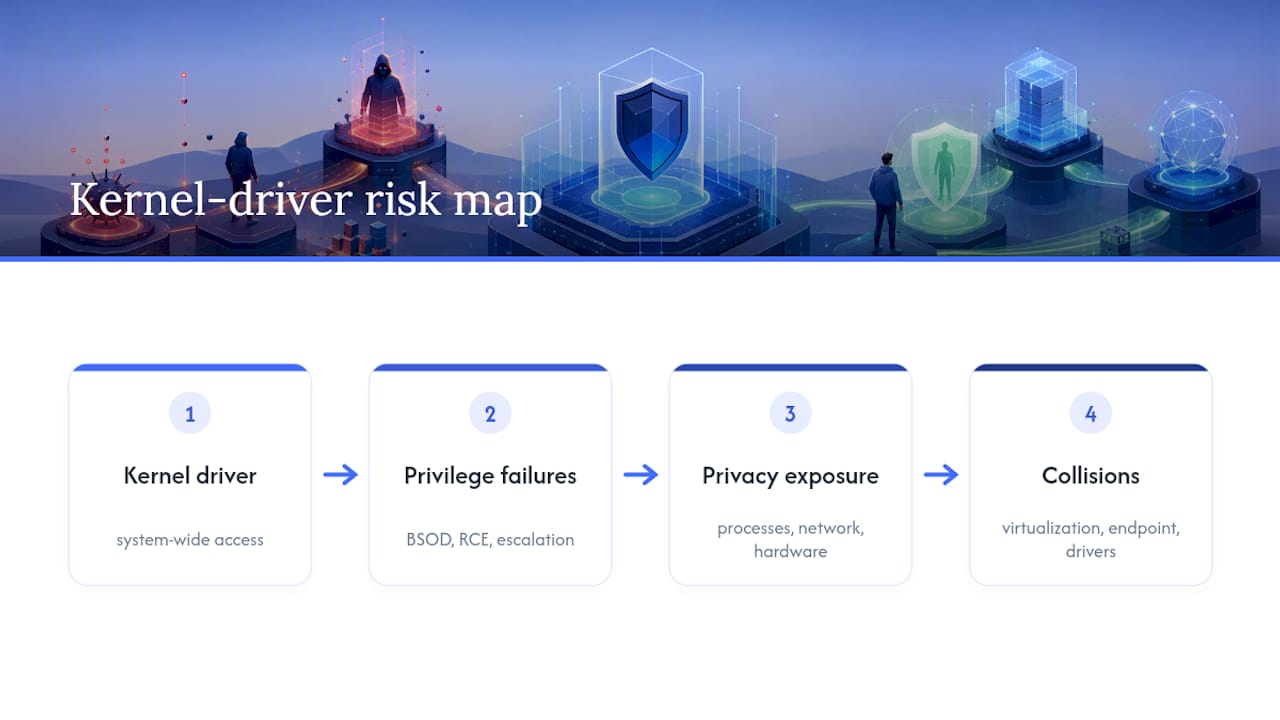
Privacy is the other half of the risk. A kernel driver with system-wide memory access can, in principle, see far more than the game it's meant to police: other running processes, network activity, connected hardware. Because these drivers are closed source, users have no independent way to audit what data actually gets collected, which is why transparency reporting around kernel access policy has become a bigger part of how Microsoft frames platform security. Kernel drivers can also collide with virtualization software, endpoint security tools, and other drivers competing for the same hooks, producing crashes that have nothing to do with cheating at all.
How Can You Reduce the Risk of Running Kernel Anti-Cheat?
You can't eliminate the exposure a kernel driver introduces, but you can shrink it. A few habits go a long way.
- Enable Secure Boot and, where your hardware supports it, TPM and Virtualization-Based Security (VBS). These platform features validate that only trusted, signed code loads early in the boot chain.
- Keep Windows and your GPU/motherboard drivers fully patched. Most kernel exploits target known, unpatched vulnerabilities rather than novel ones.
- Never install unsigned drivers from untrusted sources; Microsoft's signing requirement exists specifically to make this harder to do accidentally.
- Run day-to-day accounts without administrator rights where practical, limiting what any compromised process can escalate into.
Vendors have alternatives too. Server-side behavioral analytics, on-demand rather than persistent boot-time drivers, and hardware attestation through TPM and Secure Boot all reduce how much has to live permanently in Ring 0.
Pro Tip: You can check what's loaded on your own system with Driver Verifier or by reviewing signed drivers in Device Manager's driver details tab, comparing load timestamps against when you actually launched the game.
How Midnight-market Approaches Kernel-Level Risk
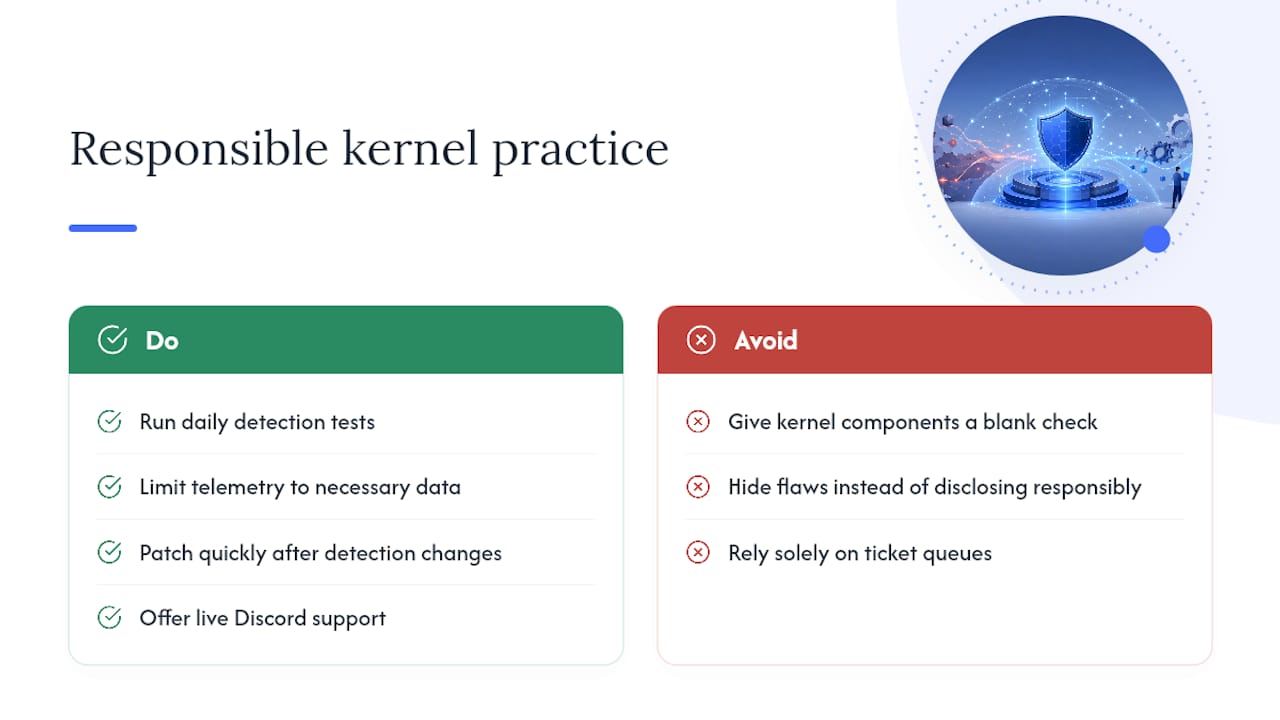
Some competitive titles genuinely need kernel-level detection to stay fair, and pretending otherwise ignores how sophisticated DMA and driver-based cheats have become. That doesn't mean every kernel component deserves a blank check.
Midnight-market's position is that responsible operation in this space means daily detection testing across supported titles, keeping telemetry limited to what's operationally necessary, and patching fast when a game's anti-cheat update changes detection behavior. Live support through Discord exists precisely because kernel-level anti-cheat is unpredictable, and users deserve a real answer when something breaks, not a ticket queue.
For readers who want more implementation detail, the kernel driver cheat risk primer and the walkthrough on cheat delivery systems go deeper into how these components get built and deployed. Security researchers who find something worth flagging are encouraged to disclose it responsibly rather than let it circulate quietly.
If you're evaluating options for a specific title, the current store catalog lists undetected cheats and DMA hardware tested against the latest anti-cheat patches, including Valorant DMA solutions built around the same hardware-level considerations covered above.
Where to Verify the Technical Details Yourself
Don't take any single explainer's word for how this works, including this one. Microsoft's own driver signing documentation and ZwMapViewOfSection reference lay out the actual API surface. The Wikipedia entry on kernel-level anti-cheat tracks vendor adoption and controversy, while Ars Technica's Vanguard coverage remains one of the sharpest pieces of incident-focused reporting on the topic.
What Should You Actually Take Away From This?
The conventional framing treats kernel anti-cheat as a binary: either you accept it or you don't play the game. That misses the more useful question, which is how much exposure a given implementation actually creates and whether the vendor is doing anything to limit it.
Boot-time persistent drivers with broad telemetry deserve more scrutiny than on-demand components with narrow scope, even when both get marketed the same way. The Birmingham research makes a point worth sitting with: kernel defenses haven't actually solved cheating, they've just moved the fight to a higher-stakes battlefield where the losses, when they happen, hit the entire operating system instead of one game session.
If you take one thing from this piece, prioritize patch hygiene and Secure Boot over worrying about which specific anti-cheat a game uses. The platform-level protections do more for your actual risk exposure than picking between competing Ring 0 vendors ever will.
— Fonics
Sources
- Kernel-level anti-cheat — Wikipedia
- Kernel-mode code signing (Microsoft)
- Ring 0 of fire: does Riot Games' anti-cheat go too far? — Ars Technica
- Windows kernel defenses aren't enough to stop a lucrative game-cheating market (University of Birmingham)
- Microsoft tightens kernel access after security incidents — The Verge