
A memory manipulation hack reads and writes a running game's RAM to freeze or override in-game values like health, ammo, or position. Before you go further, here is the decision you actually face:
- Use at your own risk: Account bans, EULA violations, potential civil liability, and malware exposure are real consequences, not edge cases.
- Choose safer alternatives: Hardware tuning, aim training, and coaching deliver competitive gains without touching game memory.
- If you still want a vendor: Vetting for daily testing, live support, and clear refund terms is the minimum bar. Midnight-market publishes this guide to help you make that call with full information.
Key technical concepts that matter here: ASLR (Address Space Layout Randomization) scrambles memory addresses on every launch, pointer chains resolve those shifting addresses reliably, and DMA hardware offloads memory reads to a separate device to avoid kernel-level detection.
Table of Contents
- What is a memory manipulation hack and how does it work?
- How do anti-cheat systems detect memory hacks?
- What are the legal and EULA risks in the United States?
- What does it actually cost and how long does setup take?
- What are the safer alternatives to gain a competitive edge?
- How do you vet a cheat vendor before handing over money?
- Midnight-market: daily-tested cheats for gamers who accept the risk
- Key Takeaways
- The real reason this guide exists
- Useful sources for further reading
What is a memory manipulation hack and how does it work?
At its core, a memory editing approach attaches to a game's running process, locates the memory address storing a value you want to change, then reads or overwrites it in a loop. The loop runs fast enough that the game never "sees" the value drop.
Key concepts in plain language:
- Process handle: The operating system permission that lets external software read or write another program's memory.
- Base module address: The starting memory location of the game's executable, which shifts every launch due to ASLR.
- Pointer chain: A sequence of offsets from the base module that leads to a specific value, surviving restarts because the chain logic stays valid even when addresses shift. Reverse pointer scanning is the standard method for building stable chains.
- AOB / pattern scan: Searching memory for a unique byte sequence to locate code or data without knowing the exact address.
- DMA (Direct Memory Access): A hardware method that reads game memory from a separate PCIe device, keeping the cheat process off the game machine entirely.
How the pieces connect:
| Input | Mechanism | Effect |
|---|---|---|
| Game process launch | ASLR randomizes base address | Hard-coded addresses break |
| Pointer chain resolution | Base module + offsets traversed | Stable target address found |
| Read/write loop | Value overwritten every ~0.01 seconds | In-game stat stays frozen |
| DMA hardware | Separate device reads PCIe bus | No cheat process on game PC |
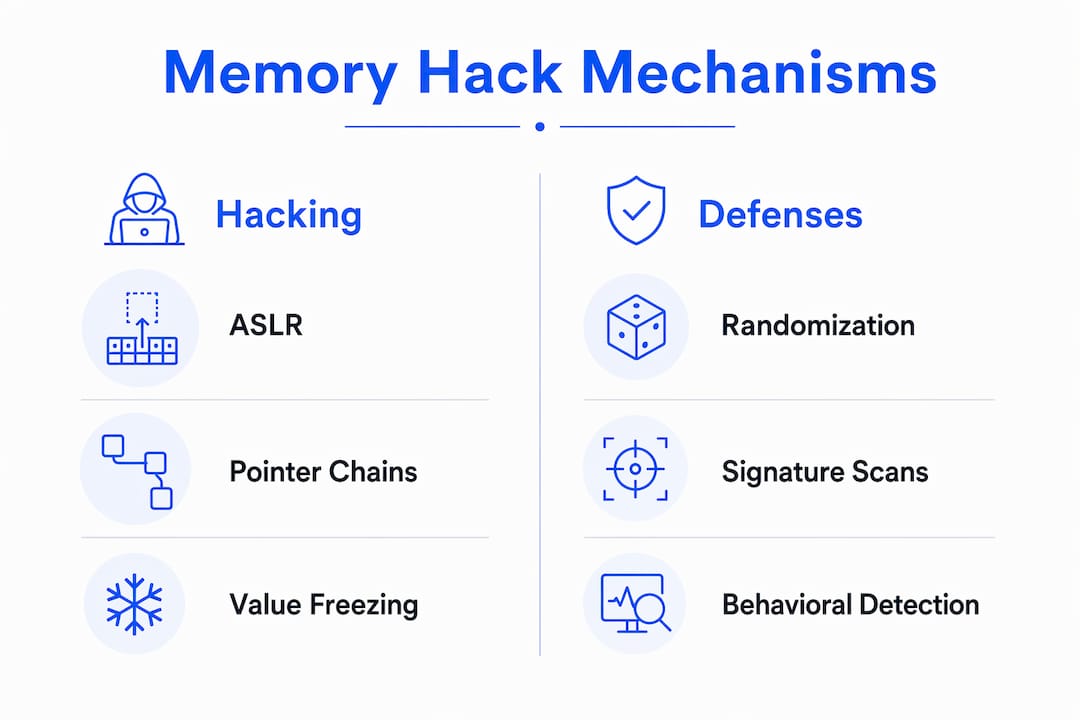
Beginner trainer scripts typically freeze values like health or ammo using exactly this loop structure. Sophisticated vendors add pattern scanning and instruction patching on top, which is where the technical gap between a $5 script and a maintained commercial product becomes obvious.

How do anti-cheat systems detect memory hacks?
Detection is not a single check. Modern anti-cheat runs multiple overlapping layers, and a cheat only needs to fail one.
- Kernel-level scanners: Software like Easy Anti-Cheat and BattlEye loads ring-0 drivers that inspect running processes, loaded modules, and memory regions the game should not be touching.
- Signature and pattern detection: Anti-cheat maintains databases of known cheat byte sequences. A cheat that hasn't been updated after a game patch often carries a stale signature.
- Behavioral and timing heuristics: Inhuman reaction times, perfect aim angles, or values that never decrease trigger statistical flags even without a direct memory scan.
- Driver and DMA detection: Anti-cheat increasingly fingerprints PCIe device signatures and checks for unauthorized kernel drivers. Web-based or remote-access memory editors add open network ports to that exposure surface.
Consequences when detection fires:
- Temporary or permanent account ban (often hardware-ID blacklisted, not just the account)
- Tournament disqualification and prize forfeiture
- Credential theft or malware infection from untrusted cheat binaries
Red flags that a cheat is likely already detected: no update in the past two weeks, no stated daily QA process, delivery as a random-named executable with no documentation. A deeper breakdown of why cheats get detected covers the specific failure modes worth knowing before you buy anything.
What are the legal and EULA risks in the United States?
The contractual risk is immediate and near-certain. The criminal risk is rare but real.
- EULA and TOS: Every major game publisher's end-user license agreement explicitly prohibits memory editing, third-party trainers, and unauthorized software. Violating the EULA gives the publisher the right to ban your account, revoke licenses, and pursue civil claims for damages.
- Civil liability: Publishers have sued cheat developers under the Computer Fraud and Abuse Act (CFAA) and the Digital Millennium Copyright Act (DMCA). Individual users are rarely targeted, but large-scale use or distribution changes that calculus.
- Criminal exposure: Rare for personal use, but distributing memory-editing tools commercially or using them to commit fraud can cross into federal computer crime territory.
- Hardware import risk: Specialized DMA devices imported from overseas may face customs scrutiny depending on classification. This is informational, not legal advice.
Action item: Read the specific EULA and platform rules (Steam Subscriber Agreement, Xbox Terms of Use, etc.) for every game you play before purchasing any third-party tool. Policies differ, and some are more aggressive about civil enforcement than others.
What does it actually cost and how long does setup take?
Realistic buyer expectations matter more than vendor marketing copy.
- Software cheats: Typically range from single-digit monthly fees for basic trainers to higher-tier subscriptions for maintained, anti-cheat-aware products. Cheap one-offs frequently break within days of a game update.
- HWID spoofers: Usually sold separately or bundled; they spoof hardware identifiers to avoid hardware bans after an account is flagged.
- DMA hardware: The most expensive route. Dedicated PCIe cards run into the hundreds of dollars. Setup requires physical installation, firmware configuration, and a second PC in some configurations.
Timeline reality:
- Digital key delivery: often instant after purchase, but activation and configuration add time.
- Pointer template stabilization after a game patch: hours to days, depending on vendor update speed.
- DMA hardware setup: expect several hours minimum for a first-time build.
The ongoing cost is the part buyers underestimate. Game updates routinely break cheats, and a vendor without a fast patch cycle means you paid for something that stops working the next Tuesday patch.
What are the safer alternatives to gain a competitive edge?
These options improve your actual performance without touching game memory or risking your account.
- Hardware and display tuning: A 240Hz monitor, low-latency GPU settings, and a wired connection reduce input lag in ways that are measurable and permanent. No ban risk.
- Network optimization: Reducing packet loss and ping through a wired Ethernet connection or a quality router can eliminate the lag spikes that cost rounds.
- Aim training software: Dedicated tools like KovaaK's or Aimlabs build muscle memory through deliberate practice. The gains transfer across titles.
- Coaching and VOD review: A single session with a ranked coach identifying your positioning errors often delivers more rank improvement than any software advantage.
- Legal configuration files and peripherals: Custom crosshairs, legal config tweaks, and high-DPI mice are within every game's terms and can meaningfully affect performance.
Pro Tip: Run a latency test using a free tool like PingPlotter before spending anything on cheats or hardware. Fixing a 60ms ping spike to 20ms often matters more than any in-game value modification.
How do you vet a cheat vendor before handing over money?
The vendor vetting step is where most buyers skip straight to regret.
Red flags to walk away from:
- No stated daily testing or QA methodology
- Missing or vague refund policy
- Delivery as an unsigned executable with no documentation
- No live support channel (Discord or equivalent)
- No hardware warranty on DMA products
Questions to ask before buying:
- How often do you update after a game patch, and what is the typical turnaround?
- Do you offer a refund if the product is detected within a stated window?
- What delivery method do you use, and is the installer signed or sandboxed?
- Is there a live Discord where I can get support before and after purchase?
- Do you provide pointer templates or just raw offsets?
Consumer protection basics: Pay with a method that supports chargebacks. Check that the vendor has a published privacy policy. Look for an active community with real post history, not a Discord with 10,000 members and zero recent messages.
Pro Tip: Scan any cheat binary through VirusTotal before running it. A legitimate vendor's installer should produce minimal or zero detections. Multiple AV flags on a fresh download is a malware warning, not a false positive.
Vendors who publish obfuscation and safety practices openly are signaling technical competence. Those who can't explain their QA process are telling you something too.
Midnight-market: daily-tested cheats for gamers who accept the risk
Midnight-market is built for competitive gamers who have weighed the risks and want a vendor they can actually trust. Every product in the Midnight-market store is tested daily across supported titles including Escape from Tarkov, Valorant, Apex Legends, Fortnite, Counter-Strike 2, and more. Hardware products like DMA cards carry warranties. Digital keys deliver instantly. Live Discord support means you are not left debugging alone at 2 AM after a patch drops.
Before purchasing, read the EULA and TOS for your game. Account bans and hardware blacklisting are real outcomes. Midnight-market's products are sold for use at the buyer's own risk, and the store's refund and privacy policies are published clearly so you know exactly what you are agreeing to.
Key Takeaways
Memory manipulation hacks carry real account, legal, and malware risks that most buyers underestimate before purchase.
| Point | Details |
|---|---|
| Core definition | Memory hacks read/write game RAM via pointer chains to freeze or override in-game values. |
| Biggest risk | Account bans and hardware blacklisting are near-certain if anti-cheat detects the tool. |
| Legal exposure | US game EULAs prohibit memory editing; civil claims under CFAA and DMCA are possible. |
| Safer alternatives | Hardware tuning, aim training, and coaching improve performance without account risk. |
| Midnight-market option | Daily-tested cheats, DMA hardware with warranties, and live Discord support for buyers who accept the risk. |
The real reason this guide exists
Midnight-market publishes this guide because the cheat market is full of vendors who skip the risk conversation entirely. That silence costs buyers accounts, money, and sometimes their hardware. The trust signals Midnight-market stands behind are daily QA testing, hardware warranties, instant delivery, and live Discord support — not marketing copy, but operational commitments. If you proceed, proceed informed.
Useful sources for further reading
- PyMemoryEditor documentation — Technical reference for pointer scanning, ASLR survival, and reverse pointer chain methodology; useful for understanding what a competent vendor's update process actually involves.
- muki01/Game_Memory_Hacking_Tutorial — Beginner trainer code showing the freeze-loop structure; useful for understanding what basic memory editing software does at a conceptual level.
- Kevin4e/K4MemPatcher — Pattern scanning and stable-pointer utilities; a reference for evaluating vendor technical claims.
- primetime00/memory_hack — Cross-platform memory editor with web front-end; illustrates remote-access risk vectors.
- Midnight-market store — Daily-tested cheats, HWID spoofers, and DMA hardware with warranties and live support.
- How game updates break cheats — Explains patch cycles and why vendor update speed is the single most important buying criterion.
- Why cheats get detected — Covers anti-cheat detection vectors in detail; read before evaluating any vendor's safety claims.