Cheat locks and key sharing don't mix well anymore. License locks pair a key with a specific device fingerprint, and modern server-side checks make casual key sharing unreliable and genuinely risky for your account. If you're weighing whether to split a key with a squad mate or grab a "shared" login off a forum, the answer is simple: don't.
Here's what to do instead:
- Buy a keyed license from a vendor you can verify, not a shared credential
- Activate it on your own machine immediately and register the device slot
- Turn on multi-factor authentication for every account tied to your purchase
Key Takeaways
Modern license systems bind keys to a single device through server-side activation, which is why sharing a key or account almost always ends in a block, a flag, or a permanent blacklist.
| Point | Details |
|---|---|
| Activation is server-side | Your key gets paired with a device fingerprint on the vendor's server, not stored locally. |
| Sharing triggers blacklisting | A second activation attempt on new hardware typically gets rejected or flags the key for review. |
| HWID uses multiple signals | Motherboard, disk, CPU/GPU, and OS markers combine to reduce false positives and resist simple spoofing. |
| Malware hides in cracked tools | Fake or shared cheats commonly bundle info-stealers and keyloggers behind a decoy interface. |
| Buy keyed, not shared | Midnight-Market issues individual keyed licenses with instant delivery, daily testing, and live Discord support for activation help. |
Table of Contents
- How Modern License-Key Systems Handle Activation and Revocation
- What Signals Do Vendors Use for HWID Locking?
- Why Sharing a Key or Account Usually Backfires
- What Spoofing Techniques Do Attackers Actually Use?
- Malware Risks Hiding in Shared and Cracked Cheat Tools
- What Are the Real Legal Risks of Cheating and Key Sharing?
- Is Using Game Cheats Ethical?
- How Key Sharing Damages Gaming Communities and Developers
- What Serious Buyers Get Wrong About Cheat Security
- Getting Set Up the Right Way With Midnight-Market
- Sources
How Modern License-Key Systems Handle Activation and Revocation
A license key by itself is just a string. What actually locks it to you happens the moment you activate: the vendor's server pairs your key with a device fingerprint and stores that record on its own backend, not on your PC. Try to activate that same key on a second machine and the server checks its records first.
That check usually plays out one of three ways:
- The activation is rejected outright because the key already has a device bound to it.
- The key gets flagged for review if the system sees repeated cross-device attempts in a short window.
- The key gets blacklisted entirely, which kills it for every device, including the original one.
Vendors increasingly rely on cryptographically signed activation tokens rather than raw key checks. The client gets a signed payload back from the server, embedding the device ID, and verifies it locally without ever touching the private signing key. That's what lets a cheat run offline for a session or two without phoning home constantly, while still keeping the actual trust decision server-side. The tradeoff is real: generous offline allowances are convenient for players with spotty connections, but they're also the exact window spoofers try to exploit before the next heartbeat check catches them.
What Signals Do Vendors Use for HWID Locking?
HWID locking isn't one number. It's a composite fingerprint built from several hardware and system markers, which is exactly why it's hard to spoof cleanly.
- Motherboard serial and BIOS UUID
- Disk volume identifiers and storage controller signatures
- CPU and GPU hardware signatures
- OS install markers and registry-level system IDs
Vendors combine several of these rather than relying on one because a single identifier is trivial to fake and prone to false positives. A disk swap or a fresh Windows install shouldn't nuke a legitimate customer's license, so most systems weight multiple signals and only flag activity when several change at once. Riot Games' own support documentation on hardware ID bans confirms publishers treat hardware identifiers as a core enforcement layer, not a side detail.
Most legitimate cheat vendors also build in device-slot management, letting you transfer an activation to a new rig or reset a slot after an upgrade without contacting support every time.
Pro Tip: Before you reformat, upgrade a GPU, or swap your motherboard, check whether your vendor's self-serve portal lets you release the old device slot first. Doing it after the fact usually means a support ticket instead of a two-click reset.
Why Sharing a Key or Account Usually Backfires
Splitting a key with a friend feels harmless until the second activation attempt hits the server and gets rejected. From there it escalates fast: a forced deactivation on the original device, a temporary flag on the key, or a permanent blacklist if the pattern repeats.
Shared accounts carry a separate layer of risk entirely. You're not just sharing a key, you're sharing login credentials tied to someone else's payment method, email, and purchase history. That setup means:
- Account recovery goes to whoever controls the original email, not you
- A chargeback on the original purchase can revoke access for everyone using that login
- Buyers of shared access typically have no appeal rights if the vendor bans the account
A comparison of game keys versus shared accounts lays this out plainly: a redeemed key tied to your own credentials is fundamentally more stable than access borrowed through someone else's account. Licensing guidance from vendors building these systems reaches the same conclusion, noting that server-side device binding is specifically designed to make key reuse a losing bet.
What Spoofing Techniques Do Attackers Actually Use?
Spoofing HWID locks isn't a single trick, it's a small industry with a few common approaches, each with its own detection weakness.
- User-mode spoofers patch the values a cheat reads at the application layer, which is the easiest to detect since kernel-level telemetry sees the real hardware underneath.
- Kernel-level driver spoofers intercept identifier calls before they reach user space, harder to catch but riskier to run since a bad driver can blue-screen a system or get flagged by anti-cheat kernel drivers.
- VM and container evasion tries to mask the environment entirely, but most licensing servers now check for virtualization artifacts as a baseline signal.
- Token replay and proxying attempts to reuse a valid signed token from another session, which sounds clever until you account for how often that token actually needs to check in.
That last one is the weak link. Dynamic analysis of commercial cheat clients found heartbeat validation cycles roughly every minute, all over TLS-encrypted channels. A replayed or proxied token has to survive that cadence indefinitely, and environment telemetry and TLS metadata tend to expose the mismatch faster than any single hardware ID check would.
Pro Tip: If a spoofer or bypass tool advertises itself as "permanent" or "one-time setup," treat that as a red flag rather than a selling point. Anything that doesn't need to keep talking to the vendor's server is also the thing least able to react when detection methods change.
Malware Risks Hiding in Shared and Cracked Cheat Tools
The scarier risk isn't a ban. It's what gets installed on your machine before the ban even happens. Cracked or "shared" cheat downloads are a favorite malware delivery vehicle precisely because the buyer's guard is already down, they expect to run something a little sketchy.
Common packaging includes patched DLLs, injectors bundled with hidden payloads, and packed executables designed to slip past basic antivirus signatures. Security research into cheat-delivered malware documents info-stealers, keyloggers, and cryptominers riding along with these tools, often installed silently behind a decoy interface that looks like the cheat menu you expected.
The biggest tell: any tool that instructs you to disable your antivirus or run as administrator before it'll work.
- A legitimate vendor doesn't need you blind to your own security software
- Cheat tools that overpromise features across every game are a common malware lure
- Cracked keys distributed on forums frequently carry payloads the original product never had
What Are the Real Legal Risks of Cheating and Key Sharing?
The legal exposure here splits into two separate tracks, and conflating them gets people into trouble.
Using a cheat in most competitive games is a contract violation, not a criminal act. Every major title's terms of service prohibits unauthorized modification of game clients, and violating that contract gets you banned, not arrested. That's a civil matter between you and the publisher, governed by the end user license agreement you accepted at install.
Key sharing changes the picture somewhat. Reselling or redistributing a license you don't have rights to redistribute can cross into actual intellectual property and licensing law, particularly if you're profiting from it at scale rather than sharing casually with a friend. Vendors selling cheat software typically license a key to a single buyer for personal use, and running an operation that resells or splits those keys commercially can expose you to breach-of-contract claims from the vendor itself, on top of any ban.
There's a separate, more serious category worth naming directly: if a cracked or shared tool installs malware on your system, and that malware is later used to access other systems or data without authorization, you can find yourself unintentionally implicated in something far bigger than a game ban. That's not a hypothetical scare tactic, it's the actual mechanism by which cheat-adjacent malware cases escalate. Sticking to a properly licensed key from a vendor you can verify keeps you firmly on the "contract violation, not criminal exposure" side of that line.
Is Using Game Cheats Ethical?
Ask ten competitive players this question and you'll get ten different lines drawn in ten different places, but a few distinctions hold up under scrutiny.
Using a cheat in a ranked, competitive match against opponents who aren't consenting to play against an aim assist or wallhack is a straightforward integrity problem. It changes the outcome for people who didn't sign up for that outcome, and that's true regardless of how good your excuse is. Most competitive gamers who buy cheats already know this and aren't looking for permission, they're looking for information about doing it with less exposure.
Where the ethics get genuinely more complicated is sharing. Splitting or reselling a key doesn't just add legal risk to you, it puts other people's access, money, and account security in the hands of someone they've never dealt with directly. If the original buyer's account gets banned or the key gets blacklisted, everyone downstream loses access with zero warning and zero recourse. That's a worse deal for your friend than just buying their own license, and it's worth being honest about that before you split a key to save $10.
There's also a quieter ethical case for using cheats only in casual, low-stakes contexts, like testing content, streaming for entertainment, or private lobbies with consenting participants, where the "who's the victim" question mostly disappears. That distinction matters more to how a lot of experienced buyers actually behave than the black-and-white framing suggests.
How Key Sharing Damages Gaming Communities and Developers
Every shared key and blacklisted account creates a small ripple that developers absolutely track. When a vendor blacklists a compromised or shared key, that's a lost sale converted into a support burden, and support costs get passed along eventually through higher prices or stricter enforcement.
The bigger community cost shows up in matchmaking quality. Widespread key sharing tends to correlate with sloppier operational security among users, since shared credentials get posted in public Discords and forums where anyone can grab them. That makes detection noisier for vendors trying to keep their user base clean, which in turn makes it harder for legitimate buyers to get quiet, low-detection access. Every publicly leaked or resold key is one more data point anti-cheat systems can use to build detection signatures against the whole product line, not just the person who leaked it.
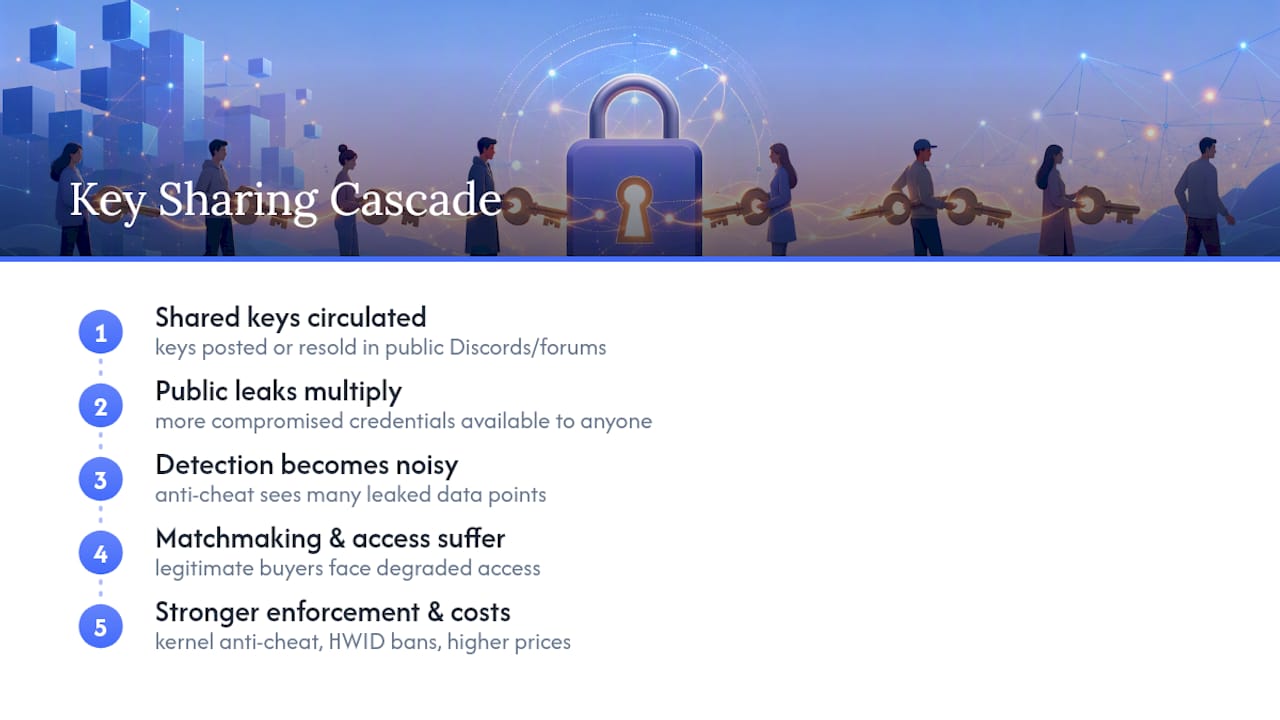
Game developers, for their part, respond to widespread cheat proliferation by investing more heavily in kernel-level anti-cheat and hardware ban enforcement, the same HWID ban infrastructure Riot documents publicly. That arms race raises costs and friction for everyone, including cheat vendors who then have to update more frequently to stay ahead. Key sharing accelerates that cycle. A single leaked key that gets passed around a Discord server can burn through a vendor's undetected window far faster than one careful buyer running it solo ever would.
What Serious Buyers Get Wrong About Cheat Security
Most guides treat license locks and HWID binding as an inconvenience to route around. That's backward. The lock is the single biggest thing standing between you and a wasted purchase, and treating it as an obstacle rather than a safeguard is how people end up buying the same key twice.
The bigger blind spot is how many buyers focus entirely on detection risk while ignoring account and system risk, which is usually larger. A ban costs you a purchase. A keylogger bundled in a cracked cheat costs you every account tied to that machine, gaming or otherwise. The malware risk isn't evenly distributed either. It clusters almost entirely around free, cracked, or shared sources, which is exactly why a properly licensed key with an active device slot is a fundamentally different risk profile than a login pulled off a forum thread.
There's also a stubborn myth that persistent spoofing is a solved problem if you just find the right tool. It isn't, and can't be, because spoofing has to keep pace with detection that's actively evolving on the vendor's side too. Anyone selling a "permanent bypass" is selling you a product with a shelf life they're not telling you about.
— Fonics
Getting Set Up the Right Way With Midnight-Market
Midnight-Market sells keyed licenses, not shared logins, which is the whole point after everything above. Every purchase, whether it's an undetected cheat for a title like Escape from Tarkov or Valorant, a DMA hardware setup, or an HWID spoofer, comes with instant key delivery so you can activate on your own device right away instead of waiting around or sharing access with someone else in the meantime.
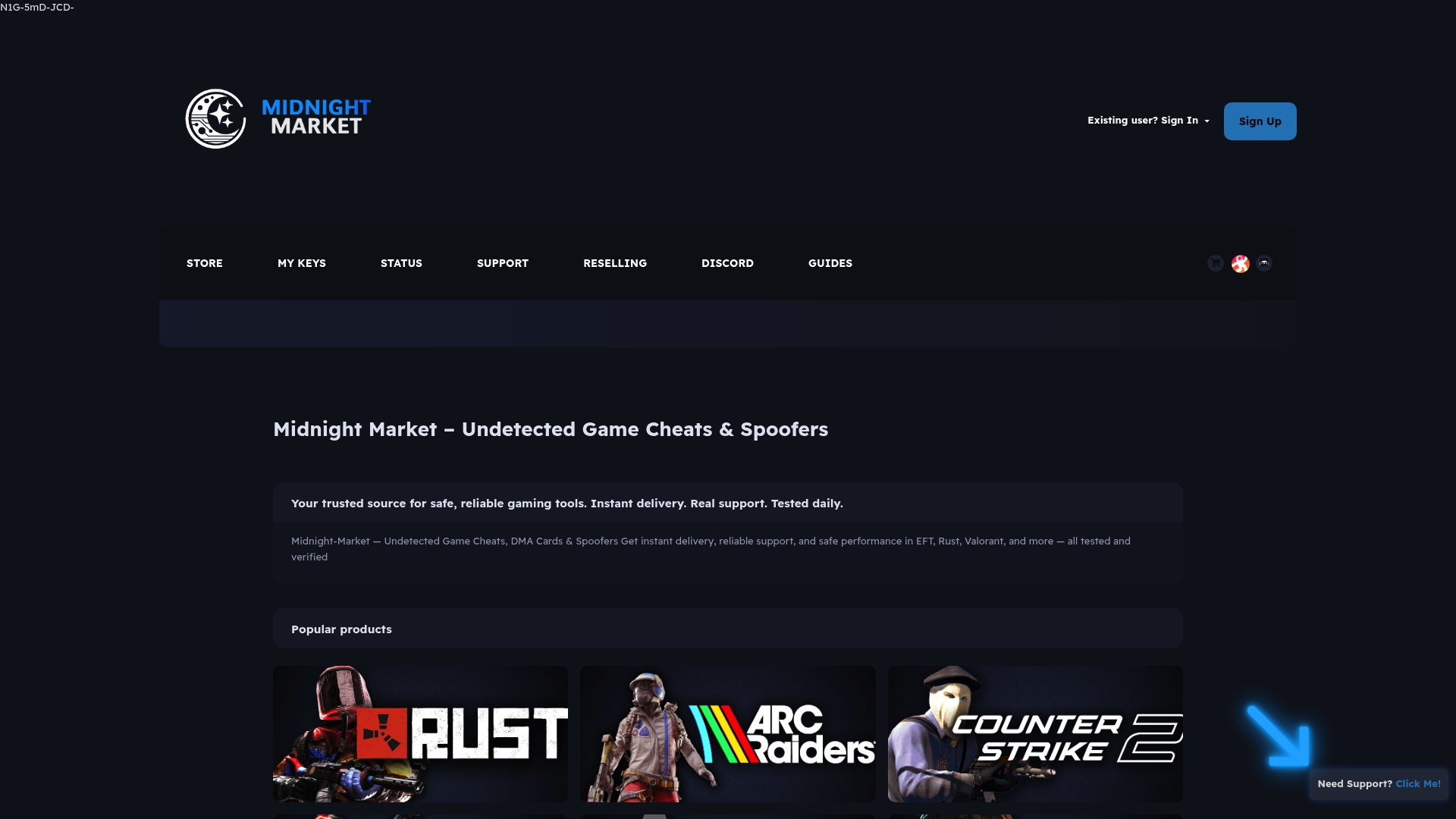
Daily testing is built into the product cycle, not bolted on after complaints roll in, which shortens the window between a detection method shifting and a fix going out. Live Discord support means if you need a device slot reset after a hardware upgrade, or you're not sure how to activate a fresh key, there's a real person answering instead of a ticket queue. Hardware products carry warranty coverage too, which matters if you're investing in a DMA card setup and want it to keep working past the first patch cycle.
Browse the current lineup at the Midnight-Market store and check activation instructions before you buy so device-slot transfers don't catch you off guard later.
Sources
- How to build a license system that doesn't get abused | Keyforge
- The latest malware hiding in video game cheat codes
- Game key vs shared account guide
- Riot Games Support: understanding hardware ID (HWID) bans
- Reverse-engineering commercial video-game AI cheat (Part 1) | Armada / risk3sixty