A trustworthy cheat provider proves itself through daily testing with visible changelogs, live public support, secure delivery and payment handling, a real warranty, and reproducible community proof. If a seller can't show all five, treat every "undetected" claim as marketing, not fact. Vet with a checklist, and remember: no provider, no matter how good, can promise permanent undetectability.
TL;DR:
- Daily testing with proof of recent updates and active change logs is crucial to verify a cheat provider’s ongoing effectiveness.
- Live, public support channels like Discord indicate a provider's operational transparency and responsiveness, not just marketing claims.
- Secure checkout with recognizable payment processors, clear refund policies, and time-stamped proof are essential for ensuring safety and legitimacy.
- Hardware-level protections such as TPM 2.0 and Secure Boot significantly reduce cheatability at the system level, making undetectability harder to promise.
- A provider’s long-term industry presence, responsive support, and transparent testing history are stronger indicators of trust than recent registration alone.
Table of Contents
- What Concrete Trust Markers Should You Check First?
- Why Is Undetected Software Getting Harder To Trust?
- How Do You Vet a Cheat Provider Before Buying?
- Which Trust Markers Does a Vetted Provider Actually Show?
- Does a Provider's History Actually Matter?
- What Security Risks Come With Using a Cheat Provider?
- When Is It Actually Time to Walk Away?
- Where Can You Learn More About Anti-Cheat and Detection Research?
- Get Undetected Cheats Backed by Daily Testing and Real Support
- Sources
What Concrete Trust Markers Should You Check First?
Cheat provider trust isn't a vibe. It's a set of verifiable behaviors, and most sellers fail at least one of them the moment you look closely. Before you hand over money or a credit card number, run through the five markers that separate a professional operation from a fly-by-night storefront that vanishes after a ban wave.
Daily testing and visible changelogs. A provider that actually tests against live anti-cheat systems publishes proof of it. Look for a changelog with real dates, not vague "updated recently" language. If the last entry is three weeks old for a game that patches weekly, that's your answer.
Live, public support channels. A Discord server with active staff, visible response times, and a history of public troubleshooting tells you more than any testimonial page. Ghost-town servers or DM-only "support" are a bad sign.
Delivery and payment security. Check for SSL on the checkout page, recognizable payment processors, and a stated refund or warranty policy before you buy, not after something breaks. Sketchy crypto-only checkouts with no alternative are a signal to slow down.
Reproducible proof. Time-stamped clips, visible logs, or independently verifiable gameplay footage matter more than a glossy trailer. Anyone can render a highlight reel; fewer sellers can show raw, dated proof tied to a specific patch version.
After-sale support for new patches. Games update constantly. A provider worth trusting tells you upfront how fast they typically restore compatibility after a major patch, and whether that support is included or billed separately.
- Daily testing with a public, dated changelog
- Active Discord or equivalent live support with visible staff responses
- SSL checkout, named payment processors, and written refund/warranty terms
- Time-stamped proof clips or logs, not just marketing footage
- Clear commitment to post-patch updates and compatibility fixes
Pro Tip: Open a provider's Discord and scroll their support channel history before buying. A real support operation has months of back-and-forth troubleshooting visible to anyone. A fake one has a handful of bot messages and nothing else.
Prior write-ups on why cheats get detected go deeper into the specific detection methods behind these markers, which helps explain why testing cadence matters as much as the cheat's feature list.
Why Is Undetected Software Getting Harder To Trust?
Anti-cheat has changed shape, and most cheat marketing hasn't caught up. Modern detection increasingly happens below the game itself, at the hardware and firmware layer, which shrinks the margin for error that used to protect sloppy software.
TPM 2.0 and Secure Boot are the biggest shift. Game developers now lean on hardware-level protections like TPM 2.0 and Secure Boot to verify that a system's boot chain and firmware haven't been tampered with. Once a title checks hardware attestation rather than just scanning running processes, a cheat that relies on injecting into memory has a much smaller window to operate unnoticed.
Kernel-mode sensors see more than user-mode ones ever could. A cheat running in user mode is easier to build and easier to catch. Kernel-level anti-cheat sits at the same privilege level as the operating system, which means it can observe driver behavior, memory access patterns, and hardware signatures that user-mode tools never touch. Providers who promise "undetected" without acknowledging which layer they're evading are skipping the part that actually matters.
Detection is shifting from reactive bans to near real-time verification. Academic research on the Trust-Verify Game Protocol (TVGP) describes a "trust but verify" referee model that uses behavior-based sensors to catch tampering, including exploits tied to ping manipulation, fabricated inputs, and sybil-style account abuse, all while keeping performance overhead low. That's a meaningful departure from older signature-based detection, which only flagged known cheat files after the fact.
By the numbers: TVGP-style sensor validation can flag multiple tampering categories in near real time rather than waiting for a scheduled ban wave, according to the MDPI study on trust-but-verify protocols. That shortens the practical lifespan of any cheat that hasn't been tested against similar behavior-based checks.
Patch cycles create short safety windows, not permanent ones. Even a cheat that works flawlessly today can break, or get flagged, the moment a developer ships a patch. Enforcement campaigns and provider takedowns reported across the industry show that developers are actively hunting providers, not just individual accounts. A provider's stability, and their speed at reacting to a patch, is now a trust signal in its own right.
- TPM 2.0 and Secure Boot narrow the gap cheats can exploit at the system level
- Kernel-mode detection sees hardware and driver behavior that user-mode scans miss
- Behavior-based referee models like TVGP catch tampering patterns, not just known files
- Ban waves and provider takedowns are increasing, making longevity a real trust factor
Readers who want the deeper mechanics behind hardware spoofing and DMA-based approaches can check how hardware cheat devices work for the technical breakdown.
How Do You Vet a Cheat Provider Before Buying?
Treat this like due diligence on any online purchase where you're trusting a stranger with your money and your account. A few minutes of checking saves you from a ban, a stolen payment method, or both.
- Ask about testing cadence directly. A provider should be able to tell you, without hedging, when their software was last tested against the specific game you're playing. "Recently" is not an answer. A date and a patch version are.
- Request proof tied to the current patch. Old clips prove nothing about today's build. Ask for footage or logs dated after the most recent game update, and check whether the community backs that claim in reviews or Discord chatter.
- Ask what happens if you get banned. A written warranty policy, even a limited one, shows the provider has thought through the worst case. No policy at all means you're absorbing all the risk.
- Check the domain and SSL certificate. A legitimate storefront runs HTTPS with a valid certificate and has been registered for more than a few weeks. A brand-new domain with no history is a red flag on its own.
- Scan independent community feedback. Reddit threads, Discord server reviews, and third-party forum mentions tend to surface complaints faster than a provider's own testimonial page ever will.
- Verify the payment flow before entering card details. Recognizable processors, a secure checkout, and the option to use a virtual or one-time card number are all signs of a provider that isn't trying to skim payment data.
Red flags that should stop you cold: an anonymous seller with no verifiable history, pressure to disable antivirus or Windows Defender before you've even paid, zero reproducible proof beyond a demo reel, and insistence on unconventional payment methods with no refund path. Any one of these on its own is a caution. Two or more together means walk away.
Payment fraud and low-quality software often travel together. The breakdown on how low quality cheats compromise accounts covers the mechanics of how a bad provider turns into a bad week for your bank account, not just your game account.
Pro Tip: If a seller asks you to disable your antivirus "for compatibility" before you've even received the product, that's not a technical requirement. That's how malware gets installed without a fight.
Which Trust Markers Does a Vetted Provider Actually Show?
Midnight-market builds its process around the same markers a careful buyer should demand from anyone in this category. Here's how those proof points map directly onto the checklist above.
- Daily testing → public changelog. Products are tested against live anti-cheat on a daily basis, with changes logged rather than left to a vague "we update often" claim.
- Discord presence → live support. Real-time staff support through Discord means questions about compatibility, delivery, or a specific game patch get answered by a person, not a ticket queue that goes silent.
- Hardware warranties → post-sale protection. DMA hardware and spoofer purchases come with warranty coverage, which shifts some of the financial risk off the buyer if something fails.
- Instant delivery → payment and access confidence. Keys are delivered immediately after checkout, which removes the multi-day limbo where a lot of shady sellers disappear.
None of that erases the underlying reality covered earlier: detection windows are shrinking industry-wide as hardware-level checks and behavior-based sensors spread. A warranty doesn't make a product permanently undetectable. It makes the financial consequence of a bad patch cycle smaller and gives you a support channel when things break instead of silence.
| Checklist item | What to verify with any provider |
|---|---|
| Testing cadence | Ask for the most recent changelog date and patch version tested |
| Live support | Join the Discord and check for active, dated staff responses |
| Payment safety | Confirm SSL checkout and a named payment processor before buying |
| Warranty terms | Get the refund or replacement policy in writing before purchase |
| Reproducible proof | Look for time-stamped clips or logs, not just a highlight reel |
If you're evaluating Midnight-market specifically, the practical move is to ask support for a recent changelog entry tied to your game and walk through the delivery process before committing to a bundle. The store page lists current product warranty terms alongside each title, so you can compare that against whatever another provider is offering before you decide.
Does a Provider's History Actually Matter?
It matters more than most buyers assume. A cheat provider's track record tells you how they've handled the two things that actually break trust: a major anti-cheat update and a payment dispute. Providers that have survived multiple developer enforcement waves, and kept support running through them, have demonstrated something a brand-new storefront simply hasn't had the chance to prove.
Longevity isn't the same as quality, but it correlates with operational discipline. A provider that's been publicly tracked, discussed, and scrutinized by a community for a year or more has left a paper trail. You can search their name alongside "banned," "refund," or "scam" and see what surfaces. A provider registered last month has no such trail, which cuts both ways: they might be legitimate and new, or they might be a rebrand of something that already burned its reputation once.
Watch for pattern behavior across rebrands. Some providers fold under enforcement pressure or legal exposure and reopen under a new name with the same Discord staff and the same product lineup. That's not automatically disqualifying, but it's worth knowing before you buy, since a provider's history of takedowns says something about how much developer attention they've attracted.
What Security Risks Come With Using a Cheat Provider?
Beyond detection risk, there's a quieter danger: what the software itself does to your machine and your data. Cracked or "free" cheat downloads are one of the more common malware delivery methods in gaming communities, often bundled with keyloggers or credential stealers disguised as the cheat's installer.
Paid providers aren't automatically safe either. A seller with no visible testing process or code review practice can unknowingly (or knowingly) ship compromised software. That's why delivery security and payment processor legitimacy matter just as much as whether the cheat itself avoids detection. A checkout without SSL, or a seller pushing you toward untraceable payment methods, isn't just a financial risk. It's often a sign the same corner-cutting extends to the product itself.
Data leaks are the other half of this risk. Handing account credentials, payment details, or system access to an unverified seller means trusting them with information you can't easily take back. Guidance on maintaining a clean account while using cheats covers practical hygiene steps, but the first line of defense is simply not buying from a seller who can't show a secure, transparent process to begin with.
When Is It Actually Time to Walk Away?
Walk away the moment a provider asks you to disable security software, refuses to show recent proof, or has no visible support history. That's not caution for its own sake, it's the same standard you'd apply to any online seller asking for your card details and system access at once. Competitive advantage is not worth a compromised account, a compromised PC, or a permanent ban that follows you across a game's ecosystem.
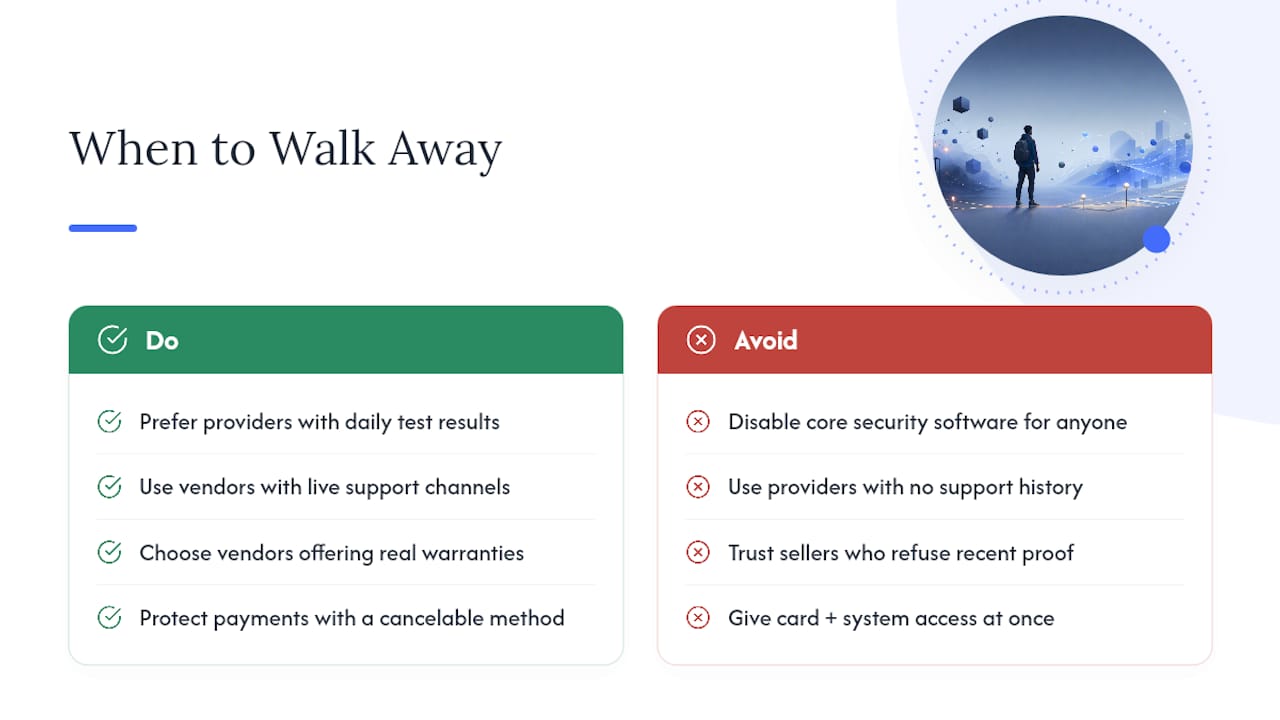
That said, informed choice matters more than blanket refusal. A provider that publishes daily test results, staffs a live support channel, and backs hardware purchases with a real warranty has taken on more accountability than a majority of the market. That doesn't eliminate risk, since detection keeps evolving and no cheat stays invisible forever. It does mean the provider has given you tools to react when something breaks instead of leaving you stranded.
Protect yourself regardless of which provider you choose. Use a dedicated payment method you can cancel easily, keep personal accounts separate from gaming accounts where possible, and never disable core security software just because a seller insists it's necessary. Read the guide on why switching providers helps your game if a provider you're using starts showing the warning signs covered above. Reputation and responsiveness should always outweigh a lower price.
— Fonics
Where Can You Learn More About Anti-Cheat and Detection Research?
For readers who want to go past the surface-level marketing claims and understand the actual technology behind modern detection, these sources go deeper than most gaming forums ever will:
- The Trusted Computing Group's primer on TPM and anti-cheat explains how hardware attestation and Secure Boot integrate with game security.
- The MDPI research paper on the Trust-Verify Game Protocol breaks down behavior-based sensor validation and its tampering-detection results.
- Xbox's industry reporting on trusted gaming security covers how developers are ramping up enforcement against providers at scale.
Get Undetected Cheats Backed by Daily Testing and Real Support
Midnight-market is built for the exact vetting checklist covered in this article, not around it. Every product gets tested daily against live anti-cheat, changes get logged, and support runs through an active Discord where staff actually answer, not a contact form that disappears into a queue.
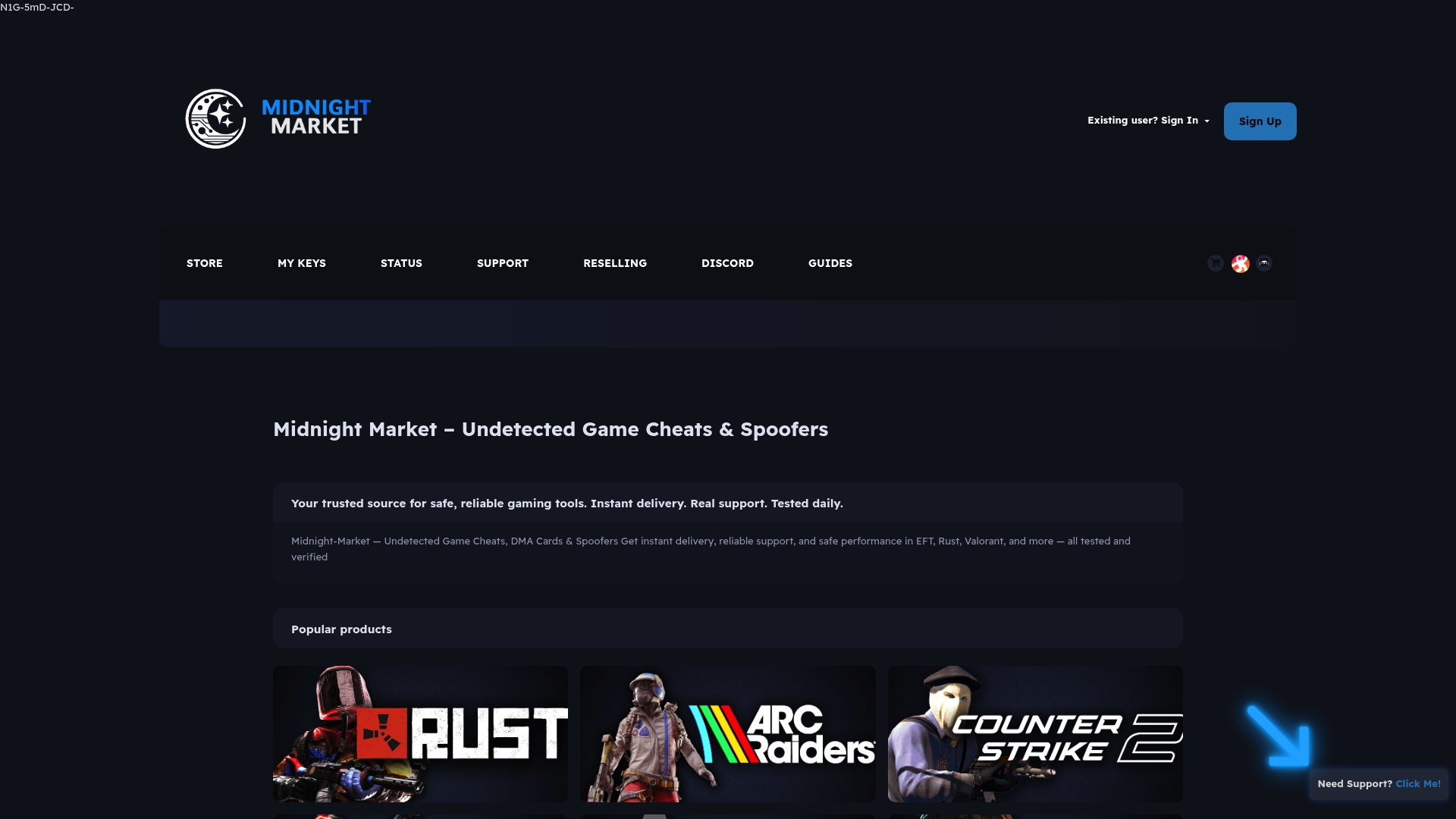
Hardware purchases come with warranty coverage, and keys deliver instantly after checkout, so you're not stuck waiting days while wondering if the seller is even real. If you're comparing that against a provider with no visible changelog or support history, the difference in risk isn't small. Browse the current lineup on the Midnight-market store, including titles like the ARK: Survival Ascended cheat package, and check the listed warranty terms before you buy. Ask support for the most recent changelog entry on your game of choice. That one question tells you more about a provider than any sales page ever will.
Sources
- Trustworthy high-performance multiplayer games with trust-but-verify protocol sensor validation | MDPI
- Building a trusted gaming future: how security powers fair play | Xbox News