An external hack is an out-of-process program that reads or writes game data by calling Windows APIs like ReadProcessMemory from a separate executable, without injecting code into the game's memory space. That architectural choice sounds cleaner than injection, but it carries the same legal exposure under the Computer Fraud and Abuse Act (18 U.S.C. § 1030), the same account-ban risk, and a serious malware threat from the underground marketplaces where most of these tools circulate. If you're here to understand what they are, how detection works, and what safer paths exist, you're in the right place.
Table of Contents
- What exactly is an external hack, and how does it differ from an internal one?
- Common features you'll see listed in external cheats
- Legal, account, and hardware risks in the United States
- How anti-cheat and detection systems actually work
- How to spot scams and stay safer when researching cheats
- Ethical alternatives that give you the same competitive edge
- How to study game security and reverse engineering ethically
- How external hacks evolved from trainers to modern cheats
- How other countries approach game hacking legally
- What external hacks actually cost the gaming community
- The psychological and social side of using cheats
- Key Takeaways
- The real cost of shortcuts in competitive gaming
- Midnight-market: daily-tested cheats with real support behind them
- Useful sources and further reading
What exactly is an external hack, and how does it differ from an internal one?
The core distinction comes down to process boundaries. An external hack runs as its own process and attaches to the game from the outside using standard Windows API calls. An internal hack (sometimes called a private hack or injected cheat) loads a DLL directly into the game's process, giving it full access to the game's memory, functions, and hooks from within.
Here's what the typical external workflow looks like at the OS level:
- OpenProcess — the external calls OpenProcess to obtain a handle to the running game process, requesting read or write access.
- ReadProcessMemory — with that handle, it reads values from specific memory addresses; the Microsoft documentation covers the exact parameters and access-right requirements.
- WriteProcessMemory — some externals also write back to modify values like ammo counts or movement speed, which increases both detection surface and legal risk.
Because the external never touches the game's code pages, it avoids some injection-based signatures. The trade-off is performance: every memory read crosses a process boundary, which is slower and noisier than an in-process pointer dereference. Modern games also use Address Space Layout Randomization (ASLR), which randomizes base addresses at each launch, so externals must resolve pointer chains or scan for byte patterns on every run.
The Game Hacking Academy's external memory tutorial demonstrates this workflow clearly using a non-protected single-player target, which is the only context where practicing these techniques is legally and ethically defensible. The David Gomes primer on internal vs. external hacks is another solid community reference that walks through the architectural difference with code examples.
For a deeper look at memory manipulation concepts, the Midnight-market blog covers the defensive side of these techniques in plain language.
Common features you'll see listed in external cheats
Knowing what these feature categories do helps you evaluate claims in repos, forums, or store listings without needing implementation details. The table below maps each feature to its user-facing behavior and its detection profile.
| Feature | What the user sees | Detection surface |
|---|---|---|
| ESP / Box ESP | Colored boxes drawn around players through walls | Overlay process + frequent memory reads |
| Bone ESP | Skeletal wireframe showing player posture | High-frequency ReadProcessMemory on bone matrices |
| Radar | Mini-map showing enemy positions | Reads position data; server-side position validation can flag impossible awareness |
| Triggerbot | Auto-fires when crosshair overlaps an enemy hitbox | Input timing anomalies; server-side shot-pattern analysis |
| Aim assistance / silent aim | Snaps or smooths aim toward targets | Mouse-input velocity patterns; server-side hit-rate outliers |
| Recoil compensation | Counters weapon recoil via input manipulation | Input-pattern heuristics |
| Data exporter / position logger | Logs entity positions to a file | Disk I/O patterns; less visible to anti-cheat but violates TOS |
Public repositories like TKazer/CS2_External on GitHub list these feature names explicitly: BoneESP, BoxESP, AimBot, Radar, TriggerBot. They're useful for understanding naming conventions, not as build guides.
Features that rely on client-side rendering (ESP overlays, radar) are harder for servers to detect directly because the server never sees the overlay. Features that affect inputs or shots (triggerbot, aim assistance) are far more exposed to server-side statistical analysis, since the server sees every shot, every hit, and every timing pattern. That distinction matters when evaluating ban risk: visual-only features don't guarantee safety, but input-manipulation features are the fastest path to a permanent ban.
Game updates routinely break offset chains, which is why cheats break after patches and why "undetected" claims have a short shelf life.
Legal, account, and hardware risks in the United States
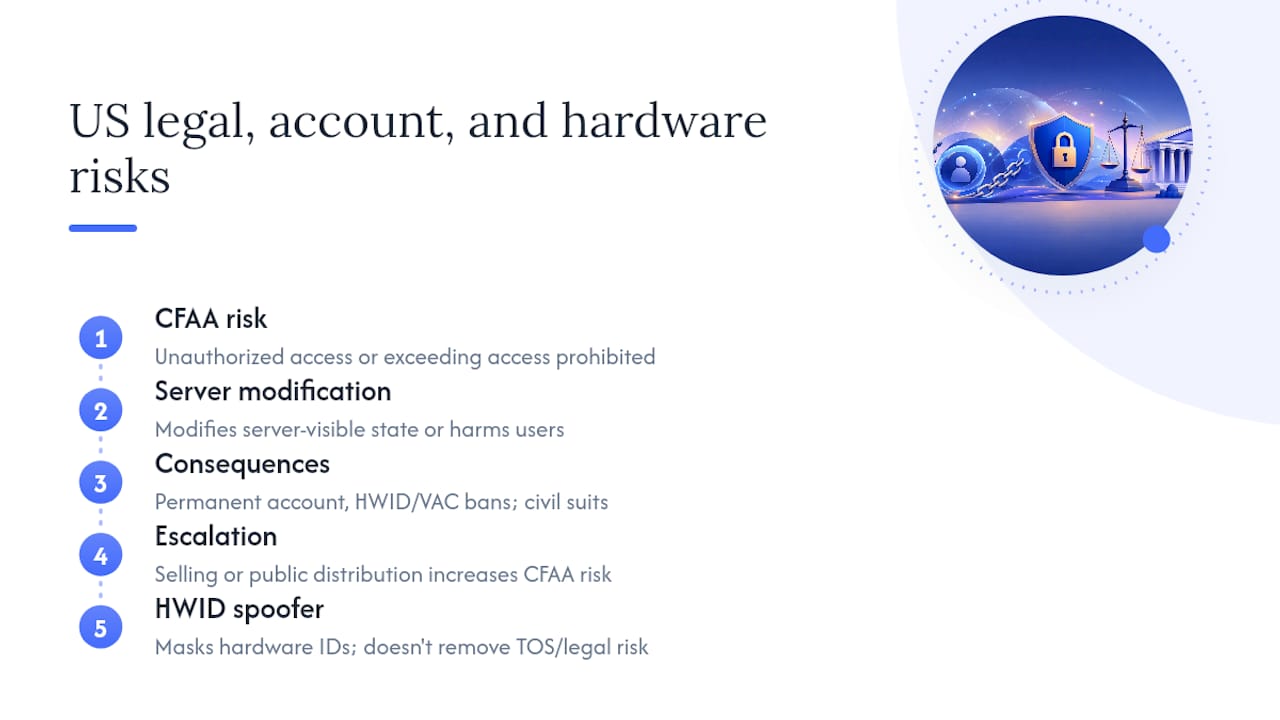
The legal exposure is real and often underestimated. The Computer Fraud and Abuse Act (18 U.S.C. § 1030) is the primary federal statute. It prohibits intentionally accessing a computer without authorization or exceeding authorized access in ways that cause damage or obtain information. Using an external cheat on a multiplayer game server you don't own can fit that framing, particularly if the cheat modifies server-visible state or degrades other users' experience.
"Private-party offensive measures that access or damage others' systems are likely unlawful without explicit government authorization under the CFAA. The line between defensive research and unauthorized access is narrower than most people assume." — Aspen Digital, "So you want to hack back?"
Beyond federal criminal law, every major game publisher's Terms of Service creates civil remedies. Valve, Riot Games, and Activision all reserve the right to pursue damages for TOS violations, and courts have upheld these claims. The practical consequence for most users isn't a federal prosecution; it's a permanent account ban, a hardware ban (HWID ban), or a VAC-style ban that follows your hardware fingerprint across games.
Pro Tip: If you receive a hardware ban, a HWID spoofer can mask your hardware identifiers, but it doesn't reverse the underlying TOS violation or eliminate legal risk.
The legal risk escalates sharply with distribution. Using a cheat privately sits at one end of the spectrum. Selling it, distributing it publicly, or building tools that specifically target other users' systems moves you into territory where CFAA criminal charges and civil suits become genuinely plausible. The Aspen Digital legal analysis makes clear that the CFAA's reach is broad enough to cover many offensive measures that private actors assume are legal.
How anti-cheat and detection systems actually work
Detection is layered, and no single method catches everything. Understanding the layers explains why "undetected" is always a temporary claim.
"Anti-cheat systems don't need to catch every cheat. They need to raise the cost of cheating high enough that most users give up. Behavioral and server-side checks do exactly that — they catch patterns, not just signatures." — Security researcher framing widely cited in anti-cheat engineering discussions.
| Detection layer | What it monitors | What triggers it |
|---|---|---|
| Signature scanning | Known binary patterns in memory or on disk | Recognized cheat DLLs, known overlay windows |
| API call monitoring | OpenProcess, ReadProcessMemory call frequency | Repeated cross-process reads at game-tick intervals |
| Kernel-mode agents | Driver integrity, unsigned drivers, hook detection | Unsigned or self-signed kernel drivers |
| Behavioral heuristics | Input patterns, aim velocity, shot timing | Inhuman reaction times, perfect recoil correction |
| Server-side validation | Hit rates, position awareness, movement physics | Statistical outliers in shot accuracy or enemy awareness |
External hacks are particularly visible to API-monitoring layers because ReadProcessMemory calls from a non-game process are unusual. Modern anti-cheat solutions like Riot's Vanguard and Easy Anti-Cheat run kernel-mode components that can observe these calls directly. Overlay windows also leave detectable traces: a transparent topmost window with no taskbar entry is a known signature.
Server-side validation is the hardest layer to beat because it operates on data the cheat author can't control. A server that knows where all players are can detect when a client's behavior implies knowledge it shouldn't have.
For a plain-language breakdown of why specific cheats get caught, the Midnight-market detection guide is worth reading before you draw any conclusions about a tool's safety.
How to spot scams and stay safer when researching cheats
The underground cheat market is full of scams, and the malware risk is often higher than the ban risk. Here's what to watch for:
- Unsigned binaries with no verifiable build chain — if you can't inspect the source or verify the publisher, assume the binary is hostile.
- Obfuscated installers — legitimate educational tools don't need to hide what they're doing at install time.
- Torrent-only or Discord-DM-only distribution — no legitimate software avoids normal distribution channels for technical reasons.
- Aggressive anti-reverse features — a tool that actively fights analysis is hiding something.
- Unusual payment flows — crypto-only, gift-card payments, or requests for personal data beyond what a purchase requires.
- "Lifetime undetected" guarantees — no external cheat can guarantee permanent undetection; any seller making that claim is lying.
Supply-chain incidents in the broader software ecosystem show how real this risk is. Even large platforms have suffered internal repository compromises, and the cheat market operates with far less oversight than mainstream software distribution.
Practical hygiene if you're doing research:
- Run unknown binaries in a sandboxed VM, never on your main system.
- Scan every download with VirusTotal before execution.
- Use a throwaway Steam or game account for any testing.
- Never share license keys or installer files with others.
- Report suspicious sellers to the platform and, if malware is confirmed, to the FBI's IC3 (Internet Crime Complaint Center).
The safe cheat download guide on the Midnight-market blog covers marketplace red flags in more detail.
Ethical alternatives that give you the same competitive edge
If the goal is to improve aim, understand game mechanics, or practice competitive skills, there are legitimate paths that don't carry ban or legal risk.
- CTF platforms for reverse engineering — Hack The Box, TryHackMe, and PicoCTF provide legal, sandboxed environments for learning memory analysis, binary exploitation, and systems programming.
The ADMinions tutorial series uses AssaultCube, a non-protected open-source game, as a learning target. That's the right model: practice on targets that explicitly permit it.
How to study game security and reverse engineering ethically
Curiosity about how games work is legitimate and can lead to a real career in security. The path just needs to stay inside legal and ethical boundaries.
- Start with C/C++ and Windows internals. Microsoft's MS Learn platform covers the Windows API from first principles, including process management, memory management, and threading. These are the same APIs externals use, taught in a legitimate context.
- Practice on non-protected targets. The ADMinions AssaultCube walkthrough and the Game Hacking Academy both use open or explicitly permitted targets.
- Use CTF platforms — Hack The Box and TryHackMe have dedicated reverse-engineering and binary exploitation tracks that teach the same skills in a legal, scored environment.
- Learn responsible disclosure norms — The CVD (Coordinated Vulnerability Disclosure) framework, documented by CISA, explains how to report findings to vendors without legal exposure.
Pro Tip: Before touching any live game's memory, verify the game's modding policy and TOS. Some games (like Tabletop Simulator) explicitly permit memory reading for mod purposes; most competitive multiplayer titles do not.
Career paths that use these skills legitimately include anti-cheat engineering (companies like Riot, Bungie, and Epic hire for this), game security research, and broader software security roles. The skills transfer directly; the legal context is what changes.
How external hacks evolved from trainers to modern cheats
The history runs longer than most people realize. In the early 1990s, memory editors like Game Genie and later Cheat Engine were designed explicitly for single-player games, with no multiplayer component to harm. The concept of reading and writing another process's memory was a feature, not a vulnerability, in that context.
As online multiplayer grew through the late 1990s and 2000s, the same techniques migrated to competitive games. Early Quake and Counter-Strike cheats were crude wallhacks that read entity positions from the game's memory and drew them on screen. The tools were simple because the games were simple: no ASLR, no anti-cheat, static memory addresses.
The arms race accelerated with the rise of dedicated anti-cheat software. VAC (Valve Anti-Cheat) launched in 2002. PunkBuster followed. Each new detection layer pushed cheat developers toward more sophisticated evasion, which pushed anti-cheat developers toward kernel-mode agents, which pushed cheat developers toward DMA (Direct Memory Access) hardware that reads memory from outside the OS entirely. That escalation is still ongoing.
The shift from hobby scripts to professionalized tooling is notable. Where early cheats were shared freely on forums, today's market includes subscription services, daily-updated offset databases, and hardware products with warranties. The technical sophistication has grown alongside the commercial stakes.
How other countries approach game hacking legally
The United States isn't the only jurisdiction with relevant law, and the legal picture varies significantly by country.
Germany has some of the strictest rules. German courts have held that distributing cheat software can violate the Urhebergesetz (copyright law) because cheats create unauthorized derivative works of the game's code. Blizzard successfully sued a German cheat developer under this theory.
South Korea treats game cheating as a criminal matter under the Game Industry Promotion Act, which explicitly prohibits tools that interfere with normal game operation. Enforcement is active, and prosecutions have resulted in fines and imprisonment.
Japan has pursued cases under the Unfair Competition Prevention Act, targeting cheat developers whose tools undermine the commercial value of games.
The European Union applies the Computer Misuse Directive framework, which member states implement differently, but unauthorized access to computer systems is broadly criminalized across the bloc.
The United Kingdom's Computer Misuse Act 1990 covers unauthorized access and modification, and UK courts have applied it to game-related cases.
The common thread across jurisdictions is that distribution is the highest-risk activity. Personal use in a private, non-competitive context sits in a legal gray area in many countries; selling, distributing, or deploying cheats against other users' systems does not.
What external hacks actually cost the gaming community
The impact on other players is direct and measurable. A competitive shooter with a significant cheating population loses casual players first. They're the ones who can't tell whether they're losing to skill or to software, and they stop playing. That shrinks matchmaking pools, which increases queue times, which drives away more players. The cycle is well-documented across titles from Counter-Strike to Escape from Tarkov.
For developers, the cost is substantial. Anti-cheat engineering teams are expensive. Kernel-mode security infrastructure requires ongoing investment. Legal action against cheat sellers costs money even when it succeeds. Some studios have quantified these costs publicly; others absorb them quietly. Either way, the resources spent on anti-cheat are resources not spent on content, performance, or new features.
The reputational damage compounds the financial one. Games with known cheating problems attract negative reviews, press coverage, and community distrust that takes years to reverse. Riot's decision to ship Vanguard as a kernel-mode anti-cheat for Valorant was controversial precisely because the studio judged the reputational cost of rampant cheating to be worse than the privacy concerns around a ring-0 security agent.
For legitimate competitive players, the harm is straightforward: their skill-based progression is undermined by opponents who aren't playing the same game. Tournament integrity, ranked ladder credibility, and the basic fairness that makes competition meaningful all erode when external cheats are widespread.
The psychological and social side of using cheats
The appeal is understandable. Competitive games are designed to be frustrating at the margin, and the gap between where you are and where you want to be can feel permanent. A cheat closes that gap instantly.
What research on cheating behavior in competitive contexts consistently shows is that the satisfaction is short-lived. Winning with assistance doesn't build the skill feedback loop that makes competitive games rewarding. Players who cheat often report escalating use, because the baseline of "winning" no longer feels meaningful without the tool. The game stops being a game and becomes a performance.
Socially, the consequences tend to isolate. Cheat communities are built around secrecy and distrust, since everyone in the community knows the others are willing to deceive. Friendships formed in competitive games often depend on shared respect for the rules; cheating breaks that foundation. When bans arrive, and they usually do eventually, the social capital built in that game is gone with the account.
There's also a documented pattern of escalation. Users who start with minor assists (recoil compensation, mild aim smoothing) often find themselves using more aggressive tools over time, because the minor assists stop feeling like enough. The psychological mechanism is similar to other forms of performance-shortcutting: the threshold keeps moving.
Key Takeaways
External hacks are out-of-process programs that read game memory via Windows APIs, and using them in multiplayer games carries real legal exposure under the CFAA, near-certain account bans, and serious malware risk from the marketplaces where they circulate.
| Point | Details |
|---|---|
| What an external hack is | An out-of-process program using OpenProcess and ReadProcessMemory to read or write game data without DLL injection. |
| Legal exposure | The CFAA (18 U.S.C. § 1030) can apply; distribution and targeting other users' systems carries the highest criminal and civil risk. |
| Account and hardware bans | Multiplayer use triggers permanent account bans, HWID bans, and VAC-style bans that follow hardware identifiers across games. |
| Top safety action | Sandbox all unknown binaries in a VM, scan with VirusTotal, and use throwaway accounts for any research. |
| Midnight-market | Sells cheats and provides live Discord support and hardware warranties for gamers who choose to purchase. |
The real cost of shortcuts in competitive gaming
The conventional wisdom in cheat communities is that detection is a technical problem with a technical solution. Get the offsets right, stay under the read-frequency threshold, use a kernel driver, and you're safe. That framing misses the actual risk structure.
Detection is not the only failure mode. The legal exposure under the CFAA is real and has been applied to cheat developers and distributors. The malware risk in underground marketplaces is arguably higher than the ban risk for most users. The psychological cost of building a competitive identity on a foundation that can be revoked by a ban wave is something the technical framing ignores entirely.
What I find more interesting than the cat-and-mouse of detection and evasion is the legitimate skill that underlies it. The Windows internals knowledge, the reverse engineering, the understanding of memory layout and process architecture — these are genuinely valuable skills. The people who built the most sophisticated cheats in the 2000s and 2010s often ended up in security careers, because the skills transfer directly. The difference is whether you practice on targets that permit it or on live multiplayer games where real people are on the other side.
If you're curious about how games work at the memory level, the ethical path is slower but it leads somewhere real. CTFs, open-source targets, and the Windows API documentation are all there. The knowledge is the same; the context is what changes.
Midnight-market: daily-tested cheats with real support behind them
For gamers who've weighed the risks and decided to purchase, the quality of the tool and the support behind it matter more than most listings admit. Unsigned binaries from anonymous Discord sellers are where the malware risk actually lives. Midnight-market's approach is different: every product in the store is tested daily for detection status, so you're not buying a tool that was undetected three weeks ago and flagged last Tuesday.

The store covers the titles where external cheats see the most use: Valorant DMA hardware solutions, Fortnite external cheats, Escape from Tarkov, Apex Legends, CS2, and more. Hardware products come with warranties. Keys are delivered instantly. Live Discord support means you're not troubleshooting alone at 2 AM. Browse the full store to see what's currently tested and available.
Useful sources and further reading
The sources below cover the technical, legal, and educational dimensions of external hacks. Each annotation explains what the source covers and why it's worth reading.
| Source | What it covers | Why it's useful |
|---|---|---|
| ReadProcessMemory — Microsoft Docs | Official API reference for reading another process's memory | Authoritative technical reference; explains parameters, access rights, and error handling |
| WriteProcessMemory — Microsoft Docs | Official API reference for writing to another process's memory | Explains why write access is more sensitive and what permissions it requires |
| OpenProcess — Microsoft Docs | Official reference for the process-handle primitive | First step in any external memory workflow; understanding it is foundational |
| Game Hacking Academy — External Memory Hack | Step-by-step educational walkthrough using a non-protected target | Safe, legal example of ReadProcessMemory/OpenProcess in practice |
| Internal vs External Game Hacks — David Gomes | Community primer distinguishing external (out-of-process) from internal (injected DLL) | Clear architectural explanation with code examples; good starting point |
| ADMinions — Reverse Engineering to Cheat Development | Multi-part tutorial using AssaultCube (open-source, non-protected) | Demonstrates responsible learning practice on a permitted target |
| TKazer/CS2_External — GitHub | Public repository listing typical external feature names (BoneESP, AimBot, Radar, TriggerBot) | Useful for understanding feature naming conventions; not a build guide |
| ASLR — Wikipedia | Overview of Address Space Layout Randomization and its effect on memory addresses | Explains why externals need dynamic offset resolution rather than static addresses |
| So you want to hack back? — Aspen Digital | Legal analysis of CFAA limits on private offensive cyber measures | Authoritative framing of where the legal line sits for unauthorized access |
| Midnight-market blog | Articles on cheat safety, detection mechanics, HWID spoofing, and hardware solutions | Publisher's own resource hub for gamers navigating these topics |
This article is general information, not legal advice. U.S. law in this area is fact-specific and evolving. Consult a qualified attorney and review the current text of 18 U.S.C. § 1030 and relevant platform terms before taking any action.