A premium cheat subscription typically includes downloadable trainers or hack clients (aimbots, ESP, macros), ongoing update access, a membership-tied license, and live support through Discord or a ticketing system. That's the short answer. Here's what each of those actually means in practice.
What you get at a glance:
- Downloadable trainers or injected clients for supported games (aimbot, ESP/loot ESP, wallhack, macros, no-recoil)
- Access to updates and new releases as game patches drop
- A membership license that stays active only while your subscription is active
- Community and live support access (Discord, forums, ticket queues)
- Optional extras: HWID spoofer support, DMA hardware, setup assistance, and hardware warranties
Midnight-market delivers all of the above, with instant key delivery and live Discord support as standard. Those two signals matter more than most buyers realize before they've had a trainer go dark mid-session with no one to call.
Key Takeaways
A premium cheat subscription includes trainers, update access, a membership-tied license, and live support, and the providers worth paying for prove it with daily testing logs, active Discord channels, and documented license terms.
| Point | Details |
|---|---|
| Core inclusions | Trainers, update access, membership license, and Discord/support are the standard package. |
| Pricing range | Monthly access runs roughly $10–$240; lifetime deals exist but often carry final-sale terms. |
| License behavior | Most software licenses stop working on cancellation; hardware products remain functional. |
| Safety signals | Require daily testing documentation, encrypted loaders, and an active support channel before buying. |
| Midnight-market | Meets the full checklist: daily testing, instant delivery, live Discord, and hardware warranties. |
Table of Contents
- What does a cheat subscription include in detail?
- How do subscription types and pricing actually compare?
- How trainers, licenses, and delivery actually work
- How safe are premium cheats compared to free hacks?
- What happens when you cancel, and can you get a refund?
- How to evaluate a provider and spot red flags
- What Midnight-market's approach actually looks like
- Midnight-market covers the full checklist
- Sources
What does a cheat subscription include in detail?
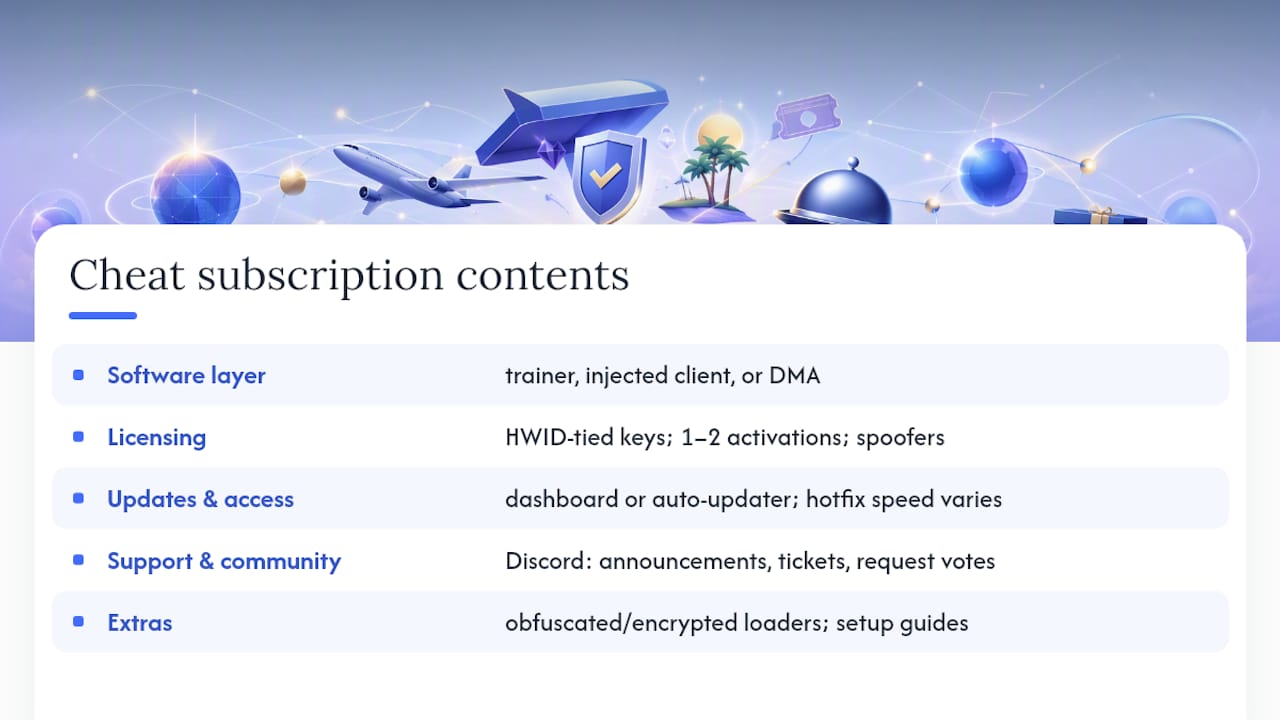
The software layer is where most of the value lives. You're typically getting one or more of the following: a standalone trainer (a memory-editing tool that runs alongside the game), an injected client (a DLL or driver-level module loaded into the game process), or a DMA-based solution that reads game memory from a second PC over a PCIe card. Premium tiers often bundle all three delivery types depending on the game.
Licenses and activation work on a key-based or account-bound model. You receive a license key tied to your hardware ID (HWID). Most providers cap activation to one or two devices. HWID spoofers, sold separately or bundled, let you reset that fingerprint if you switch hardware or get banned. Lifetime licenses exist but are less common than monthly or quarterly subscriptions.
Updates and access are delivered through a member dashboard, an auto-updater built into the loader, or direct download links that refresh after each patch. The fastest providers push hotfixes within hours of a game update. Slower ones can leave you with a broken trainer for days.
Support and community usually means a Discord server with dedicated channels: announcements for new releases, a support ticket queue, and sometimes a request channel where members vote on which games get trainers next. Forums are less common now but still appear on older platforms.
Extras worth checking for: setup guides, obfuscated loaders (which reduce detection surface), and hardware warranties if you're buying DMA equipment. Encrypted loaders specifically protect the payload from third-party tampering and are a meaningful safety upgrade over plain executable delivery.
Pro Tip: Before buying, check whether the provider publishes a release log or changelog. A public update history is one of the strongest signals that a team is actively maintaining their products, not just selling old builds.
How do subscription types and pricing actually compare?
Three models dominate the market: monthly subscriptions, lifetime one-time purchases, and tiered bundles (basic vs. elite access).
- Monthly subscriptions are the most common entry point. Pricing varies widely.
- Lifetime deals are sold as promotional windows, often at low one-time prices. A PopSci-covered example cited a lifetime offer around $34.99, though these deals typically come with final-sale terms and limited redemption windows.
- Tiered bundles split access by anti-cheat type (EAC, BE, VAC) or by feature set (lite vs. elite). Higher tiers usually mean more supported titles, faster update SLAs, and priority support.
A University of Birmingham academic study found monthly access prices ranging from roughly $10 to $240 across surveyed cheat sites, with the combined market generating an estimated $12.8M–$73.2M annually and 30,000–174,000 buyers per month. That range tells you something: a $10/month plan and a $240/month plan are not the same product. The gap usually reflects update frequency, the number of supported titles, and whether live support is actually staffed.
Industry reporting notes that premium suites can command prices up to several hundred dollars per month, with the market reaching multi-million-dollar annual revenue.
Pro Tip: Check the redemption window on any lifetime deal. Many require you to activate within 30–90 days of purchase. Miss that window and the key may expire regardless of whether you've used it.
| Model | Typical price range | License behavior | Best for |
|---|---|---|---|
| Monthly subscription | $10–$240/month | Active while paid; stops on cancellation | Gamers who rotate games frequently |
| Lifetime one-time | Promotional (e.g., ~$34.99) | Permanent access, often final sale | Long-term players on a single title |
| Tiered bundle (lite/elite) | Varies by tier | Tied to subscription or one-time purchase | Players who need anti-cheat-specific coverage |
How trainers, licenses, and delivery actually work
The distribution flow is simpler than it sounds. You buy, receive a key by email or dashboard notification, download the loader from a member portal, and enter the key on first launch. The loader checks your license status against the provider's server on each run.
Activation and HWID limits: Most loaders fingerprint your machine on first activation. If you reinstall Windows or swap hardware, you'll need a HWID reset, which reputable providers handle through a support ticket. HWID spoofers change the identifiers the game and anti-cheat read, which matters both for ban recovery and for staying under the radar.
Update mechanics: When a game patches, the trainer often breaks within hours. Good providers run version checks inside the loader itself, so you see a "trainer updating" message rather than a crash. How quickly a vendor responds to game updates is one of the clearest performance signals you can observe before committing to a subscription.
What happens when your membership lapses:
- The loader checks your license on launch and returns an "inactive" or "expired" status.
- The trainer refuses to inject or exits immediately.
- Your downloaded files stay on your machine but are non-functional until reactivated.
- Hardware (DMA cards) remains fully functional because it's a physical product, not a software license.
- To reactivate, you renew through the member dashboard or repurchase a key.
For safe installation, always run the trainer in a private or low-stakes match first. A safe download and install guide walks through the full process, including how to verify file integrity before running anything.
How safe are premium cheats compared to free hacks?
The honest answer: premium is meaningfully safer than random free downloads, but not risk-free. University of Birmingham researchers found that some free cheats exploit dangerous kernel-level driver vulnerabilities and can carry malware payloads. Premium providers generally avoid destructive kernel exploits and invest in safer loader architectures and daily testing cycles.
Market scale: The same study estimated 30,000–174,000 monthly buyers across surveyed cheat sites, with annual revenue between $12.8M and $73.2M. That scale funds a genuine arms race between anti-cheat developers and cheat providers.
The arms race is the key context. Anti-cheat systems like EAC and BattlEye push updates constantly, and why cheats get detected often comes down to a single signature change the provider didn't catch in time. Premium does not mean permanently undetectable. It means a team is actively watching and patching.
Safety signals worth requiring from any provider:
- Documented daily testing with public status updates
- Encrypted loaders (not plain .exe delivery)
- Active Discord with a real support team, not just a bot
- Hardware warranties for DMA products
- A public release log showing recent update dates
Premium subscription reporting confirms that reliable update cadence and support are the main differentiators premium sellers use, alongside warnings that scams and malware remain real risks in the broader market. CNET's gaming security coverage is a useful cross-check for evaluating vendor claims about detection resistance.
Pro Tip: Search the provider's name alongside "detected" or "ban wave" in gaming forums before buying. Community reports surface faster than any official announcement.
What happens when you cancel, and can you get a refund?
Digital key products almost universally have short or no refund windows. Once a key is delivered and activated, most providers treat it as consumed. Lifetime deals are typically final sale.
- Locate the cancellation option in your member dashboard or payment platform (PayPal, Stripe, or crypto processor).
- Cancel the recurring charge before the next billing date.
- Note the exact cancellation timestamp and save the confirmation email.
- Keep your proof of purchase and original key email in a separate folder.
- If you're within a refund window, submit a ticket immediately with your order number.
License behavior after cancellation follows the pattern described above: software trainers stop working, hardware stays functional. Don't assume a downloaded trainer will keep running. Most loaders phone home on every launch.
Pro Tip: Before canceling, back up your installer packages and screenshot your license key emails. If you re-subscribe later, having the original files saves you a re-download and confirms you have the right version.
How to evaluate a provider and spot red flags
Checklist before you buy:
- Evidence of daily testing (public status page or Discord announcements)
- Clear update cadence with dated release logs
- Stated refund or return policy (even if short)
- Active Discord with human support, not just automated responses
- Transparent license model (what happens on cancellation, device limits, HWID reset policy)
- Secure, buyer-protected payment options
Red flags:
- "Undetected forever" claims with no testing documentation
- Requests to disable security software or install unsigned drivers manually
- No support channel, or a Discord that's been inactive for weeks
- Payment methods with zero buyer protection and no dispute process
- Release logs that haven't been updated in months
Switching providers when a vendor's update cadence drops is a legitimate strategy, not a last resort. Providers who stop updating quietly are a real pattern in this market. Verify community activity on Discord and cross-check claims against independent reporting before committing to a longer subscription term.
What Midnight-market's approach actually looks like
Midnight-market tests every product daily against active anti-cheat systems including EAC and BattlEye. Keys are delivered instantly after checkout, not queued for manual review. Discord support is live, meaning a real person responds during support hours rather than an automated ticket system that closes after 48 hours with no resolution.
Hardware products (DMA cards) carry explicit warranties, which matters because DMA setups involve physical equipment that can fail independently of software. The license model is documented: software licenses are membership-tied, hardware is a product purchase. That distinction is spelled out before you buy, not discovered after cancellation.
The checklist from the evaluation section above maps directly to what Midnight-market publishes: daily testing, documented release logs, live Discord, hardware warranty, and clear license terms. Treat those signals as the floor, not a bonus.
Midnight-market covers the full checklist
Every criterion this article lays out, Midnight-market meets. Daily-tested products for titles including Escape from Tarkov, Valorant, Apex Legends, Fortnite, Counter-Strike 2, Rust, and more. Instant key delivery. Live Discord support. Hardware warranties on DMA equipment. A license model that's transparent about what cancellation means.
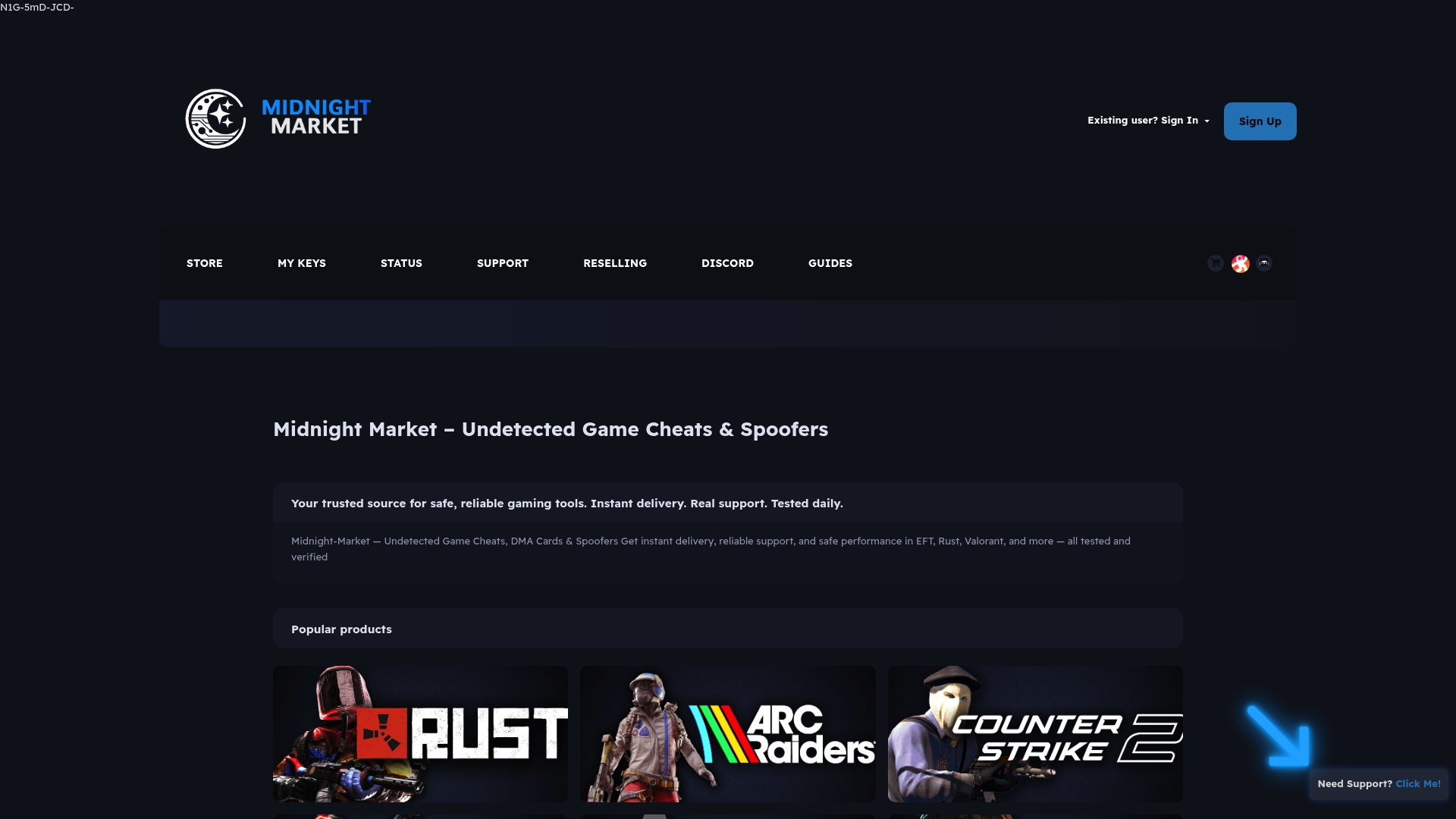
The Midnight-market store lists current bundles with full product details, including redemption windows, device limits, and warranty terms. Check the product page for your specific game or anti-cheat type. For hardware, the Godlike 10th Gen Fuser page shows warranty specifics. For tiered software access, the BE Elite bundle shows what a full-featured subscription looks like in practice. Payment is processed securely, delivery is instant, and support is a Discord message away.
Sources
- Windows kernel defenses aren't enough to stop a lucrative game cheating market - University of Birmingham
- Gaming's Secret Million-Dollar Market: How Cheat Subscriptions Rival Netflix Revenue - Gadget Review
- Grinding is optional when lifetime cheats cost $34.99 - PopSci
- The Rise of Premium Subscription-Based Cheats - Ranetki News
- Cnet