Game cheats are not automatically illegal in Canada. Whether one crosses into unlawful territory depends on context: cheating for money or stakes can trigger Criminal Code fraud provisions, breaking a game's technical locks can violate Copyright Act anti-circumvention rules, and distributing or selling cheats often breaches your license agreement and invites civil lawsuits. The usual consequence is an account ban, not a criminal record, but sellers and hardware traffickers face real exposure.
TL;DR:
- Selling or distributing cheats that bypass anti-cheat systems is likely illegal under Canada's copyright law and can lead to civil lawsuits for trafficking and infringement.
- Criminal charges for cheating with intent to defraud are rare and usually tied to large-scale gambling or betting schemes, not casual online matches.
- Breaching a game's license agreement through cheats often results in account bans, but legal action against individual players remains uncommon.
- Developers primarily enforce rules by issuing takedown notices and civil lawsuits against cheat sellers, rather than pursuing criminal prosecution.
- Building or sharing low-risk mods that do not bypass access controls significantly reduces legal exposure, especially when sticking to licensed assets and official tools.
Table of Contents
- Are Game Cheats Illegal in Canada? The Legal Framework Explained
- What Creators and Sellers of Cheats Actually Risk
- How Developers Actually Enforce These Rules
- What Happens to Players Who Use Cheats
- How to Stay on the Right Side of Canadian Law
- An Operational View on Detection and Risk
- Where to Read the Actual Law
- Why the Cheating-Is-Illegal Framing Misses the Point
- Sources
Are Game Cheats Illegal in Canada? The Legal Framework Explained
Nothing in Canadian law says "cheats are illegal" in one clean sentence. Instead, three separate legal tracks can turn a cheat into a liability, and each one has different triggers, different remedies, and wildly different odds of ever landing on a real person's desk.
Criminal Code, Section 209. This is the provision people misquote most. Section 209 criminalizes "cheating at play" when it's done with intent to defraud during a game, contest, or gambling activity, and it carries penalties including possible prison time as an indictable offence, or a lesser summary conviction. The key word is defraud. Prosecutors built this section for card sharks and rigged wagers, not headshots through walls in a public match. Legal commentators generally treat its application to ordinary online multiplayer cheating as a stretch, since there's usually no prize, no stake, and no financial victim in the classic sense. Where it does bite is betting and consideration: a rigged esports wager, a fixed tournament with cash on the line, or a scheme where a cheater fleeces other players out of real money starts to look exactly like what s. 209 was written for.
Copyright Act and technological protection measures. This is where the real teeth live. Canada's 2012 copyright amendments added anti-circumvention rules that make it unlawful to bypass a technological protection measure, or TPM, controlling access to copyrighted software. Anti-cheat systems, encrypted game clients, and license verification all count as TPMs. Section 41.1 also bans trafficking in circumvention tools, meaning you don't need to prove someone hacked the game themselves; selling the tool that lets others do it is enough. Courts can award statutory damages for TPM circumvention without a separate showing of copyright infringement, which makes this the fastest legal weapon developers reach for.
Contract law and EULAs. Every game you've ever installed came with a license agreement you clicked past. That contract typically bans cheats outright, and while breaching it usually just gets you banned, developers can and do sue cheat makers for inducing thousands of other players to breach their own agreements. Inducement to breach contract is a recognized tort in Canada, and it's become a favorite tool against cheat sellers precisely because it doesn't require proving copyright infringement at all.
Here's the practical split: developers reach for civil remedies (TPM claims, contract suits, injunctions) constantly, because they're faster and don't require police involvement. Criminal charges under s. 209 stay rare, reserved almost exclusively for cases with real money and real fraud attached. If you're asking "is cheating in games illegal" in the sense of "will I get arrested," the honest answer is almost never, unless gambling or large-scale fraud enters the picture.
What Creators and Sellers of Cheats Actually Risk
If you build, sell, or distribute cheat software in Canada, your legal exposure looks nothing like a casual player's. You're not just risking a ban; you're a potential defendant.
Selling a tool that bypasses anti-cheat software or decrypts game files puts you squarely inside TPM trafficking territory under the Copyright Act. It doesn't matter whether the buyer ever uses it. The act of trafficking, meaning offering, advertising, or selling the circumvention device, is its own violation. Add in copyright infringement claims if your product reproduces game code or assets, and inducement claims for encouraging users to breach their EULA, and a single mod menu can generate three separate causes of action against you.
Courts and legal commentators tend to weigh a few things when sorting legitimate tools from actionable ones:
- Primary purpose. Was the software designed mainly to defeat access controls, or does circumvention happen incidentally?
- Knowledge and intent. Did the seller market the product specifically as an anti-cheat bypass or aimbot for a named title?
- Scale of distribution. A private script shared with three friends draws less attention than a storefront selling keys at a large scale.
- Monetization. Charging money, running subscriptions, or advertising "undetected" status all signal a commercial operation, which is exactly what rights holders and their lawyers target first.
Academic analysis of mod creators under Canadian law makes a similar point: the line between a permitted mod and an infringing tool usually comes down to whether you reproduced original assets or cracked an access control, not whether the developer merely disapproves of what you built. That distinction matters for anyone building external hacks or mod menus, where the technical method used to inject or read game memory can itself determine which statute applies.
Pro Tip: If you're building or distributing anything that touches anti-cheat systems, assume every download counts as a separate act of trafficking under copyright law, not a one-time risk. Volume is what turns a hobby project into a target.
Clean-room development, avoiding TPM bypass entirely, and sticking to cosmetic or single-player mods reduce risk substantially. None of it makes you bulletproof if your tool's core function is defeating access controls on someone else's copyrighted software.
How Developers Actually Enforce These Rules
Game studios rarely call the police. They call lawyers, and the playbook is fairly predictable once you've seen it a few times.
- Takedown notices and cease-and-desist letters come first, usually targeting hosting providers, storefronts, or Discord servers distributing the cheat.
- Civil suits for damages and injunctions follow when takedowns fail, often combining copyright/TPM claims with contract-based inducement claims in a single filing to maximize available remedies.
- TPM circumvention claims get used specifically because they can support faster injunctive relief than waiting to prove full copyright infringement, according to Dentons' analysis of Canadian esports and gaming litigation.
- Criminal referrals stay the last and rarest step, reserved for cases involving organized fraud, large-scale betting schemes, or fixed tournaments with real financial victims.
Comparative cases inform how Canadian practitioners frame these disputes even when the ruling itself came from another jurisdiction. Legal analysis of cheat software has pointed to cases like the mod menu disputes in the United Kingdom, where courts found that providing cheat tools could authorize infringing copying and induce mass breach of license terms, a reasoning Canadian firms cite by analogy when building domestic claims.
Rights holders increasingly combine copyright, TPM, and contract theories in a single action rather than betting on one legal path. Stacking claims speeds up remedies and closes the gaps any single statute leaves open.
The pattern across nearly every documented dispute is the same: developers move fast, target the seller rather than individual buyers, and lean on whichever legal theory gets an injunction on the books quickest.
What Happens to Players Who Use Cheats
For the average Canadian gamer running a cheat in ranked matchmaking, the real risk isn't a courtroom. It's your account.
Studios ban accounts, strip earned rankings, revoke purchased content, and disqualify players from tournaments, and none of that requires proving anything in a court of law. Anti-cheat systems flag behavior automatically, and once you're caught, appeals rarely go anywhere. That covers the overwhelming majority of cases you'll encounter reading about PC hacks and competitive integrity.
Risk escalates sharply in three specific situations:
- You're selling the cheat, not just using it, which shifts you into trafficking and inducement territory covered above.
- You're trafficking hardware, such as DMA devices or spoofers marketed for cheating, which can draw copyright and TPM claims even if you never wrote a line of code.
- Money or stakes are involved, meaning betting apps, cash tournaments, or wagered matches, which is the scenario where Criminal Code s. 209 actually starts to apply.
Jail time for casually cheating in a public match is exceptionally unlikely under current Canadian enforcement patterns; the statute's fraud and stakes elements simply don't match that fact pattern. Fraud, organized betting schemes, and large-scale trafficking are a different story entirely.
If you're ever contacted by a developer's legal team or a platform's enforcement division, stop using or sharing the software immediately, preserve any purchase records or communications, and talk to a lawyer before responding to anything in writing. Assuming a ban letter is a bluff is the most common mistake people make.
How to Stay on the Right Side of Canadian Law
Most legal risk in this space is avoidable, and the fixes are less about legal complexity and more about discipline in what you build, sell, or run.
- Use official modding tools and published policies. Many studios explicitly permit modding through supported SDKs or editors. Staying inside that sandbox eliminates TPM risk entirely.
- Get written permission for anything ambiguous. If a project touches game files in a way the EULA doesn't obviously allow, ask the developer directly before you build a following around it.
- Never bypass anti-cheat or DRM systems, even for tools you consider harmless, since TPM circumvention is a strict statutory violation regardless of intent.
- License your work clearly and don't monetize copyrighted assets. Selling access to modified game content, or charging for tools that reproduce original assets, invites both copyright and contract claims.
- Talk to a lawyer before scaling up. A hobby project shared with a small Discord server carries different exposure than a storefront selling license keys at a large scale, and that transition is exactly when legal counsel earns its cost.
Pro Tip: Document every permission you receive from a developer, even informal ones over email or Discord. If a dispute ever surfaces, that paper trail is often the difference between a quick resolution and a drawn-out legal fight.
The rights and obligations research on Canadian mod creators lands on a similar conclusion: creators who avoid TPM circumvention and stick to original or licensed assets face dramatically lower legal exposure than those who don't, regardless of how good their intentions are.
An Operational View on Detection and Risk
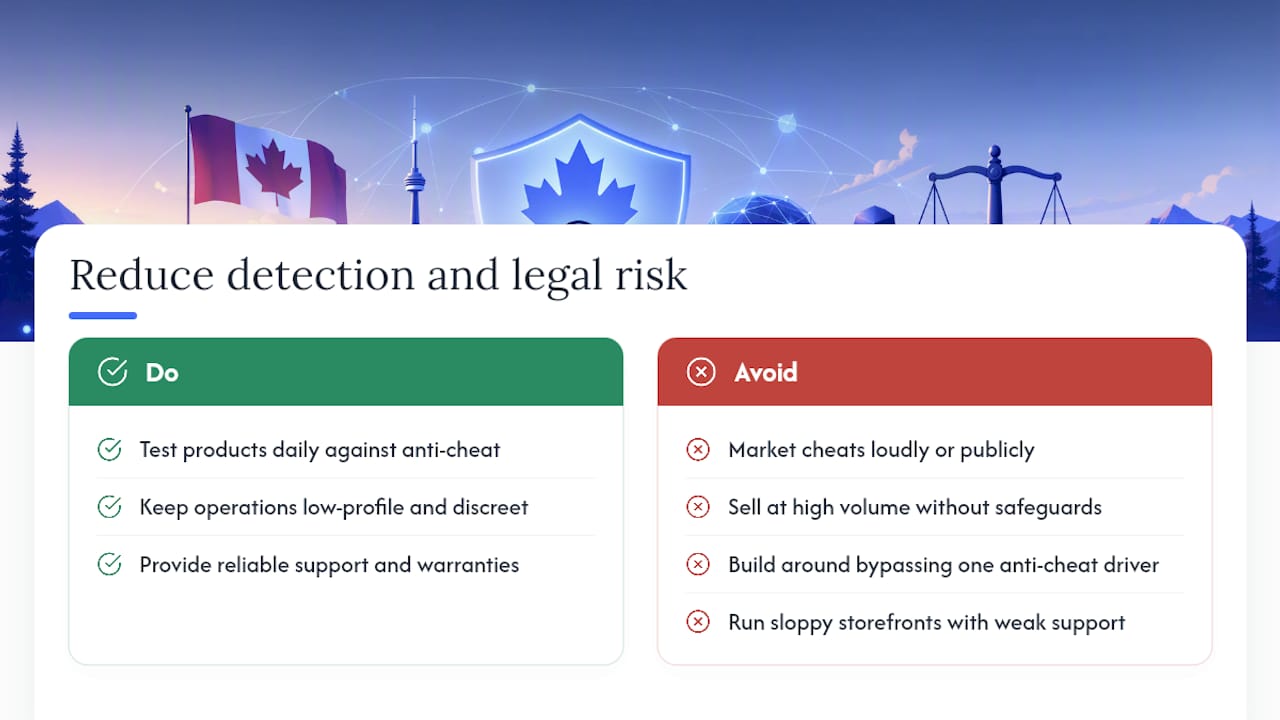
Midnight-market has spent years watching how anti-cheat systems, legal takedowns, and platform enforcement actually intersect, and a few patterns hold up consistently. Products that get flagged fastest are almost always the ones marketed loudest, sold at the highest volume, or built around bypassing a specific anti-cheat driver rather than working around detection through more conservative methods. That's part of why daily testing against live anti-cheat updates matters more than any single feature; a cheat that worked yesterday can be dead on arrival after a patch, a pattern explored in more depth in our breakdown of why cheats get flagged.
From an operational standpoint, the sellers who draw legal attention tend to be the ones running high-volume storefronts with weak support and no testing discipline, not individual players running something quietly for personal use. Midnight Market's model, built on daily-tested products, live Discord support, and hardware warranties, exists specifically because reliability and discretion reduce exposure on both fronts: detection risk and the legal attention that comes with sloppy, high-visibility operations.
None of this is legal advice. If you're facing a specific dispute, a ban appeal with legal implications, or a cease-and-desist letter, talk to a lawyer licensed in your province.
Where to Read the Actual Law
Start with the statutes themselves: Section 209 of the Criminal Code covers cheating at play, and the Copyright Act's TPM provisions cover circumvention and trafficking. For practitioner analysis, Gowling WLG's breakdown of cheating in esports and the Dalhousie Schulich Law review on mod creators both go deeper than most blog coverage.
Ready to gear up with cheats that are tested daily against the exact anti-cheat systems covered above? Browse Midnight-market's undetected cheats and DMA hardware and get instant delivery with live Discord support behind every purchase.
Why the Cheating-Is-Illegal Framing Misses the Point
The conventional wisdom treats this as a yes-or-no question, and that framing is backwards. Canadian law doesn't police cheating as a category; it polices specific acts: defrauding someone for a stake, bypassing a technical lock, breaching a contract at scale. Most casual players will never touch any of those tripwires. Most commercial sellers eventually touch all three.
What gets underweighted in most coverage is how much civil law, not criminal law, does the actual enforcement work here. Everyone fixates on jail time that almost never materializes while ignoring the injunctions and damages claims that shut down cheat operations within days. If you're a creator, the TPM trafficking provision deserves far more attention than s. 209 ever will.
The practical priority for readers is simple: players should worry about bans, not courtrooms. Creators and sellers should worry about the Copyright Act first, contract law second, and treat criminal exposure as the edge case it actually is.
— Fonics
This article is general information, not a substitute for advice from a qualified lawyer. Consult a qualified legal professional about your own circumstances before acting on anything here.
Sources
- Criminal Code (R.S.C., 1985, c. C-46) — Section 209: Cheating at play
- Federal Court decision discussing TPM circumvention and trafficking (Smart & Biggar archive PDF)
- Can cheaters ever prosper? Videogames, esports and the gamers breaking the rules to get ahead — Gowling WLG
- The Rights and Obligations of Mod Creators in Canadian Videogame Law — Christian Clavette