
Using a ban evasion tool is a high-risk decision, and the single most important rule is this: exhaust all official recovery options before touching third-party software or hardware. If you've already done that and you're still locked out, read on.
No ban evasion tool guarantees permanent immunity. Anti-cheat systems flag behavioral anomalies — sudden K/D spikes, accuracy shifts, account-creation patterns — that trigger bans regardless of whether your hardware IDs are spoofed. Hardware modification is one layer; platforms watch many more signals.
The risks are real: permanent account loss, malware from low-quality vendors, hardware blacklisting, and potential platform or legal consequences. If you've exhausted official channels and still want a commercial option, Midnight-market is one of the few providers that publishes daily testing results, offers live Discord support, and backs hardware with a warranty.
Table of Contents
- What do ban evasion tools actually claim to do?
- What are the real risks of using bypass ban software?
- How do modern anti-cheat systems detect ban evasion?
- What should you try before buying any evasion tool?
- How do you evaluate a ban evasion vendor before buying?
- Midnight-market: a vetted option for serious gamers
- Key Takeaways
- The gap between what evasion tools promise and what they deliver
- Useful sources and further reading
What do ban evasion tools actually claim to do?
These products fall into four categories, each targeting a different detection layer.
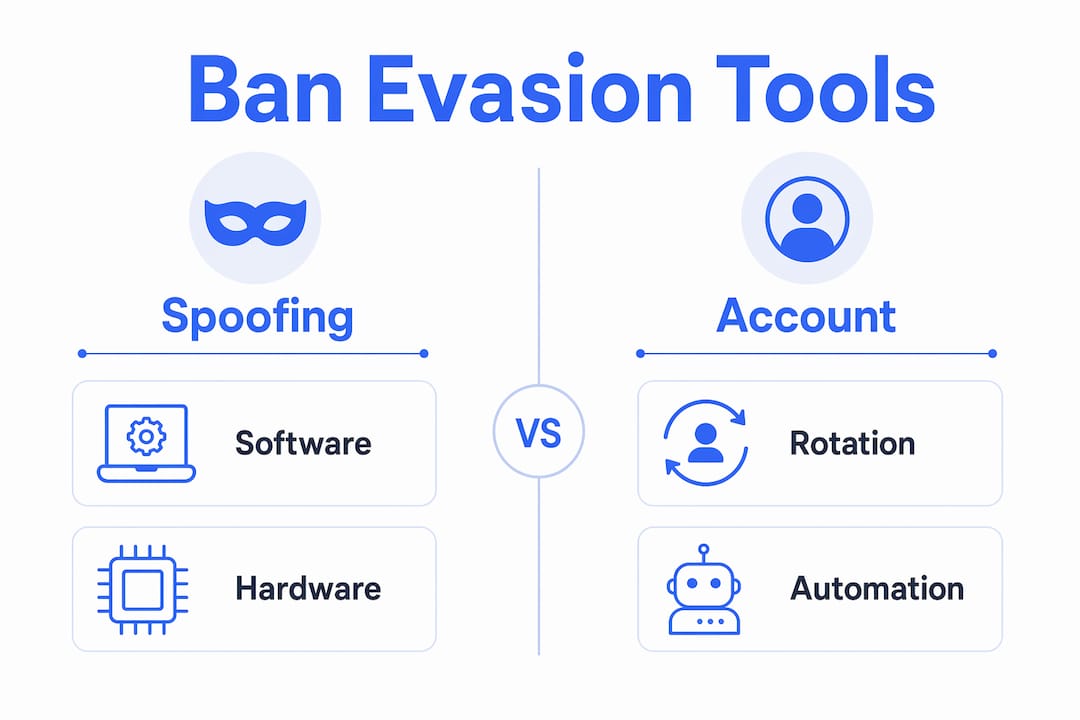
Software spoofers/obfuscators modify registry entries and driver-level hardware identifiers so the platform sees a "new" machine. Common features include one-click spoof, per-component profiles, persistent mode, and rollback support to undo changes if something breaks.
Account rotation and automation services cycle through fresh accounts, sometimes with aged profiles, to bypass account-level bans. They don't touch hardware at all.
DMA and hardware injectors operate at the PCIe bus level, reading game memory from a secondary device the anti-cheat kernel module can't see. The mechanics of hardware cheat devices are more complex than software approaches, which is why they carry a higher price and a steeper setup curve.
Site-specific workarounds cover VPN rotation, browser fingerprint masking, and cookie clearing for web-based platforms. Useful for forum or streaming bans; irrelevant for kernel-level anti-cheat in competitive shooters.
Function, not instructions: the descriptions above explain what each category modifies — not how to execute a bypass. Attempting to circumvent platform protections may violate terms of service and, in some jurisdictions, applicable law.
What are the real risks of using bypass ban software?
Technical and system risks
Kernel-level spoofing is invasive. These tools rewrite registry entries and device identifiers that interact directly with signed drivers and anti-cheat kernel modules. The result can be driver conflicts, OS instability, or a machine that won't boot cleanly. Expert users specifically look for per-game configuration and rollback features to limit collateral damage.

Low-quality cheat downloads are also a common malware vector. A tool that asks you to disable antivirus and run as administrator is asking for a lot of trust.
Account and platform risks
Platforms don't rely on hardware IDs alone. They watch account-creation timing, IP metadata, behavioral patterns, and even psycholinguistic similarity across usernames. A hardware spoof that passes the first check can still fail a behavioral review two weeks later. Multi-account detection is increasingly automated, and a flagged secondary account can pull a primary into the same ban wave.
No tool is a permanent solution. Vendors who claim 100% undetectability are selling confidence, not a guarantee. Detection systems update constantly, and a tool that passed yesterday's scan may not pass tomorrow's.
Pro Tip: Never run spoofing software on your primary gaming machine. Use a dedicated device or isolated environment for any testing — this limits hardware blacklisting to hardware you can afford to lose.
Financial risk is also real. Scam vendors are common in this space. Refund policies are often nonexistent, and a tool that stops working after a game patch leaves you with nothing. The update cadence problem is one of the most underappreciated risks: a single game update can render a paid tool useless overnight.
How do modern anti-cheat systems detect ban evasion?
Detection isn't a single check. It's a layered system combining hardware fingerprints, network metadata, account signals, and machine learning classifiers.
- Hardware IDs: motherboard serials, HDD serials, MAC addresses, GPU identifiers, and BIOS UUIDs
- IP and connection metadata: VPN detection, ASN reputation, geolocation consistency
- Account-creation signals: registration timing, email domain, payment method, and device overlap with banned accounts
- Behavioral signals: K/D ratio changes, accuracy percentiles, movement patterns, and session timing
- Psycholinguistic features: username similarity, writing style, and posting patterns across accounts
Twitch's Suspicious User Detection illustrates how this works in practice. Their ML system classifies accounts as "likely" or "possible" ban evaders using multiple combined signals, then surfaces results to moderators rather than auto-banning. False positives are expected and built into the workflow. Reddit's ban evasion filter works similarly, with configurable confidence thresholds and time-frame windows.
Academic research shows how effective these systems can be at the account level:
| Signal Type | Model | AUC / MRR | Notes |
|---|---|---|---|
| Behavioral + account signals | Ban evasion classifier | AUC = 0.78 | Prediction task, 8,551 pairs |
| Early detection signals | Early-detection classifier | — | Catches evasion faster |
| Parent/child account matching | Account-matching model | — | Near-perfect account linkage |
The takeaway: spoofing hardware addresses one signal category. Platforms are increasingly focused on the others.
What should you try before buying any evasion tool?
Official recovery resolves more lockouts than most gamers expect. Work through these steps first.
- Use the platform's official account recovery tool. Most major platforms have a self-service recovery flow. Microsoft's Outlook unblock process, for example, walks you through security verification before escalating to support.
- File a formal appeal. Document your case: account age, purchase history, and any evidence that the ban was triggered in error. Account recovery assistants can generate evidence checklists and support message templates without touching any bypass mechanism.
- Contact platform support directly. Escalate beyond the automated system. A human review catches false positives that automated filters miss.
- Follow official recovery guidance. Third-party bypass tools create security risks and don't guarantee success. Official channels are slower but safer.
- If recovery fails: consider a legitimate fresh start. A clean account with improved gameplay habits carries zero detection risk. Alternatively, use the time-out to build skills that reduce the temptation to cheat in the first place.
For any testing of third-party tools, isolate the environment. A sandbox VM or a dedicated secondary machine limits the blast radius if something goes wrong.
How do you evaluate a ban evasion vendor before buying?
Most vendors in this space make the same claims. Here's what actually separates a trustworthy provider from a scam.
Trust signals to look for:
- Daily or rigorous testing with documented results, not just marketing copy
- Per-game configuration options and transparent game coverage lists
- Rollback features and per-component spoofing to limit system damage
- Hardware warranty with clear terms
- Active update cadence with patch notes after major game updates
Questions to ask before paying:
- What is the refund policy if the tool is detected within 30 days?
- Does the product include rollback support?
- Are sample test results or lab reports available?
- Which specific anti-cheat versions are currently covered?
Red flags:
- Anonymous sellers with no community presence
- Claims of "100% undetectable" with no caveats
- No Discord or live support channel
- Opaque delivery with no product documentation
- No update history or patch notes
Community reputation matters. Check Discord servers, gaming forums, and subreddits for recent user reports. A vendor with an active community and visible moderation is harder to fake than one with a polished website and no social proof.
Midnight-market: a vetted option for serious gamers
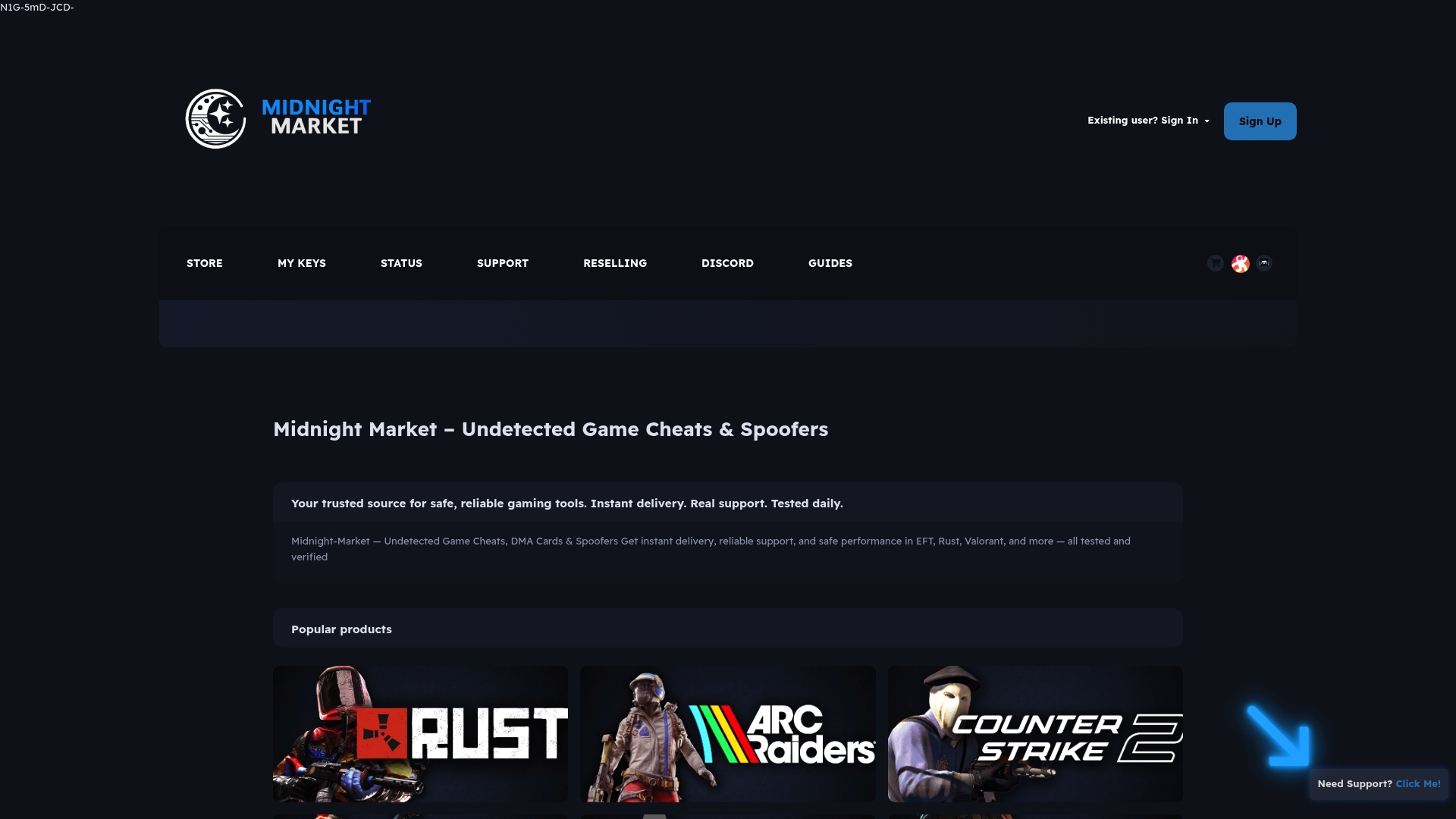
Midnight-market covers all three major product categories: software cheats, DMA-style hardware, and bundles. Their product pages document game coverage explicitly, so you know before buying whether your title is supported. For Valorant, they offer both software-based and DMA hardware options with hardware warranties. EFT players can find per-game configured products with documented feature sets.
What sets Midnight-market apart from generic providers is the combination of daily testing, live Discord support, and transparent detection-risk statements on product pages. They don't promise permanent immunity. They do promise that products are tested before they reach you and supported after. Delivery is instant on software products. Hardware ships with warranty terms.
The risk disclaimer stands regardless of provider: no tool eliminates detection risk permanently. Use a dedicated device, never your primary machine, and check the product page for current game coverage before purchasing. Browse the full store to see current software and hardware offerings.
Key Takeaways
No ban evasion tool eliminates detection risk permanently; hardware spoofing addresses one signal layer while behavioral and account signals remain active.
| Point | Details |
|---|---|
| No permanent immunity | Every tool vendor, including reputable ones, explicitly warns that behavioral bans can occur despite hardware spoofing. |
| Detection is multi-layered | Platforms combine hardware IDs, IP metadata, account signals, and ML classifiers; AUC scores demonstrate that these systems can be effective in detecting ban evasion. |
| Try official recovery first | Account recovery assistants and platform appeals resolve more lockouts than expected, with zero detection risk. |
| Vet vendors carefully | Look for daily testing, rollback support, per-game configs, hardware warranty, and an active Discord community. |
| Midnight-market | Covers software cheats, DMA hardware, and bundles with daily testing, live support, and transparent product documentation. |
The gap between what evasion tools promise and what they deliver
The marketing in this space consistently overpromises. "Fully undetected" is a snapshot claim, not a guarantee. It means the tool passed a test at a specific moment against a specific anti-cheat version. The moment that version updates, the claim expires.
What actually matters is update cadence and support responsiveness after detection events. A provider who patches within 24 hours of a detection wave is worth more than one who claims 100% safety and goes silent when bans hit. The community around a product tells you more than the product page.
There's also a skill-building argument worth taking seriously. The best anti-ban strategy is gameplay that doesn't trigger behavioral flags in the first place. Tools that help you win without looking suspicious require more configuration and discipline than most buyers expect. The shortcut often creates more work than the problem it solves.
Useful sources and further reading
- Characterizing, Detecting, and Predicting Online Ban Evasion — ACM Web Conference: Academic study of 8,551 ban evasion pairs; provides AUC and MRR figures for ML detection models. Use this to understand how effective behavioral classifiers actually are.
- Battling Ban Evasion with Machine Learning — Twitch Safety: Explains how Twitch's ML system combines account signals and surfaces results to moderators. Illustrates platform-level detection workflows.
- Ban evasion filter — Reddit Help: Documents Reddit's configurable confidence thresholds and signal-combination approach. Useful for understanding web-platform moderation.
- Hwid Spoofer 2026 — GitHub: Feature and stability notes for a hardware ID spoofer, including rollback support and per-component spoofing. Covers technical risks of kernel-level modification.
- bortoq/account-recovery-assistant — GitHub: CLI tool that generates evidence checklists and support message templates for official recovery. Does not perform bypass actions.
- SafeRestoreHelp — account recovery guidance: Practical guidance on official recovery workflows and why third-party bypass tools increase risk rather than reduce it.