
An EAC bypass is any technique that neutralizes Easy Anti-Cheat's detection or enforcement pipelines without triggering a ban or system crash. This article covers the architecture behind EAC, the conceptual attack vectors public research has documented, the legal and ToS consequences of attempting circumvention in the U.S., as well as how security researchers can engage with these systems responsibly.
What this article covers:
- High-level architecture of Easy Anti-Cheat (user-mode, kernel-mode, server-side telemetry)
- Conceptual descriptions of detection vectors and publicly documented bypass categories
- U.S. legal risks, ToS enforcement, and account consequences
- Safe research practices and coordinated disclosure guidance
- Defensive recommendations for game developers
What this article deliberately omits:
- Step-by-step exploit instructions or payload code
- Unsigned driver distribution or WHQL circumvention walkthroughs
- Specific shellcode, memory offsets, or operational bypass recipes
Midnight-market publishes this as an educational resource. The goal is informed understanding, not a how-to manual.
Table of Contents
- How does Easy Anti-Cheat's architecture actually work?
- What detection vectors does EAC use, and how do attackers respond?
- What are the legal and ToS risks of attempting an EAC bypass?
- How do you research anti-cheat safely and ethically?
- What can game developers do to harden against bypass attempts?
- Key Takeaways
- The gap between understanding EAC and acting on it responsibly
- Midnight-market: daily-tested products for detection-aware gamers
- Authoritative sources for further reading
How does Easy Anti-Cheat's architecture actually work?
Easy Anti-Cheat runs as a layered system with three distinct tiers that communicate constantly: a user-mode service, a kernel-mode driver, and a remote telemetry backend. Understanding where each tier lives explains why bypassing EAC is harder than patching a single file.
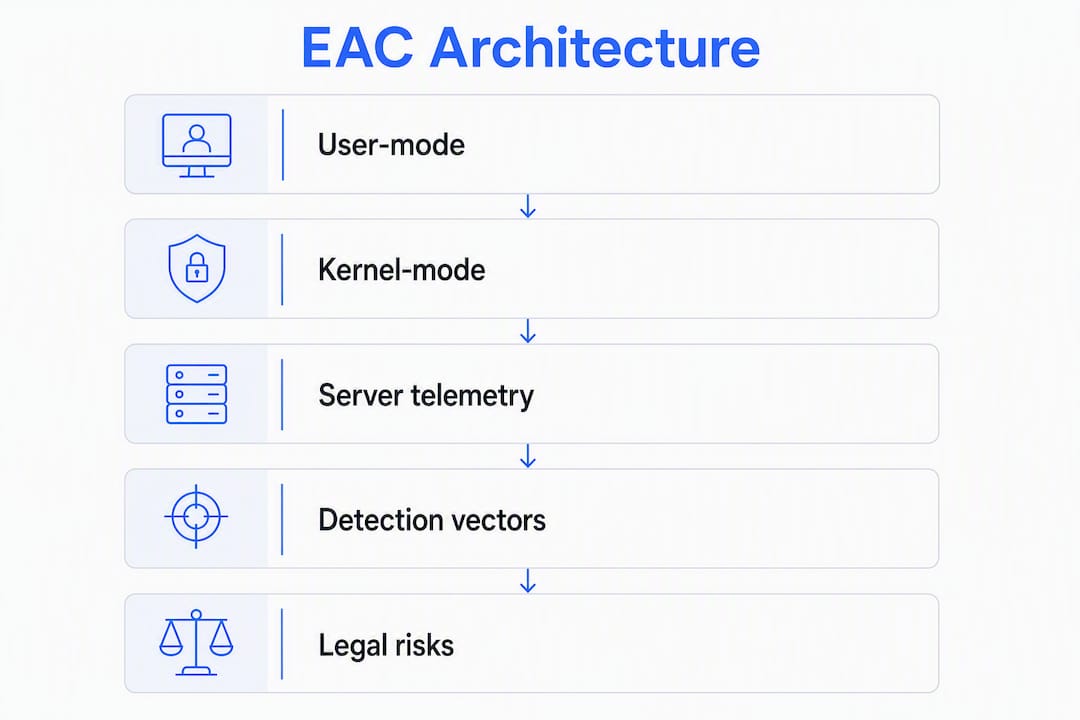
The user-mode service runs alongside the game process. It handles initial launch validation, communicates with the kernel driver via IOCTLs (I/O control codes), and forwards telemetry to Epic Games' servers. The kernel-mode driver (EasyAntiCheat.sys) operates at ring-0, giving it direct access to system memory, process handles, and hardware events. It performs memory integrity checks, monitors kernel callbacks, and can terminate processes or trigger bans from a privileged position the game process itself cannot reach.

The third tier, server-side telemetry, is what makes client-side bypasses increasingly insufficient on their own. Even if an attacker neutralizes local detection, behavioral anomalies, statistical outliers in gameplay data, and cross-session correlation on the server side can still flag an account.
| Component | Privilege Level | Primary Role |
|---|---|---|
| User-mode service | Ring-3 | Launch validation, IOCTL dispatch, telemetry relay |
| Kernel driver (EasyAntiCheat.sys) | Ring-0 | Memory scanning, integrity checks, kernel callbacks |
| Server-side telemetry | Remote | Behavioral analysis, cross-session correlation, ban enforcement |
The IOCTL bridge between the user-mode service and the kernel driver is architecturally significant. Public research has shown that modern EAC bypass strategies have shifted from static file patching to dynamic, ephemeral kernel-mode execution that hijacks legitimate IOCTL flows to execute code without modifying the driver's .text section. That shift reflects a direct response to earlier static-patch detection: if you never change the code on disk, certain integrity checks have nothing to catch.
One architectural detail that creates outsized risk: EAC builds have historically cached user-mode pointers in writable kernel .data sections. A single 8-byte write to one of those cached pointers can redirect execution to attacker-controlled code during a legitimate IOCTL call, without touching the .text section at all. That is the kind of small design decision that researchers and developers both need to understand.

What detection vectors does EAC use, and how do attackers respond?
EAC's detection surface is broad by design. The system layers multiple independent pipelines so that defeating one does not defeat the whole.
Detection vectors EAC and similar systems use:
- Integrity checks: — The driver copies sections of itself into an allocated kernel pool and periodically compares them against the originals. Research from 2020 documented how this self-integrity mechanism works and how it creates a detectable memory pool that is itself a target.
Publicly documented attacker technique categories (conceptual descriptions only):
- CR3 manipulation: A recognized vector that manipulates page-directory base registers to perform cross-process memory reads and writes while attempting to stay invisible to standard detection routines.
- TOCTOU file races: A demonstrated technique against Dead by Daylight's pak-file integrity checking, where an attacker modifies game assets after the integrity check completes but before the game uses them. Low complexity relative to kernel techniques.
For more on how kernel-mode execution interacts with anti-cheat detection, the risks involved, and safer research approaches, that primer covers the conceptual ground in detail.
| Technique Category | Conceptual Complexity | Why Attackers Find It Attractive |
|---|---|---|
| Ephemeral kernel execution | High | Leaves minimal trace; evades sampler-based detection |
| Cached-pointer hijack | Medium-High | Single small write; avoids .text modification |
| CR3 manipulation | High | Cross-process R/W with reduced detection surface |
| TOCTOU file race | Low-Medium | No kernel access required; exploits timing windows |
| Physical-aliasing writes | High | Bypasses some PatchGuard virtual-address monitors |
None of the above descriptions constitute instructions. They are conceptual categories drawn from public security research. Attempting any of them against a live game without authorization violates ToS and likely U.S. law.
What are the legal and ToS risks of attempting an EAC bypass?
The consequences of attempting an EAC circumvention range from a permanent account ban to federal criminal exposure. Most gamers focus on the ban risk; the legal risk is the one that actually scales with intent.
Account enforcement is the most immediate consequence. EAC's server-side telemetry correlates client-side signals with behavioral data, meaning a ban can arrive hours or days after the session where detection occurred. Hardware bans (HWID bans) go further: they fingerprint the machine itself, so a new account on the same hardware inherits the ban. HWID spoofing attempts to address this, but it introduces its own detection surface.
On the legal side, the Computer Fraud and Abuse Act (CFAA) is the primary federal statute that matters here. Loading an unsigned kernel driver to interact with a protected game process is a plausible unauthorized access claim under 18 U.S.C. § 1030, particularly when the ToS explicitly prohibits it. Civil claims under contract law are also possible: game publishers have sued cheat developers under CFAA and the Digital Millennium Copyright Act (DMCA). Distributing bypass tools publicly compounds the exposure significantly.
Practical appeal options are limited but exist. Most publishers, including those using EAC, offer a ban appeal process through their support portals. Appeals succeed most often when the ban was triggered by a false positive (a legitimate security tool flagged by EAC) rather than confirmed cheat use. Vendor documentation is the authoritative reference for the specific appeal path per game.
Legitimate alternatives to bypassing EAC:
- Use official modding APIs where the game provides them (many titles support structured mod frameworks)
- Play in offline or single-player modes where EAC is not active
- Use community tools explicitly approved by the developer and listed in their ToS
- For developers: test anti-cheat behavior in a controlled, licensed development build rather than a live production environment
How do you research anti-cheat safely and ethically?
Security research on anti-cheat systems is legitimate work. The line between research and violation is drawn by scope, authorization, and what you do with your findings.
Safe research checklist:
- Isolate your environment. Use a dedicated VM or a physically separate machine that is not connected to any live game account. Never run experimental drivers or PoC code on a machine tied to accounts you care about.
- Obtain a scoped test environment. Some publishers offer developer licenses or sandbox environments. Where that is not available, use a purchased copy of the game on a throwaway account explicitly created for testing.
- Use only signed testbeds. Avoid loading unsigned drivers in production Windows environments. Use a test-signing mode machine or a hypervisor-isolated environment.
- Document everything before you touch anything. Baseline memory maps, loaded modules, and IOCTL traffic before any modification. Your documentation is your evidence if a dispute arises.
- Do not distribute exploit code. A reproducible written description of a vulnerability is far more useful to a vendor than a compiled binary, and it does not become a weapon in someone else's hands.
- Report before you publish. Give the vendor a reasonable window (90 days is the industry standard, aligned with Google Project Zero's policy) to patch before any public disclosure.
Disclosure contacts and channels:
- Epic Games (EAC's developer) maintains a security contact at security@epicgames.com and participates in HackerOne's bug-bounty ecosystem.
- For game-specific issues, check the publisher's security policy page directly.
- When submitting a report, include: affected component and version, reproduction steps (written, not executable), impact assessment, and any suggested mitigations.
What to include in a responsible disclosure report:
- Non-executable memory traces or sanitized logs (no live shellcode)
- Sanitized memory maps showing the vulnerable region without operational offsets
- A written description of the attack primitive and its preconditions
- Your suggested defensive mitigation
Pro Tip: Keep your PoC as a private, written description rather than a compiled binary. A vendor can triage a clear written reproduction just as effectively, and you eliminate the risk of your research being extracted, repackaged, and distributed as a working cheat tool.
The TOCTOU race documented against Dead by Daylight is a useful case study here: the researcher demonstrated the issue clearly without shipping a general-purpose asset-modification tool. That is the model worth following.
For a deeper look at kernel driver risks and what responsible development looks like in this space, that resource covers the engineering tradeoffs in detail.
What can game developers do to harden against bypass attempts?
Most successful EAC bypasses exploit architectural decisions made early in a driver's design, not exotic zero-days. The defensive posture that holds up is one built around immutable state and minimal attack surface, not just detection breadth.
Developer defensive controls:
- Eliminate writable cached pointers in kernel .data. The cached-pointer hijack vector works precisely because a pointer in a writable section can be overwritten with a single small write. Store sensitive function pointers in read-only sections or validate them before each dereference.
- Tighten the IOCTL surface. Every IOCTL code the driver exposes is a potential entry point. Audit the full IOCTL dispatch table and remove or restrict codes that are not strictly necessary for anti-cheat operation.
- Implement server-authoritative verification. Client-side checks are necessary but not sufficient. Behavioral telemetry correlated server-side catches bypasses that successfully neutralize local detection.
- Validate driver integrity from a separate, trusted process. Self-integrity checks that store their comparison data in the same process space as the driver are manipulable once an attacker has kernel visibility. External or hypervisor-based attestation is harder to subvert.
- Deploy frequent, unpredictable driver updates. Ephemeral bypass techniques depend on stable memory layouts and predictable IOCTL behavior. Frequent updates force attackers to re-reverse each build, raising the cost of maintaining a working bypass.
Operational practices:
- Maintain strict WHQL signing hygiene and validate certificate chains at load time
- Use kernel event callbacks (PsSetCreateProcessNotifyRoutine, PsSetCreateThreadNotifyRoutine) to detect anomalous process and thread activity
- Implement rate-limiting and anomaly detection on IOCTL traffic patterns
- Keep telemetry pipelines independent of the game process so a compromised game cannot poison its own reports
| Mitigation Category | Implementation Cost | Detection Coverage |
|---|---|---|
| Eliminate writable .data pointers | Low (design change) | High — closes cached-pointer hijack vector |
| IOCTL surface reduction | Medium | Medium — reduces entry points |
| Server-side behavioral correlation | High | High — catches client-side bypass survivors |
| External integrity attestation | High | High — resists kernel-level manipulation |
| Frequent driver updates | Medium (ops overhead) | Medium — raises attacker maintenance cost |
Understanding why cheats get detected and how game updates break cheat stability are useful complements to this defensive framework, particularly for developers thinking about update cadence as a security lever.
Key Takeaways
EAC bypass attempts carry serious legal exposure under the CFAA, permanent account and hardware bans, and no reliable long-term success against a well-maintained server-side telemetry pipeline.
| Point | Details |
|---|---|
| EAC is a layered system | User-mode service, kernel driver, and server telemetry each catch different bypass attempts independently. |
| Legal risk scales with intent | Loading unauthorized kernel drivers and distributing bypass tools creates real CFAA and civil liability exposure in the U.S. |
| Researchers must isolate and disclose | Safe research requires a dedicated test environment, written (not compiled) PoCs, and coordinated disclosure before publication. |
| Developers should eliminate writable state | Removing writable cached pointers in kernel .data closes the highest-impact bypass vector at low engineering cost. |
| Midnight-market's products | Midnight-market's daily-tested cheats and DMA hardware are built with detection awareness; the store is the starting point for gamers who want products that account for current EAC detection pipelines. |
The gap between understanding EAC and acting on it responsibly
The public research on EAC bypass methods is genuinely impressive work. The ephemeral execution patterns, the cached-pointer hijack, the physical-aliasing primitives — these are not the work of script kiddies. They reflect real systems-level expertise. What gets lost in most discussions is that the same architectural understanding that enables a bypass also points directly at the fix. A researcher who documents a writable .data pointer vulnerability and reports it to Epic Games has done something more durable than someone who ships a working cheat: they have made the system harder to break for everyone.
The conventional framing treats "bypass research" and "defensive security" as opposite camps. They are not. The most useful EAC security work in the public record reads like a developer postmortem, not a cheat release. The CVEAC-2020 write-up, the RACEAC TOCTOU documentation, the 2026 Rust build teardown — each one is more valuable as a defensive reference than as an attack recipe, because the attack window closes with a patch while the architectural lesson persists.
Midnight-market operates in this space with a clear-eyed view of what detection-aware products require: daily testing, rapid response to driver and game updates, and an honest account of what the risks are. That is not a contradiction of the security-first framing here. It is what taking detection seriously actually looks like in practice.
Midnight-market: daily-tested products for detection-aware gamers
If you came here understanding EAC's detection architecture and you want products built to account for it, Midnight-market is the direct answer. Every cheat and DMA hardware solution in the store is tested daily against current anti-cheat builds, including EAC-protected titles like Escape from Tarkov, Valorant, and Fortnite. That testing cadence is the concrete difference between a product that works on launch day and one that gets you banned a week later when the driver updates.

Midnight-market offers instant key delivery and live Discord support, so you are not troubleshooting alone when a game update changes the detection surface. Hardware solutions like the Evo Valorant DMA package operate at a layer that software-only detection has a harder time reaching. Browse the full catalog at the Midnight-market store and find the product that fits your game and your risk tolerance.
Authoritative sources for further reading
These are the primary references behind the technical claims in this article. Read them for depth; do not run any compiled PoC code outside an isolated, lawful test environment.
-
thesecretclub/CVEAC-2020 (GitHub) — Archival PoC repository accompanying the secret.club write-up. Useful for understanding the integrity-check bypass at a code level; do not run in a live environment.
-
kprprivate/EAC-CR3-BYPASS (GitHub) — User-mode and kernel-mode example repository demonstrating CR3 manipulation as a bypass vector. Conceptually useful for understanding cross-process memory access approaches.
-
ioncodes/RACEAC (GitHub) — Documents the TOCTOU race against Dead by Daylight's pak-file integrity checking. A clean example of responsible research documentation: the vulnerability is explained clearly without shipping a general-purpose attack tool.
-
Epic Games / HackerOne bug-bounty program — The official channel for reporting security vulnerabilities in Epic Games products, including EAC. Submit findings here before any public disclosure.
Reminder: Downloading and executing PoC binaries from public repositories carries real risk — legal, account-related, and operational. If you are studying these for defensive or research purposes, read the code; do not run it outside a fully isolated, purpose-built test environment with no live accounts attached.