
If you've already decided the risk is worth it, skip straight to a private, actively maintained provider. That's the short answer. Public downloads and free GitHub builds are not the starting point — they're where accounts and PCs get burned. Competitive players who accept the ban and security trade-offs get the best outcome from a small-user-base private build with daily testing and live support.
Before you buy anything:
- Use a dedicated alt account, never your main
- Verify the provider runs daily testing timed to BattlEye patches
- Confirm live support exists (Discord, not just a ticket form)
- Avoid any free or public download — treat them as malware until proven otherwise
- Test your first session in an offline raid before going live
Table of Contents
- What do Escape from Tarkov cheats actually do?
- How cheats are delivered and what that means for detection
- How does BattlEye detect EFT cheats, and what's your real ban risk?
- Why free cheats are traps and what private builds actually provide
- How do you evaluate a private cheat provider before buying?
- How Midnight-market approaches detection and security risk
- What does a typical EFT cheat cost, and what do refund policies look like?
- Key Takeaways
- The trade-offs buyers don't talk about enough
- Midnight-market's EFT lineup: what you get and how to start
- Useful sources and further reading
What do Escape from Tarkov cheats actually do?
EFT cheats split into three functional categories: offensive tools that help you win gunfights, informational tools that change how you read a raid, and economy tools that manipulate loot or inventory. Knowing which category a feature falls into matters because detection risk and ban severity are not equal across them.
Offensive features:
- Aimbot: Automatically locks or snaps aim to a target. Ranges from subtle aim assist to full lock-on. Behavioral detection catches aggressive settings quickly.
- Triggerbot: Fires automatically when crosshairs align with a valid target. Often paired with aimbot; detectable through inhuman reaction timing.
- No recoil: Eliminates or reduces weapon recoil patterns. Subtle on single-fire, obvious on full-auto — server-side behavior logs can flag it.
Informational features:
- ESP (Extra Sensory Perception): Draws boxes, skeletons, or labels over players and items through walls. The most widely used feature in EFT because it changes every loot and engagement decision without requiring inhuman aim.
- Wallhack: A subset of ESP — specifically renders player or object positions through solid geometry. Often used interchangeably with ESP in the community.
- Chams: Replaces player or item models with solid colors visible through walls. Functionally similar to ESP but rendered differently, sometimes harder for screenshot-based detection to flag.
- Radar: Displays a minimap overlay showing all player positions in real time. Lower detection surface than on-screen ESP because it runs as a separate process.
Economy and loot tools:
- Loot ESP / item filters: Highlights specific items by ruble value or category. Dramatically cuts looting time.
- Inventory / dupe tools: Manipulate in-game economy or duplicate items server-side. These carry the highest ban risk by a significant margin because they leave server-side anomalies that BattlEye and Battlestate's own logs catch independently of client-side detection.
If your goal is competitive advantage with lower exposure, stick to visual and informational features. Economy tools are a different risk tier entirely.
How cheats are delivered and what that means for detection
The delivery method determines your detection surface more than the feature list does. Four main approaches exist, and each has a different relationship with BattlEye.
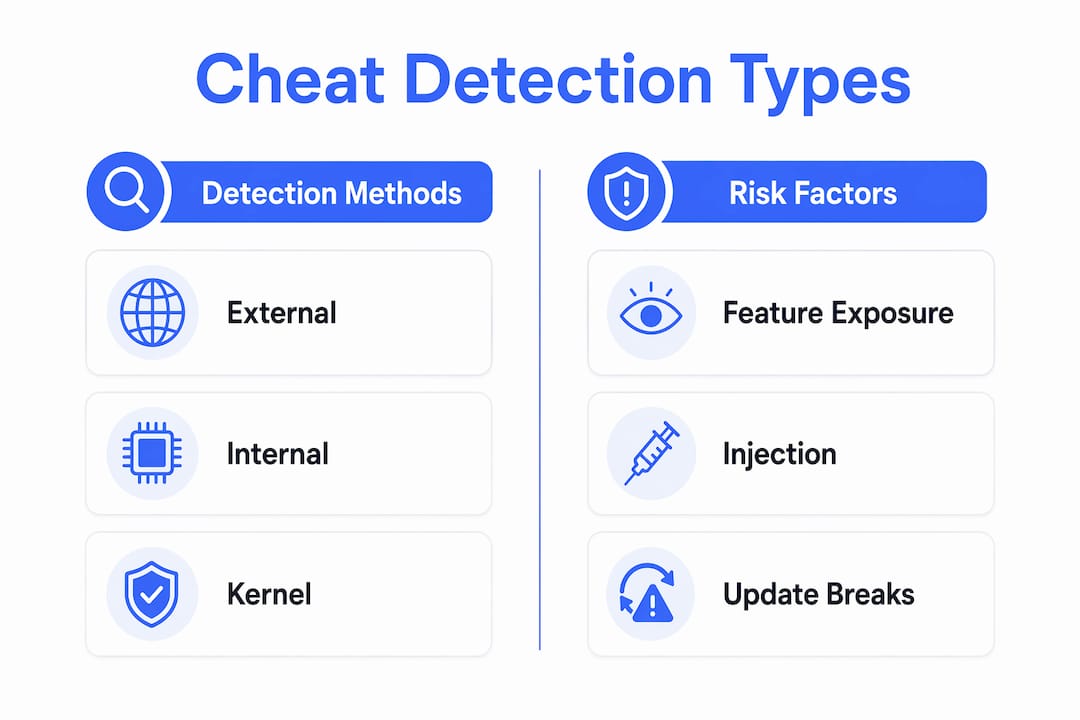
External (overlay/process reading): The cheat runs as a separate process and reads game memory from outside. It draws an overlay on top of the game window. Lower privilege level means less access to game internals, but also less capability. Detection risk is moderate — BattlEye scans for known external processes and window hooks.

Internal (DLL injection): Code is injected directly into the game process. More feature-rich and responsive, but the injection itself is a detection vector. BattlEye monitors loaded modules and flags unsigned or unknown DLLs. Requires admin rights and typically needs antivirus exclusions set before running.
Kernel-level (driver-based): Operates at the OS kernel level, below where BattlEye normally scans. Harder to detect but also harder to build safely. A poorly written kernel driver can blue-screen your system or trigger Windows integrity checks. Not a beginner option.
DMA/hardware: A physical PCIe card reads game memory from a second PC over Direct Memory Access. Because the reading happens on separate hardware, the game process sees nothing unusual. Detection surface shifts to behavioral analysis rather than file or driver signatures. Hardware warranties matter here — DMA hardware solutions introduce physical delivery logistics and a different vendor trust model entirely.
Operational basics that apply regardless of method:
- Set antivirus exclusions before running any installer
- Run as administrator
- Never stream or record while the cheat menu is open
- Use an alt account for every session until you've confirmed stability
Pro Tip: Before your first live raid, run the cheat through a full offline session and watch for any unusual process behavior or game crashes. A stable offline run doesn't guarantee safety, but an unstable one is a clear signal to stop and contact support before going further.
Game updates frequently break cheat functionality by changing memory layouts and offsets. A provider that patches within hours of a game update has a materially smaller window of exposure than one that takes days.
How does BattlEye detect EFT cheats, and what's your real ban risk?
BattlEye is the primary anti-cheat running in Escape from Tarkov. It operates at the kernel level and uses a combination of signature scanning, behavioral analysis, memory integrity checks, and player reports. No single detection vector catches everything — which is exactly why the cat-and-mouse cycle between providers and BattlEye is continuous.
How detection typically happens:
- Signature scanning: BattlEye maintains a database of known cheat file hashes and driver signatures. Public builds get added to this database fast because they're widely distributed.
- Memory integrity checks: The game client periodically verifies its own memory. Injected code that modifies game state leaves traces.
- Behavioral analysis: Inhuman aim patterns, impossible reaction times, and movement anomalies get flagged server-side. This catches aggressive aimbot settings even when the cheat itself is technically "undetected."
- Player reports: Mass reports from a single session can trigger manual review. Playing obviously — landing every headshot at 200 meters — accelerates this.
- Economy anomalies: Server-side logs catch inventory manipulation independently of client detection.
BattlEye ban waves tend to hit in clusters: a period of relative quiet followed by a mass ban event that catches users of builds that had been running undetected for weeks. The window between "technically undetected" and "banned in the next wave" is the core risk every buyer accepts.
Practical mitigation steps that actually reduce exposure:
- Test new builds in offline raids first
- Keep sessions short and behavior plausible
- Never use economy or dupe tools on an account you care about
- Avoid playing during known patch windows when detection is highest
- Use detection vector awareness to understand what BattlEye is actually scanning for
The real ban risk for a well-maintained private build used with behavioral restraint is lower than most forum posts suggest. The risk for a public build used aggressively is close to certain, eventually.
Why free cheats are traps and what private builds actually provide
Security researchers report that most freely available EFT cheats are designed to compromise user hardware or act as honeypots rather than provide reliable undetected gameplay advantage. That's not a warning to ignore. Free builds on GitHub and public forums carry malware, backdoors, and keyloggers at a rate that makes them genuinely dangerous to run.
Public GitHub repositories for EFT are a specific problem. Many public repos advertise full-featured builds as "undetected" but lack the small-user exclusivity that actually keeps a build off BattlEye's radar. A build used by thousands of players gets added to signature databases within days. Some repos exist specifically to harvest credentials from players desperate enough to run unknown compiled binaries.
What a legitimate private build provides instead:
- Small install base: Fewer users means the build's signatures stay out of BattlEye's database longer
- Active update cadence: Patches timed to game updates and BattlEye releases, not weeks later
- Anti-detection tuning: Obfuscated code, encrypted communication, and behavioral randomization
- Paid support: Someone to contact when something breaks, not a dead Discord server
Red flags that should stop you immediately:
- No documented update history or patch notes
- No refund or replacement policy stated anywhere
- Compiled binaries from an anonymous builder with no community presence
- Payment methods that offer zero buyer protection
- No active Discord or support channel
- "Lifetime undetected" guarantees — no honest provider makes that claim
Low-quality installers commonly embed keyloggers and credential-harvesting telemetry. The account you lose might not be your EFT account — it could be your email, your Steam account, or your payment credentials.
How do you evaluate a private cheat provider before buying?
Vetting a provider takes about 15 minutes if you know what to look for. The checklist below covers the signals that separate trustworthy private providers from scams and low-effort resellers.
Trust signals to require before purchase:
- Documented daily testing against current BattlEye builds
- Public patch notes or update logs with timestamps
- Small or capped user base (providers that advertise this are being honest about why it matters)
- Live Discord support with active staff, not just a bot
- Clear refund or replacement policy in writing
- Hardware warranty documentation for any DMA product
- Alt-account testing guidelines published somewhere accessible
Questions to ask the vendor directly:
- What is your update cadence after a game patch or BattlEye update?
- How do you test before marking a build as undetected?
- What is your user cap for this product?
- What happens if the build gets detected — replacement, refund, or nothing?
- Do you provide installation assistance or just a download link?
- What payment methods do you accept, and what buyer protection exists?
A provider that answers these questions clearly and quickly is a different category from one that deflects or goes quiet. Finding consistently working cheats in 2026 comes down to these signals more than any feature list.
Delivery method matters too. External builds are generally easier to install and lower-risk for first-time buyers. Internal builds offer more features but require more setup. DMA hardware requires a second PC and physical hardware — higher upfront cost, different detection profile. Know which you're buying before you pay.

How Midnight-market approaches detection and security risk
Midnight-market publishes daily testing as a core operational commitment, not a marketing line. Every product in the store is tested against current BattlEye builds before being listed as undetected. When a game update drops, the testing cycle restarts — the build doesn't go back on sale until it passes.
How those signals map to buyer concerns:
- Daily testing → lower detection window: A build verified today has a smaller exposure gap than one verified last week
- Live Discord support → faster fixes: When something breaks after a patch, you reach a person, not a ticket queue
- Hardware warranty → DMA confidence: Physical hardware that fails or arrives damaged has a documented replacement path
- Instant delivery → no waiting: Access starts immediately after purchase, not after a manual review process
Midnight-market's EFT product line covers multiple feature tiers. Nextcheat EFT Lite delivers aimbot and ESP for players who want core competitive features without a complex setup. The Chams and visuals tier focuses on in-raid awareness through ESP chams and visual packs — no economy manipulation, lower behavioral detection risk.
For buyers who want to understand the technical side before purchasing, the obfuscation and cheat safety guide explains why encrypted and obfuscated builds behave differently from public compiled binaries.
What does a typical EFT cheat cost, and what do refund policies look like?
Private EFT cheat pricing varies by feature tier and delivery method. Entry-level external builds with ESP and basic aimbot typically run in the range of a monthly subscription, while full-featured internal builds or DMA hardware setups cost significantly more upfront. Hardware solutions carry the highest initial cost because you're buying physical equipment in addition to software access.
Subscription models are standard for software-based cheats. Most private providers sell access in 30-day, 90-day, or lifetime tiers. Lifetime access sounds appealing but carries a real caveat: if the build gets permanently detected, "lifetime" access to a dead product is worth nothing. Monthly subscriptions let you walk away cleanly.
Refund policies vary widely and are one of the clearest trust signals in the market. A provider with no stated refund policy is telling you something. Legitimate providers typically offer replacement access if a build gets detected within a short window of purchase, or a refund if the product never worked on your system. Read the exact terms before paying — "replacement" and "refund" are not the same thing, and the distinction matters when a ban wave hits.
Payment method is a secondary concern but worth noting. Providers that accept only cryptocurrency with no buyer protection are a higher-risk transaction than those offering payment methods with dispute resolution. Neither is a dealbreaker, but factor it into your overall risk assessment alongside the refund terms.
Key Takeaways
Private EFT cheats from a vetted provider with daily testing and a small user base carry materially lower detection risk than any public or free build.
| Point | Details |
|---|---|
| Private over public, always | Free and public builds carry malware risk and get detected fast; private builds with small user counts stay off BattlEye's radar longer. |
| Alt account is non-negotiable | Never run any cheat on your main account; use a dedicated alt for every session until the build is confirmed stable. |
| Update cadence is the top trust signal | Require documented daily testing timed to BattlEye patches before purchasing from any provider. |
| Know your feature risk tier | Visual and informational features (ESP, chams, radar) carry lower detection risk than economy or inventory tools, which leave server-side traces. |
| Midnight-market for EFT | Midnight-market offers Nextcheat EFT Lite and Nextcheat EFT Chams with daily testing, live Discord support, hardware warranties, and instant delivery. |
The trade-offs buyers don't talk about enough
The competitive gains from a well-configured EFT cheat are real and immediate. ESP alone changes how you play every raid — you stop reacting and start deciding. That shift in information advantage is what most buyers are actually paying for, not the aimbot.
What the forums underplay is the ongoing cost of staying operational. A private build from a reliable provider doesn't install once and run forever. Game patches break things. BattlEye updates change detection surfaces. You'll spend time on Discord waiting for a patch, running offline tests after updates, and occasionally sitting out a few days while a fix is built. Budget for that time, not just the subscription fee.
The purchase-to-operational timeline for a private software build is usually short: buy, receive download link instantly, follow the install guide, run an offline test, go live. That part is fast. The ongoing maintenance rhythm is what separates buyers who stay operational for months from those who get frustrated and go looking for a "better" free build — which is where accounts and PCs get compromised.
When to back out: if a provider goes quiet after a patch, stops posting update notes, or tells you a detected build is "still safe to use," those are exit signals. A refund or replacement request is the right move at that point, not continued use of a flagged build. The cost of a lost account on your main far exceeds the cost of a monthly subscription.
Midnight-market's EFT lineup: what you get and how to start
Midnight-market runs daily testing on every EFT product and backs each one with live Discord support — not a ticket queue, an actual support channel with staff who respond when patches drop. That's the practical difference between a provider that cares about staying operational and one that sells access and disappears.
For EFT specifically, the store carries Nextcheat EFT Lite (aimbot and ESP for players who want core features with a straightforward setup), Nextcheat EFT Chams (visual packs and ESP chams for in-raid awareness with a lower behavioral detection profile), and DMA hardware options for buyers who want to shift detection risk to the hardware layer. Hardware products come with documented warranties. Every product ships with instant delivery — access starts the moment your payment clears.
Purchase checklist to get operational fast: buy your tier at the Midnight-market store, read the install guide before running anything, set antivirus exclusions, use your alt account, run one full offline raid to confirm stability, then join the Discord for ongoing support and patch notifications. That's the full sequence from payment to live raid.
Useful sources and further reading
For buyers who want to go deeper on security, installation safety, and provider vetting before committing:
- How Low Quality Cheats Compromise Accounts: Covers malware patterns, keyloggers, and credential theft embedded in low-quality installers. Read this before downloading anything from an unknown source.
- How Game Updates Break Cheats: Technical explanation of memory layout changes and why update cadence is the most important provider signal.
- Why Cheats Get Detected: Breaks down BattlEye detection vectors and what actually triggers a ban flag.
- How to Maintain a Clean Account Using Cheats: Practical alt-account hygiene and session management steps.
- Safe Hack Download Guide: Step-by-step install safety guidance including checksum verification and streaming precautions.
- Obfuscation and Cheat Safety: Explains why obfuscated private builds behave differently from public compiled binaries and what that means for detection.
- Cheating in Escape from Tarkov is Easy: Independent security researcher analysis of the EFT cheat ecosystem, including honeypot and malware risks in free builds.
This article is general information for educational purposes. It does not constitute legal or professional advice. Cheating in online games may violate terms of service and result in permanent account bans. Verify current rules and risks with the relevant platform or a qualified professional before acting.