
Internal cheats run inside the game's process, giving them direct memory access, lower latency, and far more capability, but that same access leaves fingerprints that anti-cheat systems are built to find. External cheats read and write memory from outside the process, which caps what they can do but keeps them off the game's own turf, and generally out of its most aggressive scanners. DMA hardware complicates that picture further by moving the entire operation onto a second physical device, changing the detection equation rather than solving it.
TL;DR:
- Internal cheats operate within the game's memory space using hooking techniques, making them more capable but also more detectable through process scans.
- External cheats mainly use memory reading and overlay rendering from outside the game, offering safer profiles but limited direct game control.
- DMA hardware offloads memory manipulation to a second device, reducing detectability but requiring complex setup and hardware investment.
- Modern anti-cheat systems use layered detection, combining signature scans, behavioral analysis, and driver inspections, which can catch both cheat types in different ways.
- The ongoing arms race pushes cheat developers toward hybrid methods and hardware solutions, but detection methods continue to evolve rapidly.
Table of Contents
- External vs. Internal Cheats: How Internal Cheats Actually Work
- External vs. Internal Cheats: How External Cheats Actually Work
- External vs. Internal Cheats: The Side-by-Side Technical Comparison
- What DMA Hardware Changes About External Cheating
- How Anti-Cheat Actually Detects Internal and External Cheats
- Choosing Between Internal and External: A Decision Checklist
- Where This Analysis Comes From
- A Short History of Internal and External Cheating
- Balancing Curiosity With Responsibility
- Sources
External vs. Internal Cheats: How Internal Cheats Actually Work
Internal cheats live inside the target process. A loader injects a DLL into the game's memory space, and from there the cheat code executes with the same privileges and the same address space as the game itself. That proximity is the entire appeal. Reading a player's health value or overwriting an aim vector doesn't require crossing process boundaries. It's a direct pointer dereference.
Most internal cheats rely on hooking to intercept function calls before the game's own code runs. Two techniques dominate:
- VMT hooking (virtual method table hooking), which swaps out pointers in a C++ class's virtual function table so a call to, say, a render function detours through the cheat's code first.
- Inline hooking, which patches a jump instruction directly into the start of a target function, redirecting execution to custom code before returning control.
Because internal cheats sit inside the process, they can also do direct rendering hooks, drawing ESP boxes or skeletons straight into the game's own graphics pipeline (DirectX or OpenGL) instead of painting a separate window on top. That's part of why internal aimbots tend to feel smoother. They're reading and modifying real game state on the same tick as the engine.
Finding the right memory addresses is the hard part. Values move between game updates, so developers either hardcode offsets (fast, but breaks on every patch) or use pattern scanning, searching memory for a byte signature unique to a function or structure. Signature scanning survives updates better, but it's slower to write and still breaks when a developer changes surrounding code. Internal cheat development also demands real reverse engineering skill: symbol discovery, disassembly with tools like IDA or Ghidra, and enough understanding of the game's class layout to know what you're hooking before you hook it.
Some internals go further and load a kernel-mode driver instead of a userland DLL, which sidesteps certain usermode detection but requires a signed driver and puts code at ring 0, where anti-cheat increasingly inspects driver lists and signatures directly. Kernel access buys more power and more risk in the same breath.
Pro Tip: If you're learning internal development, start with pattern scanning instead of hardcoded offsets. It takes longer to write, but you won't be rebuilding your entire cheat every time the developer ships a patch.
External vs. Internal Cheats: How External Cheats Actually Work
External cheats never touch the game's process directly. Instead, they run as a separate program that calls Windows APIs like ReadProcessMemory and WriteProcessMemory to peek into (and occasionally poke at) the target's memory from outside. That separation is what gives external tools their safer detection profile, since there's no injected code living inside the game binary for a scanner to trip over.
A typical external tool runs a loop: open a handle to the game process, read a batch of memory addresses on some interval, then hand that data off to a rendering layer. The rendering layer is almost always an overlay, a transparent, click-through window drawn on top of the game using DirectX or a similar graphics API, positioned to line up with the game's own coordinates.
Common external builds include:
- ESP overlays that draw player boxes, distance, and health bars over the live game window.
- Rudimentary aimbots that read enemy coordinates and move the mouse cursor toward a calculated angle, usually through simulated input rather than direct memory writes to aim variables.
- Input macros that automate recoil control or rapid-fire patterns based on read memory values or fixed timing.
The engineering constraints are real. Polling memory on every frame is expensive, so most externals throttle their read loop to something like 60 to 144 times per second rather than matching raw game tick rate, which introduces a small but measurable latency compared to an internal hook reading state on the same cycle. Overlays also depend on the game running in windowed or borderless windowed mode. Full-screen exclusive mode can block a transparent window from rendering on top of the game at all, which is part of why so many cheat providers instruct users to switch modes first.
Development tooling for externals leans less on disassemblers and more on process introspection tools like Cheat Engine for finding addresses, alongside a standard debugger for the overlay application itself. It's a meaningfully shallower reverse-engineering curve than internal work, which is a big part of why externals are the more common entry point for new cheat developers.
External vs. Internal Cheats: The Side-by-Side Technical Comparison
| Factor | Internal cheats | External cheats |
|---|---|---|
| Capability / features | Full memory read/write, direct rendering hooks, deep game state control | Read-mostly access, overlay rendering, input simulation |
| Detection risk | Higher. Injected code and hooks are directly scannable inside the process | Lower baseline, but not immune to behavioral or driver-level checks |
| Development complexity | High. Requires reverse engineering, hooking, offset/pattern maintenance | Moderate. Process reading and overlay rendering, shallower RE curve |
| Performance / latency | Near-zero added latency, runs on the game's own tick | Small added latency from polling intervals, typically 60 to 144 Hz |
| Stability / crash risk | Higher. A bad hook or bad offset can crash the game process itself | Lower. A crash in the external tool rarely takes the game down with it |
| Typical countermeasures needed | Obfuscation, driver signing workarounds, anti debug, offset updates every patch | Handle access hardening, overlay detection evasion, timing normalization |
Community consensus on this trade-off is remarkably consistent: internals deliver more features at higher ban risk, externals are easier to build and quieter against casual anti-cheat checks, and neither approach is immune to a determined detection system. That last part matters more each year.
A few things flip that comparison depending on context:
- Anti-cheat sophistication. Kernel-level anti-cheat (the kind now standard in most competitive shooters) narrows the safety gap between internal and external significantly, because it inspects driver lists, memory access patterns, and handle behavior regardless of which side of the process boundary the cheat lives on.
- Maintenance cadence. Internal cheats break harder on game patches because hardcoded offsets and hook targets shift with every recompile, while externals relying on pattern scanning tend to survive minor patches more gracefully.
- Hybrid designs. Some developers combine internal hooks for state reading with an external rendering process for the overlay, splitting the injected footprint to a minimal read-only hook while keeping the riskier visual and input logic outside the process. This is a deliberate middle path, not a loophole, and it still carries injection risk on the hook side.
Maintenance burden deserves its own line item. Frequent game updates and telemetry sharing across anti-cheat vendors raise long-term detection risk for both cheat types, which means a cheat that's safe today isn't a permanent guarantee. It's a moving target that requires ongoing developer attention, not a one-time build.
What DMA Hardware Changes About External Cheating
Direct Memory Access hardware takes the external model and moves it off the host machine entirely. A DMA device, typically a PCIe card, reads and writes the target computer's memory from a second physical system, so the process running the actual cheat logic never executes on the machine running the game at all.
That separation changes the detection surface in a genuine way, but it doesn't make DMA invisible. Manipulation originating off-host shifts what anti-cheat can even see, since there's no cheat process, no injected DLL, and no hooked function running on the game's own CPU. What's left to detect is the memory access pattern itself, and increasingly, hardware-level signatures tied to known DMA cards.
The operational cost is where DMA gets complicated in practice:
- A second computer or a capable capture setup is required to receive and display the read memory data.
- The DMA card itself (commonly a PCIe FPGA device) needs to be physically installed and configured correctly, which is a real hardware project, not a software download.
- Firmware and driver signatures on DMA hardware are an active area of anti-cheat research, meaning the "off-host" advantage narrows over time rather than staying fixed.
- Setup complexity and hardware cost put a real floor under casual experimentation. This isn't a five-minute install.
For readers weighing whether the logistics are worth it, a hardware-focused breakdown of how DMA devices operate covers the physical setup in more depth than a memory comparison article can. The honest summary: DMA trades convenience for a genuinely different detection profile, not a guaranteed one.
How Anti-Cheat Actually Detects Internal and External Cheats
Modern anti-cheat rarely relies on one detection method. Layered systems combine signature checks, memory integrity verification, and behavioral telemetry, and that layering is exactly why a cheat that dodges one check often trips another.
Signature-based detection scans loaded modules, driver lists, and known code patterns against a database of previously flagged cheats. This is the fastest layer to update and the easiest for developers to evade temporarily through obfuscation, which is also why it's never used alone.
Behavioral telemetry looks at what a player does rather than what code is present. This is the layer developers underestimate most:
- Timing anomalies, like reaction times that are inhumanly consistent across hundreds of engagements.
- Input patterns that show a mouse snapping to a target angle rather than tracking it with human jitter.
- Accuracy statistics that sit far outside the distribution for a given weapon, distance, and rank bracket.
- Unexpected memory write patterns, values changing in ways that don't correspond to any legitimate game action.
- Presence of unsigned or unusual drivers, a signal that matters even for externals if a DMA setup or kernel-assisted tool is involved.
Concrete signals like these matter far more to detection systems than vague "ban risk" framing suggests. A cheat doesn't get flagged because it's "risky" in the abstract. It gets flagged because a specific memory write, timing pattern, or driver signature crossed a threshold someone coded into the anti-cheat engine.
If you're developing or testing rather than playing live, isolating test accounts on non-production setups is standard practice for avoiding collateral bans that have nothing to do with your actual research goal.
Pro Tip: Test on a dedicated account and, where possible, a dedicated machine or VM. A ban on a research account costs you nothing. A ban on your main costs you everything you've built on it.
For a deeper technical rundown of what triggers these systems specifically, this breakdown of detection vectors is worth reading before you write a line of code.
Choosing Between Internal and External: A Decision Checklist
Match the approach to what you're actually optimizing for, not what sounds more capable on paper.
- Define your goal first. Building for maximum feature depth points toward internal. Prioritizing account safety and a smaller footprint points toward external. Pure research or reverse-engineering practice can go either way.
- Weigh your risk tolerance against the anti-cheat. A game running kernel-level anti-cheat narrows the safety gap between internal and external considerably, so check what you're up against before committing engineering hours.
- Check your operational setup. Internal work demands real reverse-engineering chops, a debugger, and a plan for offset maintenance. DMA demands a second machine and hardware budget. External demands the least infrastructure to start.
- Have a rollback and isolation plan. Keep test accounts and dev environments separate from anything you value, and never test unfinished builds on a live ranked account.
- Consider whether you need a cheat at all. Sanctioned test servers, offline practice modes, and legitimate mod tools solve a lot of the same curiosity without touching a live anti-cheat system.
Pro Tip: If your real goal is learning game internals rather than gaining an edge, offline single-player builds or private test servers get you the same reverse-engineering practice with zero account risk.
Where This Analysis Comes From
This comparison draws on publisher testing practices including daily detection checks across supported titles, live support for setup issues, and hardware warranties on DMA products, alongside the technical writeups and community threads cited throughout. For readers who want the step-by-step version of any concept covered here, the driver and installer walkthrough and the obfuscation safety guide go deeper into implementation specifics than a comparison piece can.
A Short History of Internal and External Cheating
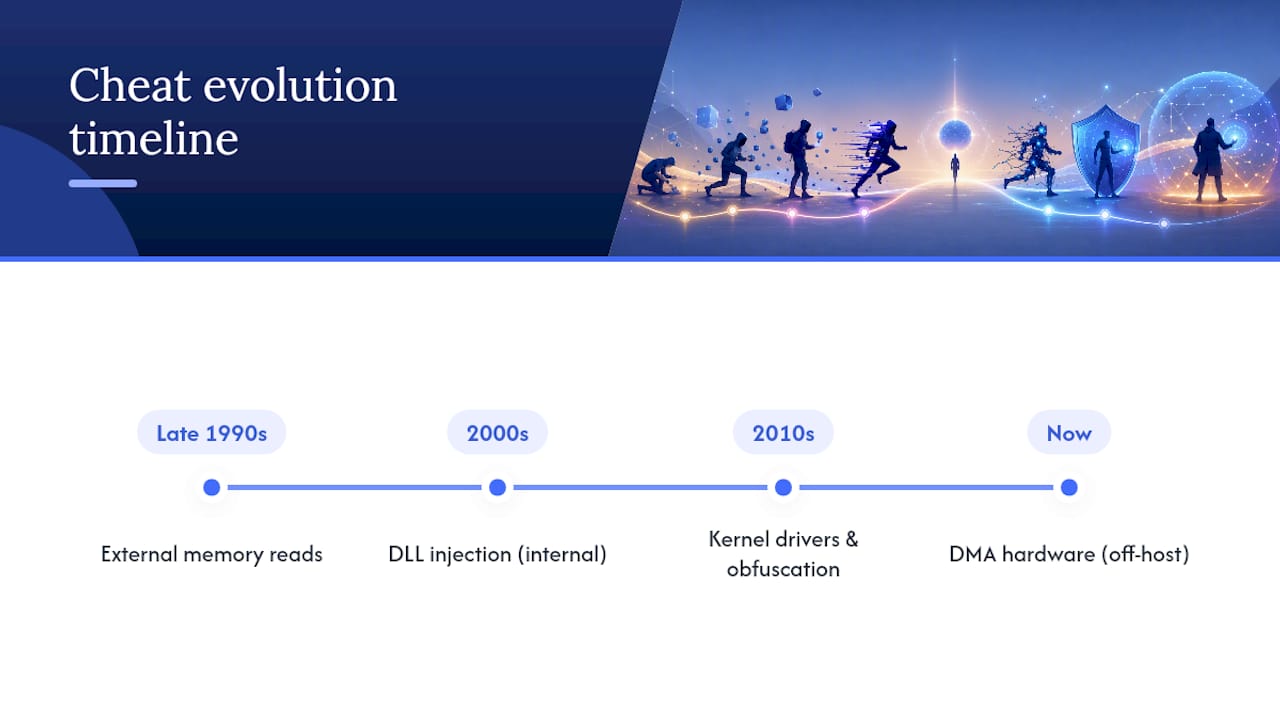
External cheating came first, historically speaking, largely because it was the easier problem to solve. Early PC multiplayer cheats in the late 1990s and early 2000s, think basic wallhacks and aim assistance for titles like Counter-Strike and Quake, worked by reading memory from a separate process, since game code back then had little to no active memory protection to speak of. Anti-cheat as a category barely existed yet.
Internal cheats grew in prominence as games got more complex and detection got smarter. DLL injection became the standard delivery method once developers realized that living inside the process gave them access to rendering pipelines and game logic that external reading couldn't touch cleanly. The 2010s saw an acceleration on both sides: anti-cheat vendors introduced kernel-level drivers of their own (a direct response to how effective internal cheats had become), and cheat developers responded by pushing obfuscation, encrypted communication, and pattern-scanning techniques to survive more frequent patch cycles.
DMA hardware is the newest chapter, emerging as kernel anti-cheat made both traditional internal and external software cheats progressively riskier. Moving the cheat off-host entirely was less a clever new idea and more a logical response to a software detection arms race that had made every other option harder to sustain.
Balancing Curiosity With Responsibility
Understanding how internal and external cheats work is legitimate technical curiosity, and there's real reverse-engineering value in it. That value disappears the moment testing spills into live competitive matches and affects other players' games. Build and test in isolated environments, on accounts and machines that don't matter to you, and be transparent about what you're actually doing and why.
Detection methods evolve constantly, so whatever you learn today has a shelf life. Keep reading the technical side of the anti-cheat conversation, not just the cheat side, if you want to understand where this is actually heading.
— Fonics
Sources
- Are internal or external cheats better? | Game Learning Society
- A systematic review of research on cheating in online exams from 2010 to 2021 - PMC
- Internal cheat development part 1 | Medium
- Internal vs External Hacks - What's the difference? | GuidedHacking